
If Consciousness Exists Beyond the Brain, Why Do People Get Dementia, Amnesia, or Alzheimer’s?

One of the most common questions people ask in consciousness work is this:
“If memories and consciousness exist beyond the brain, then whydo people experience dementia, amnesia, or Alzheimer’s disease?”
It is an important question because it touches the intersection of:
neuroscience
psychology
spirituality
shamanic understanding
And the answer becomes clearer when we stop looking at the human being only as a physical structure.
The Brain Is Essential — But Is It the Whole Story?
Modern medicine studies the brain through biology, chemistry, and neuroscience.
From a medical perspective, conditions such as:
Alzheimer’s disease
dementia
amnesia
cognitive decline
are linked to:
neural degeneration
trauma
inflammation
aging
disrupted brain pathways
And this understanding is valid and necessary.
Medicine is essential.
But in deeper consciousness-based systems such as shamanism, hypnosis, and altered-state work, the human being is not viewed only as a brain or body.
Instead, the human system is understood in layers.
Understanding the Human Being in Layers
A simplified way to understand this is:
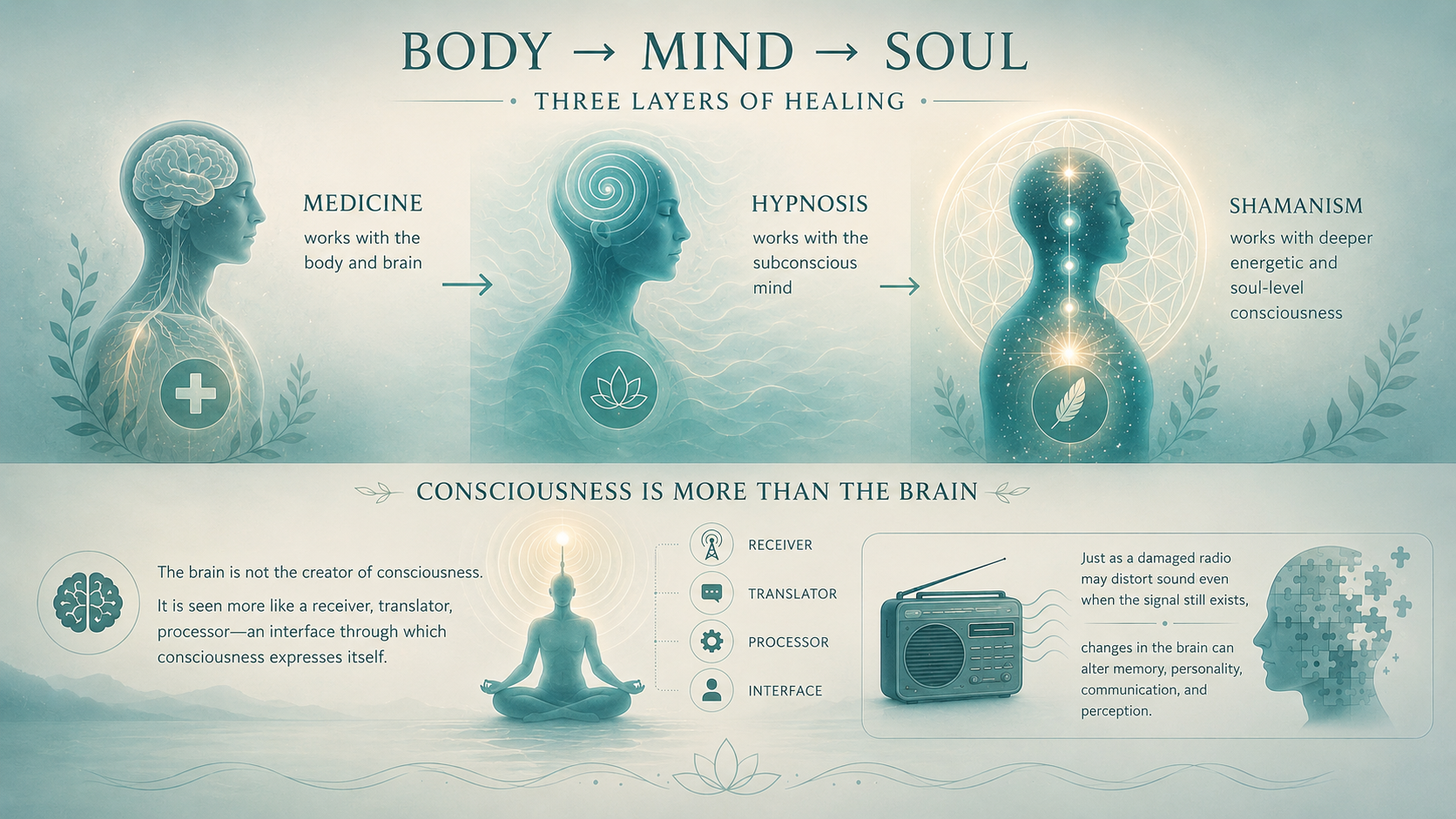
Medicine works with the body and brain
Hypnosis works with the subconscious mind
Shamanism works with deeper energetic and soul-level consciousness
Body → Mind → Soul
From this perspective, the brain is not necessarily seen as the creator of consciousness.
It is seen more like:
a receiver
translator
processor
interface through which consciousness expresses itself
This means that even if consciousness exists beyond the physical brain, damage to the brain can still affect how consciousness is expressed in this lifetime.
Just as a damaged radio may distort sound even when the signal still exists, changes in the brain can alter memory, personality, communication, and perception.
Why This Question Appears in Consciousness Work
This question becomes especially important because many people have observed unusual experiences during:
near-death experiences (NDEs)
past life regression
deep hypnosis
terminal lucidity cases
shamanic states
altered states of awareness
In some cases, individuals access memories, awareness, or clarity that seem larger than normal brain functioning alone.
These observations lead many practitioners to explore whether consciousness may extend beyond purely neurological activity.
This does not invalidate science.
It simply suggests that the relationship between brain and consciousness may be more complex than currently understood.
A Shamanic Perspective on Mental and Cognitive Disorders
In shamanic traditions, mental and cognitive conditions are often understood as multi-layered.
This means that two people with the same medical diagnosis may still have very different deeper causes or energetic patterns.
Shamanic understanding generally looks at three layers simultaneously:
1. Physical Layer
This includes:
genetics
nervous system changes
trauma
toxins
degeneration
aging processes
This is where medicine and neuroscience play a vital role.
2. Psychological Layer
This includes:
unresolved trauma
suppressed emotions
chronic fear
grief
subconscious fragmentation
This is where psychotherapy and hypnosis often work deeply.
3. Soul or Energetic Layer
In shamanic understanding, deeper imbalance may sometimes involve:
energetic fragmentation
soul loss
ancestral patterns
spiritual disconnection
unresolved soul-level experiences
This does not mean every illness is “spiritual.”
But it suggests that human suffering may contain layers beyond the physical alone.
What Is Soul Loss in Shamanism?
One important concept in shamanism is soul loss.
Soul loss does not mean the soul disappears.
It refers to a state where parts of a person’s vitality, identity, or energetic presence become disconnected due to intense experiences such as:
trauma
grief
abuse
shock
fear
repeated emotional suppression
In shamanic observation, the person may appear physically present, but internally disconnected from themselves.
This can manifest as:
emotional numbness
confusion
loss of identity
emptiness
fragmentation
disorientation
feeling “not fully here”
Shamanic work attempts to restore balance and reconnection at this deeper level.
Can Shamanism Replace Medicine?
No.
A responsible shamanic practitioner does not reject medical treatment.
Serious consciousness work understands that:
medicine stabilizes the body
psychology and hypnosis support the mind
shamanic work explores deeper energetic and soul-level imbalance
These approaches can complement one another rather than compete.
The Importance of Ethical Understanding
One of the biggest mistakes people make is romanticizing mental illness as “spiritual awakening.”
This can be dangerous.
Not every psychological condition is spiritual.
And not every spiritual experience is psychological illness.
Discernment, groundedness, training, and ethics are extremely important in this field.
This is why serious shamanic work requires:
structure
supervision
responsibility
proper training
The Future of Healing May Be Integrative
As consciousness studies continue evolving, many practitioners believe the future of healing may become more integrative.
Rather than separating disciplines completely, we may eventually see deeper collaboration between:
medicine
neuroscience
psychology
trauma therapy
hypnosis
consciousness research
energetic understanding
This creates a more holistic understanding of the human being.
Final Clarity
From a shamanic perspective, the brain may express consciousness, but consciousness itself may not be limited only to the brain.
This does not reduce the importance of neuroscience or medicine.
It simply opens the possibility that human awareness may be larger, deeper, and more layered than we currently understand.
And perhaps the future of healing lies not in choosing one perspective over another — but in learning how all of them connect together.
Frequently Asked Questions
-
From a neuroscience perspective, the brain plays a critical role in processing, organizing, and expressing memory. In consciousness-based and shamanic perspectives, the brain may function more like an interface or receiver through which consciousness operates. This means damage to the brain can affect how memory is accessed or expressed, even if consciousness itself may extend beyond the physical brain.
-
No. Responsible shamanic practice does not reduce medical conditions to “spiritual problems.” Conditions such as Alzheimer’s disease and dementia involve important biological and neurological factors. Shamanic perspectives may explore additional emotional, energetic, or soul-level dimensions alongside medical understanding — not instead of it.
-
In shamanic traditions, soul loss refers to a state where a person becomes energetically disconnected from parts of themselves after trauma, grief, shock, abuse, or prolonged emotional suppression. It is often associated with feelings of emptiness, fragmentation, emotional numbness, or loss of identity.
-
Shamanic work may support emotional, energetic, and spiritual balance, but it is not a replacement for medical or psychological care. Ethical practitioners often work alongside medicine, therapy, and trauma-informed approaches rather than against them.
-
No. Serious shamanic work avoids romanticizing mental illness. Some conditions may involve emotional or energetic imbalance, while others are primarily neurological or psychological. Proper discernment, grounding, and professional support are essential.
-
A simplified way to understand it is:
Medicine works with the body and brain
Hypnosis works with the subconscious mind
Shamanism works with deeper energetic and soul-level consciousness
Each approach focuses on a different layer of the human experience.
-
Terminal lucidity refers to rare cases where individuals with severe cognitive decline or dementia suddenly regain clarity, memory, or awareness shortly before death. These cases are sometimes discussed in consciousness research because they raise questions about the relationship between brain function and awareness.
-
This remains one of the biggest questions in neuroscience, philosophy, and consciousness research. Materialist science generally views consciousness as produced by the brain, while many spiritual and shamanic traditions see consciousness as something larger that operates through the brain rather than being created by it.
-
Near-death experiences (NDEs) are reported across cultures and often include heightened awareness, vivid memory, or perception during periods of extreme physical crisis. Researchers, neuroscientists, and consciousness practitioners continue studying these experiences to better understand the nature of awareness and perception.
-
No. Ethical and grounded shamanic practitioners do not reject science or medicine. Many modern practitioners view healing as potentially integrative, involving medicine, psychology, neuroscience, trauma work, and consciousness exploration together.
Have questions about this work?
You may explore our trainings, sessions, or contact us for guidance.
