
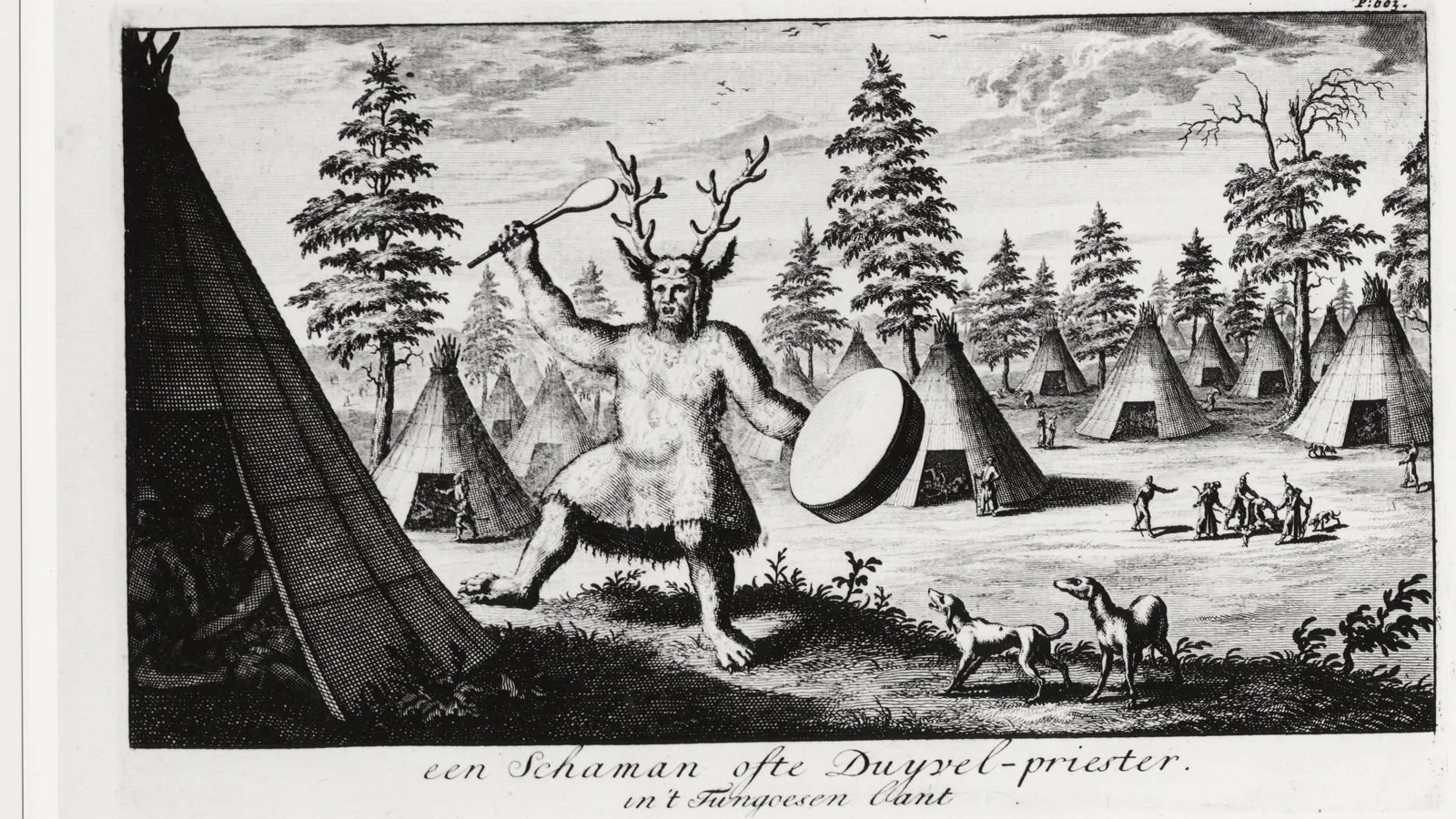
“A shaman or devil-priest in the land of the Tungus.” Plate 80 from Nicolaes Witsen’s Noord en Oost Tartarye — the first image of a Siberian shaman published in Europe. Witsen never saw the scene. The horns, claws and the word Duyvel-priester are the engraver’s theology, not an Evenki record. Public domain; Huygens Institute Witsen image register. 29,32
Home/History of Shamanism
A Research-Informed History
History of Shamanism: Origins, Evidence, Suppression and Revival
Not one beginning, one founder, or one unbroken global timeline — but several connected histories, each supported by a different kind of evidence.
Ritual specialists, spirit relationships, healing practices, ceremonial arts and altered-state traditions have appeared in many societies. The surviving evidence does not establish that they all belonged to a single prehistoric religion.
Direct answer: practices now described as shamanic may be ancient, but shamanism was not one proven prehistoric world religion. The term has a traceable northern Eurasian history, while the traditions later grouped beneath it have distinct local histories.1–4
This page therefore follows several stories at once: the deep history of ritual behaviour; the northern Eurasian history of the word shaman; the expansion of that word through European writing and scholarship; the suppression and survival of local traditions; and the growth of Indigenous revitalisation, core shamanism and global training in the modern period.1–3
Start Here
Introduction: More Than One History
Questions such as “Where did shamanism begin?” appear simple, but they combine different kinds of history. A responsible answer must first separate them.
The history of practices
Many communities have recognised people who communicate with spirits, conduct ceremonies, diagnose misfortune, protect a group, heal, divine, accompany the dead or enter unusual states of consciousness. These roles are not identical. They may be inherited or earned, public or private, specialised or combined with other responsibilities. The practices also have local names, rules, cosmologies and histories. Calling every such person a “shaman” can support comparison, but it can also hide important differences.1,2,4
The history of the word
The international word shaman entered European knowledge through encounters with Tungusic-speaking peoples in Siberia. Its spelling, translation and proposed etymology have varied. From that regional setting, the term travelled through Russian records, European travel literature, missionary accounts and learned debate. The history of this word can be traced more securely than the beginning of all practices now placed beneath it.1–3
The history of classification
From the nineteenth century onward, scholars increasingly used shamanism as a comparative category across continents. The category drew attention to recurring themes such as spirit relations, altered states, ritual authority and healing. It also encouraged the idea that very different institutions were expressions of one universal religious type. Modern scholarship continues to debate when this comparison is illuminating and when it becomes too broad.2–4
The history of disruption and renewal
Colonial, missionary and state systems frequently attacked Indigenous ceremonies and specialists through conversion campaigns, law, schooling, land dispossession, confiscation and anti-religious policy. Yet disruption did not produce one uniform outcome. Traditions survived through families, secrecy, adaptation, syncretism, memory, objects and relationships with place. In some communities, present-day practice reflects strong continuity; in others, revitalisation includes recovery, reconstruction and innovation after severe interruption.5,6
Overview
Five histories, not one line of descent
Ritual specialists and spirit relationships, under local names, with many separate community histories.
A northern Eurasian term, associated with Tungusic contexts, carried outward through Russian and European writing.
Scholarship expands a regional word into a global comparative category — and continues to debate its limits.
Colonial, missionary and state campaigns, varying sharply by region — met by secrecy, adaptation and family transmission.
Indigenous renewal and sovereignty alongside core shamanism, neo-shamanic movements and global training.
The history of shamanism is best understood as several interacting histories rather than one uninterrupted global tradition. Each track carries its own evidence and chronology; the bars are schematic and not drawn to scale.
This page therefore tells histories in the plural. It will use the word shamanism when it is historically necessary or analytically useful, while giving priority to local names and community descriptions wherever the sources allow.
A Distinction Held Throughout
Historical evidence and spiritual belief
Historical method cannot decide whether spirits exist, whether a journey reaches another world or whether a ceremony carries sacred power. Those are philosophical, theological and experiential questions. History can investigate who described an experience, how a community understood it, what practices surrounded it and how the account changed over time. It can also assess whether a modern claim of antiquity, continuity or cultural origin is supported.
Keeping these questions separate protects both intellectual honesty and spiritual plurality. A historian does not need to dismiss a community’s cosmology in order to label an archaeological inference as uncertain. A practitioner does not need to turn a meaningful experience into proof of a universal prehistoric religion.
Throughout this page, phrases of this kind identify different kinds of statement rather than ranking one way of knowing as the only legitimate one:
That distinction remains essential throughout.
Fast Answers
History of Shamanism at a Glance
The quickest safe answer is this: practices later described as shamanic may draw upon very old human capacities for ritual, symbolism, music, healing and altered experience, but “shamanism” did not begin as one global religion at a known prehistoric moment. Its modern history was formed by an interaction between local traditions, European encounters, academic comparison, political suppression and contemporary renewal.
Historical guide · Twelve points
There is no securely established start date
Ritual and symbolic behaviour are ancient, but archaeology cannot identify one universal religion called shamanism.
The word has a regional history
The international term is associated with Tungusic-speaking peoples, especially Evenki contexts in Siberia.
The word and the practices have different timelines
Comparable ritual roles existed under local names before Europeans globalised the term.
Prehistoric claims remain debated
Cave art and unusual burials may support ritual interpretations, but they do not prove a named shamanic institution.
Similarity does not prove one origin
Contact, migration, convergence and independent development may all explain particular similarities.
European records are useful but unequal sources
They may preserve observations while also carrying missionary, colonial or sensational assumptions.
Academic classification changed the subject
Nineteenth- and twentieth-century scholarship expanded a regional word into a global comparative category.
Suppression varied by region
Colonial laws, missionisation, confiscation, schooling and Soviet anti-religious campaigns did not operate in the same way everywhere.
Survival was active, not passive
Families and communities preserved knowledge through secrecy, adaptation, language, memory, objects and place.
Revitalisation is not always simple restoration
It may combine continuity, recovered memory, reconstruction and new institutions.
Core shamanism is modern
It developed in the late twentieth century and is historically distinct from community-governed Indigenous traditions.
The history is still unfolding
Digital media, tourism, heritage policy, research and commercial training now shape representation and access.
Historical confidence also changes across the timeline. For recent periods, researchers may have named people, documents, oral histories, photographs, laws and institutional records. For deep prehistory, only material traces survive. The further back we go, the more carefully we must distinguish evidence from interpretation.
This changing confidence is why a single uninterrupted timeline can mislead. A dated law and a prehistoric image are not equivalent forms of evidence. A law may establish what a government intended to prohibit, though not everything that happened in practice. A cave image establishes that people made and placed an image, but not the exact experience or institution behind it. The history becomes clearer when each claim carries the kind of evidence that supports it.
The Aim of This Page
The same principle applies to the present. A contemporary organisation can document when its own curriculum began, but it cannot use that date or its popularity to establish ancient lineage. A community can speak authoritatively about its own living heritage without being asked to represent every Indigenous people.
The aim of this page is not to eliminate broad comparison. It is to prevent broad comparison from replacing history.
Method
How Do We Know the History of Shamanism?
The historical record is not a single archive. It is a set of sources produced by communities, practitioners, archaeologists, officials, missionaries, ethnographers, collectors, museums and later interpreters. Each source can reveal something, and each has limits.
Community and oral knowledge
Living communities hold histories through language, lineage, place, ceremony, story, song, kinship and responsibility. Oral knowledge is not merely a substitute for written evidence. It may preserve relationships and meanings that administrative or museum records never understood. At the same time, access may be restricted. A tradition’s willingness to share some knowledge does not make every story, name, image or practice public property.
Community sources should therefore be treated as forms of authority, not simply as “data” to be extracted. The question is not only whether information is available, but who has the right to interpret, reproduce or teach it.6,10
Written and museum records
Travel diaries, court proceedings, missionary reports, legislation and administrative files can establish dates, encounters, prosecutions and changing public descriptions. Museum catalogues can document objects, collectors and provenance. Yet these records were often produced within unequal systems. A confiscated drum may be meticulously catalogued while the trial, conversion campaign or community loss surrounding it is minimised.
Legal ownership of an object is also different from cultural authority over its meaning. Museums may care for objects and archives, but custody does not automatically grant permission to display restricted knowledge or define a living tradition.10
Ethnography
Ethnography can describe ritual life, social roles and local interpretation in far greater detail than many official records. Its value depends on who conducted the research, with whom, in what language, under what political conditions and with what relationship to the community. Older ethnographies may contain irreplaceable observations while using categories that communities reject or that later scholarship has revised.
The safest method is triangulation: compare ethnography with community accounts, regional history, language, material records and the political setting in which the research was produced.
Archaeology and interpretation
Archaeology works from material context: bodies, objects, pigments, animal remains, architecture, spatial pattern and traces of repeated action. It can often show that a burial or place had unusual social and ritual importance. It is much less able to recover the precise name of a role, the content of an experience or the meaning of a symbol.
Identifying a “shaman” archaeologically is therefore an inference. Researchers may build a case from a patterned combination of evidence, but alternative explanations must remain visible.7–9
Why every source has limits
A colonial document may preserve a date but distort a ceremony. An archaeological assemblage may show ritual treatment but not identity. A museum object may survive after the language needed to interpret it has been attacked. A contemporary account may be authoritative for one community without being generalisable to another.
Reliable history does not choose one source family and dismiss the rest. It asks what each source can support, what it cannot support, who produced it and whose authority may be missing.
There is also a difference between absence of evidence and evidence of absence. Practices carried privately or orally may leave few written records, especially under suppression. That silence can suggest an interruption in public documentation without proving that all knowledge disappeared. Conversely, silence cannot by itself prove that an unbroken institution survived. Strong histories look for converging indications in family accounts, language, material culture, local archives and later community memory.
Translation is another source layer. European documents often reduced several local roles to one word, while modern English may translate distinct concepts as spirit, soul, healer or shaman. These choices can create similarities that were not present in the original language. Where a local term is known, retaining it alongside a careful explanation helps the reader see the difference between the source and the translator’s category.
Weighing the evidence
Evidence ladder and source layers
Different sources support different kinds of historical claim. Each tier is named in words as well as shade, and the order runs from greatest contextual authority to greatest uncertainty. Higher contextual authority does not mean unlimited public access.
Quick reference
Evidence types and limits
| Evidence type | What it can often establish | What it cannot establish alone |
|---|---|---|
| Community and oral knowledge | Local meaning, authority, continuity, responsibility | A universal account of all traditions |
| Written primary records | Dates, laws, encounters, official actions | Neutral understanding of Indigenous practice |
| Ethnography | Detailed social and ritual context | An unchanged timeless tradition |
| Museum records | Object history, provenance, collection context | Community consent or complete cultural meaning |
| Archaeology | Material pattern, bodily treatment, ritualised space | Exact belief, title, experience or universal identity |
Scroll the table sideways on a narrow screen.
Two Tracks
Two Histories: The Word and the Traditions
Track one: local traditions and ritual specialists
Across time and place, communities have recognised many kinds of ritual authority. Some specialists work with spirits; some conduct healing, divination, hunting rites, funerary work, weather rites or protection; some hold several roles. Their authority may come through inheritance, illness, visions, apprenticeship, elder recognition or community need. The institution may be closely linked to kinship and subsistence, or it may develop within towns, courts, monasteries and modern organisations.
These local histories cannot be reduced to a single title. Even within northern Eurasia, neighbouring peoples used different terms, recognised different powers and organised ritual life in different ways. Beyond that region, words such as angalkuq, tohunga and many others belong to their own languages and histories. They should not be treated as translated versions of one universal office.1,21–25
Track two: the word and comparative category
The second track begins much later. European writers encountered Tungusic-speaking peoples and circulated a version of the word šaman/saman. The word entered travel literature and intellectual debate, then anthropology and the history of religions. Over time, scholars applied it to ritual specialists far beyond Siberia. In the twentieth century, comparative theories and popular spiritual movements made shamanism a globally recognised category.2,3,28,33
This expansion created a new historical reality. People in many settings now use shaman, shamanic or shamanism as self-descriptions, academic labels, tourism terms or training categories. The word’s later global life is real, but it should not be projected backwards as though all earlier peoples already belonged to the same religion.
Why the distinction matters
Without the two-track model, a website may make two opposite errors. It may claim that all shamanic traditions originated in Siberia because the international word did. Or it may claim that a universal religion called shamanism existed everywhere in prehistory because comparable ritual behaviours are ancient. Neither conclusion follows from the evidence.
The stronger formulation is: the international word has a traceable northern Eurasian history, while the traditions later grouped beneath it have multiple local histories. Comparison remains possible, but it must be specific about what is being compared and why.1–4
Side by side
Two histories, side by side
- Multiple community histories
- Local names, institutions and authorities
- Continuity, suppression and local renewal
- No requirement of one common origin
- Regional Tungusic term enters European writing
- Term expands through travel and scholarship
- Global comparative and popular category emerges
- Modern label can be shared without proving ancestry
Language guide
Historical claim language guide
Precise language does not weaken the history. It is what makes the page trustworthy.
Before the Record
Deep Human History Before Written Records
Ancient symbolic behaviour
Long before written history, humans buried the dead, used pigments and ornaments, made music, marked bodies and landscapes, and produced symbolic imagery. These activities demonstrate complex social worlds and forms of ritualised behaviour. They also show that human beings have long created meaning around death, identity, relationship, memory and forces beyond ordinary control.
What they do not provide is a label. A pigment deposit cannot tell us the title of the person who placed it. An image cannot, by itself, establish whether it recorded a vision, narrated an event, taught a story or marked a social relationship. Deep history is therefore relevant to the history of ritual, but it is not documentary proof of one universal shamanic religion.7,8
Burial, music and ritual space
Unusual burials, carefully arranged objects, sound-making instruments and repeated use of particular spaces may indicate ceremonial action. When several kinds of evidence occur together, archaeologists can ask whether a society recognised specialist ritual roles. Evolutionary and neurocognitive models have also proposed that altered-state practices may have offered social, healing or integrative functions in some hunter-gatherer settings. These remain theoretical models, not an agreed origin story.8,11
The important distinction is between a human capacity and a historical institution.
Rhythmic sound, absorption, dissociation, imagination and trance-like experience may be possibilities available to human beings generally.
The way a community understands, teaches and authorises those experiences is historically and culturally specific.
What remains unknowable
Archaeological evidence rarely reveals the exact words spoken, the private content of an experience, the local name of a spirit or the rules governing access to ritual knowledge. It may suggest that an activity was special, repeated or socially important. It cannot automatically identify the person involved as a “shaman.”
This does not make deep history meaningless. It makes disciplined uncertainty necessary. A careful history can describe what survives, explain why particular interpretations arose and show where evidence ends.3,7,38
Deep-time research is especially vulnerable to the desire for a clean beginning. A spectacular image or burial can become a symbolic “birth certificate” for a modern identity. That use may be emotionally compelling, but it asks the archaeological record to answer a question created much later. Prehistoric communities did not organise themselves around today’s global debate about the age of shamanism.
The more productive question is not “Was this definitely shamanism?” but “What forms of ritual labour, special knowledge, sensory practice and social distinction are supported here?”
This reframing allows archaeology to contribute to a broad history of ritual without forcing people from the distant past into a modern category. It also leaves room for future discoveries and changing interpretations.
Evidence caution
Deep-time caution
Ancient ritual behaviour is not the same as proven ancient shamanism. Material evidence can support claims about symbolism, ceremony and unusual social roles. It rarely establishes a named religious institution or one continuous global tradition.
Reading the Ground
Archaeology: What Material Evidence Can and Cannot Tell Us
Material context
Archaeologists begin with context rather than labels. They examine where objects were found, how a body was treated, whether pigments or animal parts were deliberately arranged, whether objects show use or deliberate breakage, and whether the pattern differs from other sites or burials. An isolated unusual object is weak evidence. A coherent assemblage with repeated contextual signals is stronger.8,9
Pattern and comparison
Material criteria can help researchers identify possible ritual specialisation. A rare combination of objects, bodily treatment, performance equipment, animal associations and a distinctive location may support such an interpretation. Comparison with historical or ethnographic cases can generate questions about what those materials may have enabled.
Comparison must remain bounded. The presence of a drum-like object in two distant settings does not prove a shared institution. A pattern becomes more persuasive when several independent lines of evidence converge within the local archaeological context.7–9
What to look for
Material traces of ritual
Look for combinations, not magic objects. No single find identifies a ritual specialist. Interpretation rests on how these signals occur together:
Inference and alternative explanations
The same burial may support several hypotheses. Rich or unusual grave goods could indicate ritual status, craft specialisation, family standing, gendered responsibility, disability, exchange networks or a combination of roles. Animal remains may be offerings, food, symbols, tools or evidence of ecological relationships. Archaeological interpretation improves when these alternatives are examined instead of using “shaman” as an all-purpose explanation for anything unusual.7,8
How interpretation works
From material trace to historical interpretation
What was found, and where?
Which explanation best accounts for the pattern?
What else could explain it, and how certain can we be?
Archaeological interpretation becomes stronger when context, pattern and alternatives are made explicit. Burial position, ochre, tools, animal remains and spatial pattern are observed first. A supported interpretation follows. Alternative explanations remain visible, and a confidence label is attached at the end — not assumed at the start.
Confidence labels
This page uses three practical confidence levels:
Supported by primary records, community testimony or strong specialist consensus. Directly documented.
Several lines of evidence make an explanation plausible, but identity or meaning remains inferential.
Evidence permits the hypothesis, but alternatives remain substantial or the comparison is distant. Speculative.
These labels do not rank cultures or experiences. They describe the strength of a particular historical claim.
A Contested Case
Cave Art and the Shamanism Debate
The shamanic interpretation
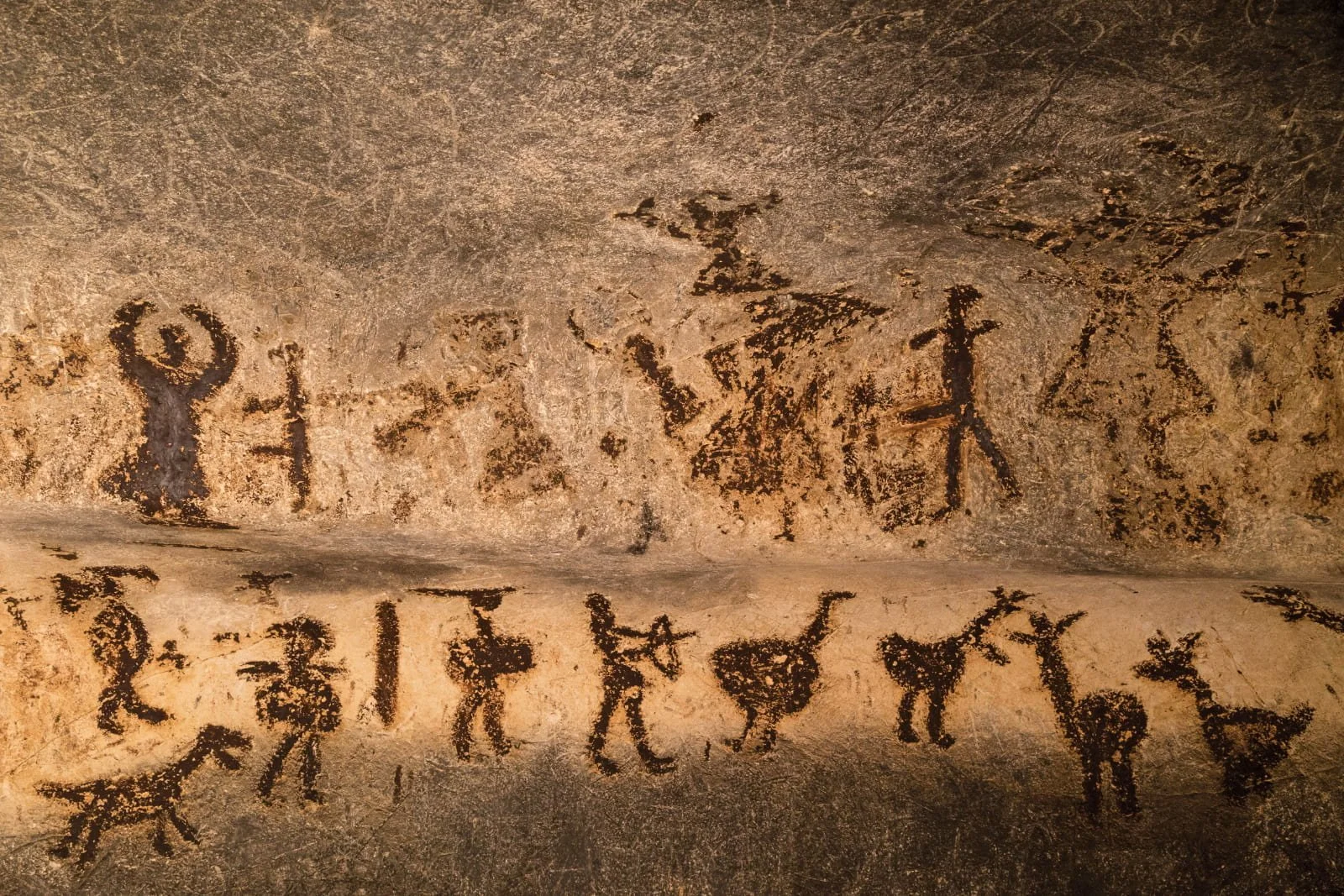
One influential approach interprets some Palaeolithic cave art through comparison with altered states and historically documented shamanic practices. Jean Clottes and David Lewis-Williams argued that certain geometric signs, composite beings, transformed bodies and deep-cave settings could reflect visionary experience and ritual mediation. Their proposal helped move cave art debate beyond simple ideas of decoration or “hunting magic.”12
The interpretation is a scholarly model. It does not mean that every cave image is shamanic, that all artists were ritual specialists or that one religion extended unchanged across Ice Age Europe.
The neuropsychological model
The neuropsychological component proposes that human nervous systems may produce recurring visual phenomena during altered states, including geometric forms, intensification and imagery shaped by cultural expectations. Researchers then ask whether some rock-art motifs and spatial settings correspond to such experiences.12,13
This model offers a possible bridge between embodied experience and culturally formed imagery. Its reach is also contested. Similar shapes may arise through many processes, and even a neurological resemblance cannot recover the social meaning assigned to an image by a particular community.
Major criticisms
Critics argue that broad shamanic explanations can overextend ethnographic analogy, treat diverse foraging peoples as interchangeable and turn a flexible category into a universal answer. Some rock-art traditions are better explained through local narrative, social identity, ecology, initiation, territorial marking, pedagogy or political relations. Others may have served several functions at once.13–16
The debate also concerns method. If “shamanism” is defined so broadly that any unusual image, animal-human figure or hidden location confirms it, the theory becomes difficult to test. Responsible interpretation needs criteria that could also count against the hypothesis.
Four ways to read the images
Cave art: competing interpretations
| Interpretive lens | What it asks | Main caution |
|---|---|---|
| Altered-state or shamanic | Do motifs and spaces relate to visionary experience or ritual mediation? | Similar forms do not prove identical institutions |
| Narrative and memory | Do images preserve stories, events or ancestral knowledge? | Narrative content is rarely recoverable with certainty |
| Ecology and subsistence | How do species, seasons and landscapes shape meaning? | Animals may carry more than economic meaning |
| Social and political | Do images mark identity, initiation, territory or authority? | Social uses can coexist with ritual ones |
Scroll the table sideways on a narrow screen. These lenses are not mutually exclusive; a single site may support several at once.
What can responsibly be said
Some cave and rock art may have been connected with ritual, altered experience or specialist mediation. Shamanic interpretations are influential and may be persuasive in particular contexts. They are not a settled explanation for all prehistoric art and do not prove an unchanged global religion. Regional archaeology, image sequence, landscape and local evidence must guide the conclusion.14–16
Evidence caution
Why “shamanic art” is debated
Calling an image “shamanic” is an interpretation, not a description. The label should follow evidence about context, sequence, regional comparison and plausible alternatives, rather than replace that analysis.
Three Cases
Burials, Bodies and Possible Ritual Specialists
Unusual graves invite strong stories. The most responsible approach describes the burial first, then explains why particular researchers proposed ritual specialisation, and finally preserves alternative interpretations.
Hilazon Tachtit
Excavators described a burial of an older woman placed with an unusual assemblage that included animal remains and carefully treated objects. The grave differed from others at the site, and the authors interpreted the woman as a ritual specialist or “shaman.” Later work on the deliberate breakage of a ground-stone object added evidence of patterned ritual action around the burial.17,18
The context strongly supports an unusual social and ceremonial role. It does not preserve the woman’s title, her community’s explanation of her work or proof that her institution matched later Siberian examples.
Bad Dürrenberg
This burial has long been presented by researchers and the State Museum of Prehistory as the grave of a female ritual specialist. The body, associated infant, ochre, animal materials and distinctive assemblage have supported interpretations involving healing, altered states or ceremonial authority. Osteological research has also contributed to discussion of the individual’s embodied experience.19,20
The museum label “shaman” is historically influential, but it remains an interpretation. The evidence supports an exceptional burial and possible ritual status more strongly than it supports a universal job title.
Upton Lovell G2a
Excavated in the early nineteenth century and later associated with a “shaman” or goldworker. A modern reassessment focuses on the movement and use of stone and gold-working materials, asking what the tool assemblage reveals about skilled practice, craft identity and social relations.56,57
This case is valuable precisely because it complicates the label. Specialist craft, performance, transformation and ritual status may overlap, but the evidence does not securely identify a shaman. A careful account keeps the early excavation record, modern material analysis and later popular naming separate.
Why “first shaman” is misleading
“First shaman” headlines turn interpretation into identity and create a false evolutionary milestone. Archaeology is unlikely to discover the first person who mediated with spirits or used altered states. Such practices may leave no distinctive material trace, and the word itself belongs to a much later linguistic history.
The three cases above demonstrate something more useful: communities in different periods buried certain people in highly distinctive ways, and those contexts may indicate specialised ceremonial roles. They do not establish one office, one ancestry or the start of a universal religion.17–20,56,57
Burials also record how the living chose to represent the dead. Grave treatment may reflect the person’s activities, but it may equally express the mourners’ memory, family status, social tension or hopes for the deceased. An assemblage can reveal a relationship between a person and a community without functioning as a literal inventory of occupation.
Older excavations introduce additional limits. Objects may have been removed without precise spatial recording, human remains may have been interpreted through outdated assumptions, and striking grave goods may have attracted labels that endured long after the original evidence was reassessed. Modern scientific techniques can refine chronology, biological history and material use, but they do not automatically translate archaeological pattern into religious identity.
Summary
The three cases at a glance
| Case | What survives | Responsible conclusion |
|---|---|---|
| Hilazon Tachtit | Distinctive burial, animal remains, ritual treatment of objects | Interpreted by excavators as a possible ritual specialist |
| Bad Dürrenberg | Exceptional Mesolithic grave, ochre, animal materials and bodily evidence | Strong case for unusual status; “shaman” remains interpretive |
| Upton Lovell G2a | Early excavation record and specialised stone and gold-working assemblage | Skilled craft identity is supported; shamanic identity is not secure |
Scroll the table sideways on a narrow screen.
Evidence caution
What a burial cannot tell us
- The person’s exact title or self-understanding
- The private content of visions or beliefs
- Whether a similar grave elsewhere represents the same institution
- A direct line of continuity to a later tradition
- The “first” appearance of shamanism
Comparison and Its Limits
Hunter-Gatherer Societies, Mobility and Ritual Roles
What comparison can illuminate
Cross-cultural comparison can help researchers form questions about ritual specialisation, mobility, subsistence, healing and altered states. It may show that ritual authority often interacts with practical concerns such as hunting, health, weather, kinship, conflict and the management of uncertainty. It can also reveal recurring differences: some roles are inherited, some are initiated; some specialists serve a small kin group, while others acquire wider public authority.11,21
Why analogy is not ancestry
Living hunter-gatherer peoples are not unchanged remnants of the Palaeolithic. They have histories of trade, migration, colonialism, technological change, religious encounter and political adaptation. Using them as direct models of “early humanity” freezes contemporary communities in an imagined past and ignores their own historical agency.
Ethnographic comparison is best used as a source of possible relationships to test against archaeological context, not as proof that a prehistoric population held the same beliefs.3,7,22
The distinction
Analogy is not ancestry
“Could this documented relationship help us interpret a material pattern?”
“This living people directly preserves the prehistoric practice.”
The first can be a cautious research method. The second requires evidence that resemblance alone cannot provide.
Variation in ritual roles
Ritual roles vary with ecology, gender, age, political organisation, family lineage and community recognition. Northern Eurasian accounts alone include substantial differences among Evenki, Daur, Buryat, Sakha and other peoples. Global comparison introduces still more variation. Some practitioners work primarily through spirit mastery; others emphasise possession, ancestral relations, divination, healing or ceremonial leadership.
Variation is not noise around a universal core. It is part of the history. The comparison becomes more honest when it identifies a specific feature rather than assuming a complete shared system.21,22
Ethical caution
Living peoples are not fossils
Contemporary Indigenous communities belong to the present. Their knowledge may illuminate human possibilities and local histories, but it must not be used to turn them into specimens of Europe’s or humanity’s past.
Four Explanations
Migration, Diffusion and Independent Development
When comparable practices appear in places that were never in contact, four different processes could account for it. Distinguishing them is what separates a historical claim from a resemblance.
Diffusion
Diffusion occurs when practices, stories, objects or institutions spread through contact. It is historically documented in many religious settings. Trade routes, marriage, diplomacy, pilgrimage and political expansion can all move ritual ideas.1,21
Strongest when: chronology, contact routes, terminology and local transformation can all be demonstrated.
Migration and contact
Population movement may carry ritual specialists and cosmologies into new landscapes. Contact can also produce syncretism, conflict or selective borrowing without mass migration. Central Asian histories, including encounters between local spirit traditions, Buddhism, Islam and state power, show that ritual worlds can be reshaped through prolonged interaction.23
Caution: such documented cases should not be projected automatically into deep prehistory.
Convergence
Different societies may develop similar practices independently because human bodies and communities face comparable conditions: illness, grief, uncertainty, ecological risk, conflict and the need to interpret extraordinary experience. Rhythm, fasting, sensory reduction, dancing or intense attention can also produce recurring experiential features.11,21
Note: shared experiential features do not prove a common historical source.
Independent local development
Local traditions are creative historical systems. Similarity may coexist with independent development, and borrowed elements may acquire meanings very different from those in their source setting.
Implication: the evidence supports a mixed model — contact and migration in some cases, convergence in others, and local development throughout.
Similarity is a question to investigate, not proof of one origin.
No single migration route securely explains every tradition later described as shamanic. That conclusion does not deny particular histories of diffusion. It rejects only the claim that one speculative route explains the whole world.1,3
How to test a resemblance
Diffusion, migration or convergence?
Is contact documented? If yes, what travelled — and how was it transformed on arrival?
Is population movement supported by independent evidence?
If not, could shared human or ecological conditions explain the resemblance?
What evidence shows local development in its own right?
Ask these in order. More than one process may apply to the same case.
A note on maps
Why this page draws no arrow of expansion
Maps of shamanism often show a single arrow spreading outward from Siberia. This page does not, because no such route is established. Where regions are shown, they mark dated archaeological evidence and documented historical contact zones — not a line of descent.
Blank space on such a map means the evidence is insufficient. It does not mean a region lacked ritual life.
Where the evidence is
Documented cases and events on this page
Each marker is a place this page cites by name. There are no arrows of spread, and no national borders — modern states did not exist for most of this history. Blank areas mean this page cites no case there, not that a region lacked ritual life.
Similarity is a question to investigate, not proof of one origin. Markers are indicative locations for named cases, not a distribution map of shamanism.
Where the evidence is
Documented cases and events on this page
Every place this page cites by name, grouped by the kind of evidence it rests on rather than by geography. Regions absent from this register are absent from this page’s citations — not from the history of ritual life.
Similarity is a question to investigate, not proof of one origin. These cases are grouped by evidence type precisely because they are not instances of one thing.
Where the Word Comes From
Siberia, Tungusic Peoples and the Word Shaman
Tungusic and Evenki contexts
The international term shaman is most securely associated with Tungusic-speaking peoples of northern Eurasia, especially Evenki contexts encountered by Russians and Europeans. Transliteration and etymological arguments vary, so a single literal translation should not be presented as final. What can be said with confidence is that a regional title travelled outward and became the basis of the global word.1,2,24
This origin of the term matters because early European knowledge did not emerge from an abstract universal category. It emerged from encounters with real peoples living across vast northern landscapes under changing imperial conditions.
Local terms and neighbouring traditions
Northern Eurasia never contained one uniform “Siberian shamanism.” Tungusic-speaking communities, Buryats, Sakha, Daur, Mongolian groups and many others maintained distinct languages, ritual offices and relations with neighbouring religions. Some institutions shared themes such as spirit relations, drumming, healing or journeying; others differed in initiation, costume, gender, lineage, cosmology and public authority.1,21–25
Using shaman as a regional or comparative term can be practical, but local names should come first whenever possible. A general category is a map, not the territory.
Three things, not one
Term, people and region
The international word shaman is associated with Tungusic linguistic history.
Evenki and other Tungusic-speaking peoples have their own histories and contemporary lives.
Siberia and northern Eurasia contain many distinct ritual traditions.
None of these three should be treated as interchangeable.
Landscape, kinship and ritual life
Evenki ritual life described in ethnographic and museum records was embedded in kinship, hunting, reindeer, mobility, landscape, spirits and material objects. Drums, clothing, metal pendants and carved forms were not detachable “tools” with universal meanings. They belonged to relationships among people, animals, ancestors, places and unseen beings.24–26
Museum collections preserve significant evidence, but they also record the history of collecting. Catalogue labels may translate Indigenous categories into the vocabulary of the collector or institution. A photograph of an Evenki family in 1907 should therefore be read as a dated encounter in a particular place, not as an illustration of a timeless ethnic type.
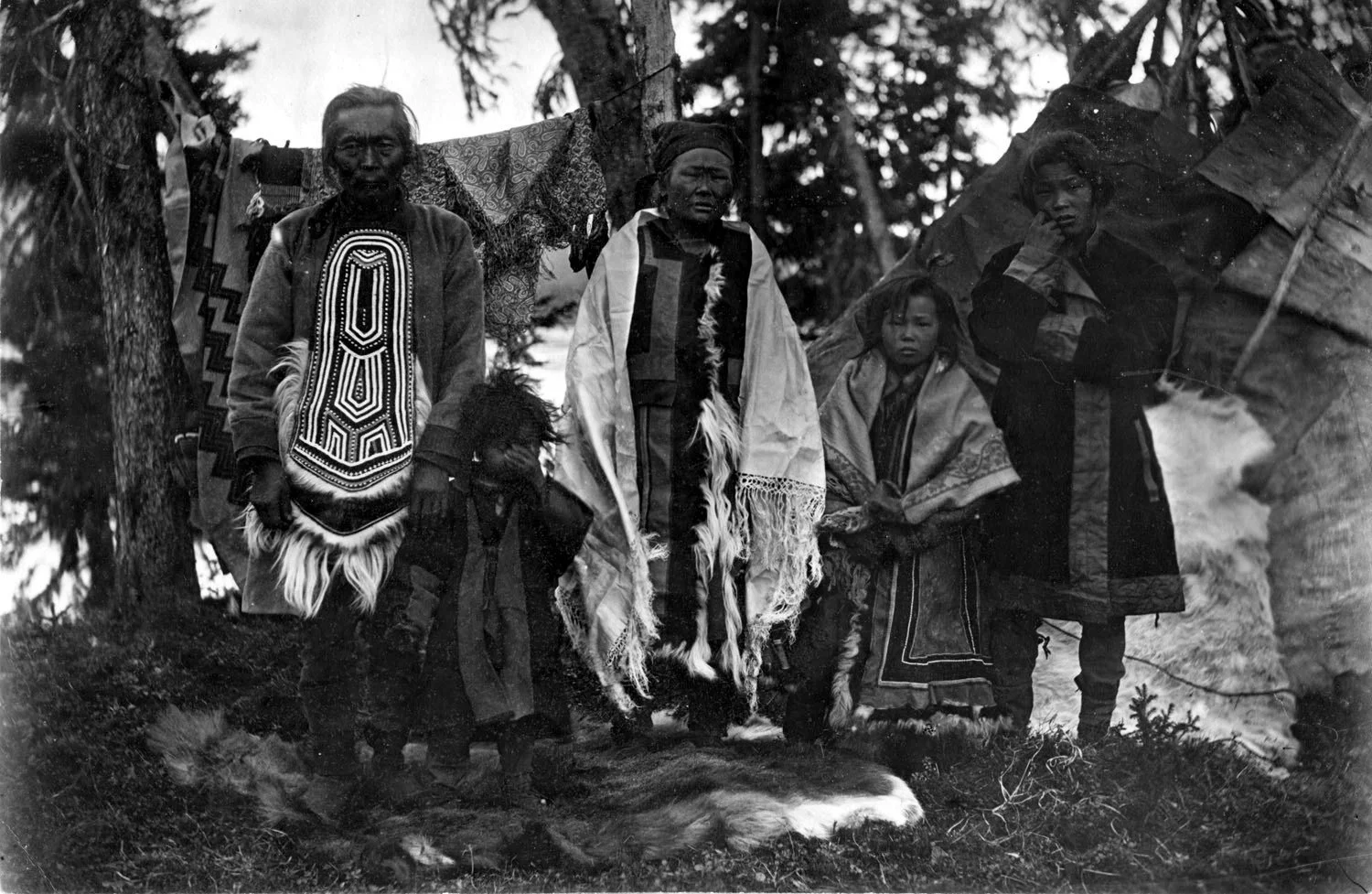
Poligus’s Evenki family, 1907. Photograph by A. A. Makarenko: the family of the Evenki shaman Poligus, Yenisey Governorate, Podkamennaya Tunguska River, 1907. Russian Ethnographic Museum collection. Public domain. 26
A dated photograph of a named family in a specific place, made under particular collecting conditions. It is not a generic or timeless image of Evenki life, and should not be captioned as one.
What the word did and did not name
In its regional settings, the word referred to particular specialists, not to every form of northern religion. As Europeans expanded the term, shamanism came to name an increasingly broad collection of practices and ideas. The word’s new comparative use did not erase its Tungusic history, but it changed its scale and meaning.1–3,27
This distinction prevents two forms of erasure. It avoids treating Evenki people merely as the origin point of a Western concept, and it avoids portraying all other communities as branches of an Evenki religion.
The regional setting also changed historically. Imperial expansion, trade, Christian missionisation, Soviet administration, settlement and industrial development affected mobility, language and ritual life. What nineteenth- or early-twentieth-century ethnographers recorded was not a pristine survival outside history. It was knowledge and practice already responding to political and economic change.
For this reason, museum collections should be read biographically. A drum or garment has a history before collection, a moment of acquisition, an institutional life and sometimes a later history of community access or restitution. Recording only its physical description leaves out the relationships that made it meaningful and the power conditions through which it entered the museum.
Reading the record
A regional title, not a world religion
The word shaman has a traceable home. That home is a language and a people — not the origin of every tradition later described by the word.
The Record Begins
Early Russian and European Encounters
Seventeenth-century encounters
Russian expansion across Siberia brought administrators, traders, missionaries and travellers into contact with northern Indigenous peoples. Records from these encounters introduced European readers to unfamiliar ritual specialists, but the accounts were shaped by practical and religious agendas. Some writers described observed ceremonies; others repeated hearsay or interpreted spirit relations through Christian categories of sorcery and the devil.1,28,58
Eighteenth-century circulation
By the eighteenth century, the shaman had become a recognisable figure in European intellectual culture. Writers used the figure to debate religion, enthusiasm, fraud, nature, civilisation and the limits of reason. The “shaman” circulating in learned Europe was therefore already more than a report about Siberia. It was also an argument through which Europeans defined themselves and imagined other peoples.2,28
Travel, mission and learned culture
Nicolaes Witsen’s Noord en Oost Tartaryen helped circulate one of the most influential early European visual representations of a Tungus or Evenki shaman — the engraving at the top of this page. The image has often been reproduced as though it were neutral ethnographic evidence. Witsen did not personally witness the depicted scene. The plate belongs to a chain of reports and representation, and must be read as evidence of European image-making as well as an uncertain record of Indigenous practice.29,30,32
Early accounts remain historically valuable. Critical reading does not require dismissing them. It requires separating observation from genre, hearsay, religious polemic and later reproduction.
The European circulation of the shaman figure also changed depending on the debate in which it appeared. In one text the figure could represent superstition; in another, natural religion; in another, poetic inspiration or deceptive performance. The same borrowed description might therefore serve different philosophical arguments.
A method that still matters
Repetition is not corroboration
Tracking reuse matters because a widely reproduced image can appear to be multiple independent testimonies when later authors are actually copying an earlier source.
This is why source chains are essential. A claim should be traced as close as possible to the earliest record, then compared with regional scholarship and, where available, community knowledge. Repetition across books does not increase reliability if all of them depend on the same unverified account.
Historical guide
Early encounter timeline
Russian and European records encounter northern ritual specialists.
Witsen’s publication contributes an influential image tradition.
The shaman circulates through travel writing and European debate.
Ethnology and anthropology expand the term comparatively.
How Europe Looked
The Colonial Gaze
Demonisation and dehumanisation
European and Russian writers often interpreted Indigenous spirit relations through Christian categories. Practitioners could be described as devil-worshippers, impostors, irrational figures or people afflicted by madness. Such descriptions did more than express disagreement. They placed Indigenous knowledge below European religion, medicine and reason, helping to justify conversion and governance.2,3,30
Exoticisation and spectacle
The opposite image was not necessarily more respectful. Shamans were also turned into exotic spectacles: strange costumes, dramatic drums, uncontrolled bodies and mysterious powers detached from kinship, landscape and responsibility.
Practitioner as impostor, madman or worshipper of devils — a figure to be converted, corrected or governed.
Practitioner as costume, drum and mystery — a figure to be marvelled at, collected or performed.
Demonisation and romanticisation could coexist. Both reduced living people to types created for outside audiences.
Classification as power
Classification made diverse specialists administratively and intellectually legible. A single label allowed officials and scholars to compare, regulate or dismiss practices whose local organisation they only partly understood. Later academic comparison could be more careful, but it inherited archives shaped by conquest, missionisation and collecting.2,3,31
This does not mean every scholar or traveller acted with identical intent. It means that knowledge was produced within unequal relations, and those relations affected what was recorded, translated, collected and ignored.
How to read archives critically
Ask who created the record, whether the event was witnessed, who translated it, why it was documented, what institution preserved it and whose account is absent. For images, include the creator, date, archive, rights status and representational context. Public-domain status settles a copyright question; it does not settle cultural appropriateness or historical accuracy.10,32
Evidence caution
Archival source bias checklist
- Who produced the record, and for what audience?
- Was the event witnessed, translated, coerced or reported by others?
- Which religious, medical or administrative categories shaped the description?
- What local name or explanation was replaced?
- Who preserved the item, and who can authorise its present use?
Worked example
Reading Witsen critically
Apply the checklist to the engraving at the top of this page. It can be read at two levels, and the two carry very different degrees of certainty.
A Tungus ritual specialist in a camp. Witsen did not witness the scene; the horns, clawed feet and the caption Duyvel-priester follow European convention rather than observation.
How Europeans pictured, published and repeated an image of Siberian practice — and how that image travelled into later books, debate and popular imagination.
The second can be historically secure even when the first remains uncertain. That is why the plate is worth publishing, and why it must never be captioned as a portrait.
The Category Expands
From Local Term to Global Academic Category
From Siberian term to ethnological category
The word’s expansion did not happen at once. It moved from regional encounters into travel accounts, natural histories, philosophical debate and later ethnology. By the nineteenth and twentieth centuries, scholars increasingly used shamanism to compare ritual specialists across Asia, the Arctic, the Americas and elsewhere.1–3,28
Historical guide
How the word travelled
Comparison across continents
Comparative studies identified recurring features: relations with spirits, altered states, ritual performance, healing, divination, soul journeys and community service. These comparisons sometimes revealed useful structural questions. They also encouraged scholars to remove practices from language, land, kinship and political history so that they would fit a universal model.
The value of comparison depends on its scale. Comparing a specific practice across named contexts is different from declaring whole religions equivalent.
Debates over usefulness
Some scholars retain shamanism as a practical comparative category when it is carefully defined. Others argue that its breadth produces false unity or imports Siberian and Western assumptions into unrelated traditions. The debate cannot be solved simply by accepting or banning the word. A better practice is to state the feature being compared, use local terminology and keep differences visible.3,4,21
The trade-off
What expansion cost
As the category expanded, its reach increased while its specificity decreased. Responsible scholarship reverses that loss by returning to community names, institutions and histories.
Gender and the imagined prehistoric shaman
Popular and archaeological imagery often reduced the shaman to a male “sorcerer” from deep prehistory. Critical histories show that early records and later ethnographies include women, men and gender-diverse forms of ritual authority, with patterns varying by community. The image of one male prehistoric type tells us as much about later European imagination as it does about past societies.3
The Model That Shaped the Idea
Twentieth-Century Theories and Mircea Eliade
Eliade’s synthesis
Mircea Eliade’s Shamanism: Archaic Techniques of Ecstasy, first published in French in 1951 and later in English, became one of the most influential comparative works on the subject. Eliade drew material from many regions and organised it into a history of religious techniques centred on ecstasy, ascent, descent and communication with other worlds.33
The book gave readers a powerful, coherent model. It also helped transform shamanism from a specialist comparative term into a widely recognised idea about ancient spirituality.
Ecstasy and journeying
Eliade treated ecstatic journeying as a defining feature and distinguished it from possession in ways that later readers often adopted as universal. This emphasis made journeys, cosmological levels and techniques of altered consciousness central to modern accounts. Yet many local traditions organise authority around wider institutions: kinship, sacrifice, divination, possession, community recognition, political relations and responsibilities to place.4,33
Influence on scholarship and popular culture
Eliade’s synthesis influenced the history of religions, archaeology, literature and emerging modern spiritual movements. It helped create a language through which people outside Indigenous settings could imagine “archaic techniques” as cross-cultural human possibilities. This influence intersected with, but did not solely cause, the later development of core shamanism and neo-shamanic practice.2,34
Later critiques
Later scholars criticised the model for universalising, decontextualising traditions and privileging ecstasy over local institutions. Critics also questioned the idea that a common ancient essence could be reconstructed by selecting similar-looking elements from many societies.1–4,34
Both readings, held together
Eliade: influence and critique
| Historical influence | Major critique |
|---|---|
| Created a memorable global synthesis | Combined traditions at a scale that obscured difference |
| Centred ecstasy and journeying | Privileged one feature over local institutions |
| Shaped scholarship and popular spirituality | Encouraged claims of an archaic universal essence |
| Made shamanism widely legible | Often relied on decontextualised secondary ethnography |
Scroll the table sideways on a narrow screen. Each row is one achievement read two ways.
Eliade remains historically important. The responsible approach is neither to repeat his model as settled fact nor to erase its influence. His work belongs in the history of how the modern global idea of shamanism was made.
Historical guide
Universal model or local history?
Both can generate useful questions. But local evidence must control local claims.
Named Laws, Named Places
Colonial and Missionary Suppression
Suppression did not follow one script. It operated through overlapping mechanisms, and the term shamanism is not the correct local name for every affected tradition. The examples below are placed together to compare colonial power, not to declare the traditions equivalent.
Missionisation and conversion
Missionaries often condemned spirit relations, ritual objects, masked ceremonies, songs and local healing as pagan or demonic. In southwest Alaska, Yup’ik elder accounts describe pressure against masked dancing and ceremonial life, alongside memory, adaptation and later renewal. The collaborative work Agayuliyararput / Our Way of Making Prayer preserves named community perspectives that complicate a simple story of disappearance.40,59
Conversion could involve conviction, coercion, selective adoption and syncretism at the same time. The presence of Christian forms does not by itself reveal whether older responsibilities ended, continued privately or were reinterpreted.
Law and criminalisation
Colonial governments sometimes converted missionary hostility into law. In Canada, the Potlatch Ban targeted Indigenous ceremonial systems and enabled arrests and confiscations. U’mista Cultural Society’s account centres Kwakwaka’wakw experience and the later return and renewed care of confiscated regalia. Potlatch should not be treated as another word for shamanism; its inclusion shows how law attacked community ceremony and governance.36,37
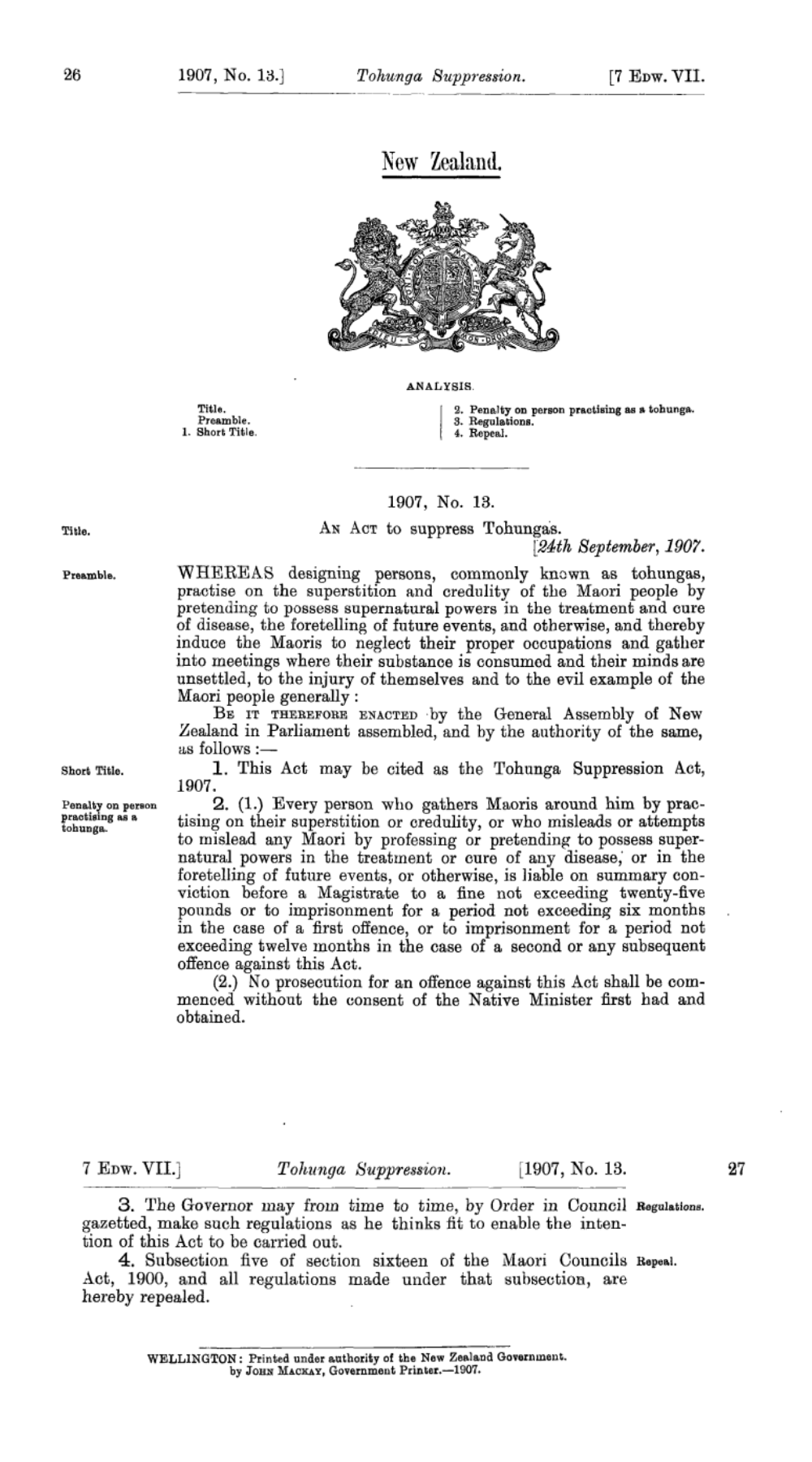
In Aotearoa New Zealand, the Tohunga Suppression Act 1907 targeted activities associated with tohunga. The statutory text establishes formal criminalisation, while Māori legal-historical analysis shows why conviction numbers alone cannot measure the wider chilling effect on knowledge, authority and transmission. Tohunga is a Māori category with meanings that exceed the English word shaman.38,39
The document above
Tohunga Suppression Act 1907, Public Act 1907 No 13
Printed under authority of the New Zealand Government by John Mackay, Government Printer, 1907. Assented 24 September 1907. Repealed 1962. No copyright subsists in New Zealand legislation.38
The preamble is the historical evidence. It names tohunga as “designing persons” and frames Māori knowledge as “superstition and credulity.” Section 2 attaches a fine of twenty-five pounds or six months’ imprisonment to a first offence, twelve months to a second. This is what criminalisation looked like in statutory language.
A complication worth stating
Who passed it, and what that means
The Act was introduced by James Carroll — Timi Kara — himself Māori and then Native Minister, and it was supported by Māui Pōmare and Māori members of the House. Presenting it purely as an external imposition would be inaccurate.
It would be equally inaccurate to treat that support as evidence that the Act was benign. Its backers argued from a position that Māori health required displacing tohunga with Western medicine — a judgement formed inside a colonial settlement, under population collapse and intense pressure toward assimilation. Support secured within those conditions does not make the statutory language above less contemptuous, nor its effects less real.
Documented convictions were few, and the record is incomplete: prosecutions were brought whose outcomes have not survived. The Act’s significance lies less in how often it was used than in what it authorised, and in what families concluded about teaching openly once it existed.38,39
Schooling and language loss
Mission and state schooling often separated children from language, elders and ceremonial knowledge. The impact extended beyond the prohibition of a single rite. When terminology, songs, ecological vocabulary and kinship responsibilities were interrupted, the conditions through which knowledge was transmitted were damaged. Community records from Kwakwaka’wakw and Yup’ik contexts show why ceremonial continuity cannot be separated from language, elders and intergenerational teaching.36,37,40
This mechanism differed across regions and institutions. It should be documented through community-specific histories rather than assumed as an identical global experience.
Land dispossession and ecological disruption
Ritual knowledge is often relational and place-based. Dispossession, restricted movement, settlement, extraction and ecological change can therefore disrupt ceremony even without a law naming religion. If access to hunting grounds, plants, animals, sacred places or seasonal routes is lost, the practical world in which knowledge operates is altered. The sources used here demonstrate this relational problem in specific community and heritage settings; they do not support one universal account of dispossession.36,40,48
Confiscation and museum collection
Objects were seized during trials, bans and conversion campaigns and later entered archives and museums. The 1692 trial of the Sámi noaidi Poala-Ánde, known in records as Anders Poulsen, involved the seizure and interpretation of his drum through a coercive legal and Christian framework. Modern restitution history shows that the object’s biography did not end with its collection.35,60
Confiscation could weaken practice while also unintentionally preserving material evidence. That paradox does not turn seizure into safeguarding. Present-day institutions must distinguish legal custody from the rights and authority of source communities.10
Two things the record hides
Why prosecutions are the wrong measure
A law may produce few convictions and still create fear, encourage officials or missionaries to intervene, or persuade families not to teach younger generations openly. Likewise, a mission may never issue a formal prohibition but can reshape education, public status and access to ceremonial spaces.
Resistance also took many forms: refusing conversion, concealing objects, adapting songs, moving ceremonies into private settings, using Christian forms selectively, petitioning for return, teaching children quietly or later creating community institutions. These strategies should not be romanticised. They often occurred under risk and alongside irreversible loss. Including them restores Indigenous agency without minimising coercion.
Five mechanisms
How suppression operated
| Mechanism | Example used here | Historical effect to investigate |
|---|---|---|
| Missionisation | Yup’ik ceremonial life in southwest Alaska | Condemnation, selective continuity, memory and renewal |
| Law | Potlatch Ban; Tohunga Suppression Act | Criminalisation, fear, arrests and chilling effects |
| Schooling and language pressure | Region-specific colonial education | Interrupted intergenerational transmission |
| Dispossession | Land- and ecology-based traditions | Loss of access to places, species and seasonal relations |
| Confiscation | Sámi drum; Kwakwaka’wakw regalia | Removal, museum custody, restitution and renewed authority |
Scroll the table sideways on a narrow screen. These mechanisms interacted; they did not operate in isolation.
Evidence caution
Suppression is region-specific
Do not write “colonialism banned shamanism everywhere.” A responsible account names each of these:
Different Clocks
State Suppression in Northern and Central Asia
Anti-religious campaigns
Soviet anti-religious policy disrupted public ritual, institutions and transmission in several northern and Central Asian regions. Practitioners could be denounced as exploiters or remnants of a backward past; objects were confiscated or destroyed; public activity became dangerous; and younger generations encountered official atheism through schools, media and administration.5,41–44
The intensity and timing varied. A history of Buryatia cannot stand for Sakha, Tuva, Mongolia or every northern people, and state discourse did not always match local enforcement.
Objects, institutions and public practice
Suppression targeted more than individual belief. It affected the material and social conditions of practice: drums, clothing, ritual spaces, public ceremonies, teacher-student relationships and community recognition. Some objects survived in museums or private care; some knowledge continued within families; some lines were severely interrupted.42,43
Changing Soviet representations
Soviet representations were not static. Research on the anti-religious press shows shifts in the way shamanism was discussed, including movement from older cultural and evolutionary descriptions toward language about subjective experience in parts of the 1960s discourse. Media representation is not the same as policy or lived practice, but it reveals changing ways the state and its institutions made the subject intelligible.41
Regional variation
In Buryatia, the histories of Buddhism, shamanic practice, Soviet rule and post-Soviet public life intersected in distinctive ways. In Sakha, religion and atheism were embedded in ethnic, political and cultural transformation. Other northern communities faced different administrative structures, demographic pressures and possibilities for secrecy.5,42,43,61
The common phrase “Soviet suppression of shamanism” is therefore only a starting point. It must be broken into regional evidence about policy, representation, objects, institutions and lived experience.
Historical guide
Four things that moved at different speeds
| Early Soviet decades | Mid-century | Late Soviet period | Post-Soviet period | |
|---|---|---|---|---|
| Policy | Anti-religious campaigns intensify; older institutions targeted | Public practice and transmission remain constrained | Constraint persists, unevenly by region | State control of religion recedes |
| Official representation | Practitioners denounced as exploiters or as backwardness | Cultural and evolutionary framings in the anti-religious press | Parts of 1960s discourse shift toward subjective experience | Inherited state categories used, rejected or reworked |
| Lived effects | Danger, denunciation, confiscation and destruction | Private and family continuity; secrecy; wide regional variation | Memories and practices persist unevenly | Public re-entry; authority renegotiated |
| Renewal | — | — | Continuity through private, family and cultural forms | Recovery, institutions, debate and innovation |
Scroll the table sideways on a narrow screen. Dashes mark where this page cites no evidence for that lane in that period — not that nothing occurred.
After the Soviet period
Post-Soviet revival involved recovering silenced histories, renewing family lines and creating public organisations, ceremonies and identities. It was not simply the return of a preserved pre-1917 system. Decades of interruption, urbanisation, new media, nationalism, scholarship and global exchange shaped the forms that appeared.5,46,61,62
State categories also influenced revival. Soviet ethnography and cultural policy had classified peoples, customs and permissible forms of folklore. After the Soviet period, communities and practitioners sometimes used, rejected or reworked those inherited categories when presenting religion publicly. A revival can therefore respond simultaneously to ancestral memory, academic description, national politics and international interest.
Public visibility brought opportunity and contest. It allowed ceremonies and practitioners to re-enter social life, yet it also raised questions about representation, legitimacy, gender, lineage and commercialisation.
How to read the disputes
Debate is not disproof
These debates are part of the history of revival, not evidence that revival is false. They show that authority is being renegotiated after long periods in which the state attempted to control it.
How Knowledge Kept Moving
Survival, Adaptation and Syncretism
Family and lineage
When public institutions were attacked, family and lineage could become crucial channels of transmission. Knowledge might continue through stories, remembered names, care of objects, dreams, healing practices or recognition of descendants. Some lineages remained active; others retained fragments that later generations reassembled.45,46
Secrecy and private practice
Secrecy protected people and practices, but it also narrowed opportunities for teaching and public recognition. Private continuity may leave little documentary evidence, which means official archives can exaggerate disappearance.5,46
Two opposite errors
Because secrecy leaves thin records, silence in an archive can be misread in either direction. It may indicate that practice continued out of official sight — or it may reflect genuine interruption.
Absence of documentation cannot prove that a tradition disappeared. Nor can it be used to invent an unbroken lineage where a community itself describes interruption. The community’s own account is the stronger authority.
Syncretism and adaptation
Traditions often changed through contact with Buddhism, Christianity, Islam, state medicine and modern institutions. Syncretism may be creative and community-directed, or it may develop under coercive pressure. Change does not automatically make a tradition inauthentic, and resemblance to an older form does not automatically prove continuity.5,6,23
In cities and post-socialist settings, practitioners may organise through new associations, public events, clinics, media or professional networks. The form changes, while relationships with ancestors, place or responsibility may remain central.46,62
Memory, objects and place
Songs, landscapes, regalia, photographs, museum collections and family memories can become anchors for renewal. They do not carry one self-explanatory meaning. Their interpretation may be contested among elders, practitioners, institutions and younger generations.
Seven channels
How knowledge survived
Transmission rarely depended on one route. Where public institutions were closed, these carried knowledge instead — usually several at once:
The balance differs by community. No single channel should be assumed dominant without local evidence.
The standard for this section
Two stories that both distort
Survival histories must hold loss and agency together.
Five Words, Five Meanings
Indigenous Revitalisation, Heritage and Sovereignty
Renewal is described with several words that are often used loosely. In historical writing they mean different things, and choosing the wrong one misrepresents a community’s own account of what happened.
Continuity
Transmission persists across generationsKnowledge and practice transmitted across generations, even when outward forms change. It does not require a tradition to remain frozen. Communities may adopt new materials, institutions or public languages while maintaining recognised responsibilities and authority.5,6
Adaptation
Form changes while responsibilities continueThe outward shape of practice shifts — through contact, migration, urban life or new institutions — while relationships with ancestors, place or responsibility remain central.
Revitalisation
A community actively strengthens practiceAn active strengthening of language, ceremony, education, community participation or public recognition. It may draw upon elders, family memory, archival sources and renewed access to land or objects. UNESCO’s record of the Traditional Knowledge of the Jaguar Shamans of Yuruparí offers one example in which community participation and consent are part of the safeguarding documentation. It is not a template that outsiders can apply universally.6,47,49
Reconstruction
Knowledge rebuilt after interruptionAfter severe interruption, communities may use oral memory, historical records, objects and comparative knowledge to rebuild practices or institutions. The word should not be used to question legitimacy. Nor should reconstruction be disguised as an unchanged survival if the community itself describes loss and recovery.
Innovation
New forms for contemporary conditionsNew forms created in response to present needs: associations, festivals, digital archives, urban practices, new teaching structures or public heritage programmes. All living traditions change. The historical question is who guides the change and how it relates to community authority.
These five can coexist within one community at the same time. The community concerned is best placed to describe the relationship among them — and to decide what may be shared.
Who has authority to decide?
Indigenous sovereignty includes authority over naming, representation, restricted knowledge, transmission and cultural materials. UNDRIP affirms rights relating to culture, institutions, heritage and self-determination, while UNESCO and museum ethics frameworks emphasise community participation. These frameworks matter, but no international label transfers ownership of knowledge to a state, museum, researcher or training provider.10,48,49
Consent must also be specific. Permission to document a ceremony is not necessarily permission to teach it commercially, publish sacred details or train an artificial-intelligence system on the material. Community protocols may change, and some knowledge should remain inaccessible. Community-led labelling and traditional-knowledge governance frameworks make these distinctions explicit.63–65
Four different questions
Object record and community authority are not the same
Documents possession and provenance — where an object has been, and who has held it.
Proposes a reading of what an object or practice may have meant.
Defines copyright, title and legal possession within a jurisdiction.
Governs cultural meaning, who may access what, and what responsibility attaches to it.
One layer does not automatically confer the others. Holding an object, publishing an interpretation or owning a copyright does not grant authority over cultural meaning.
Heritage recognition can be valuable without being neutral. It may bring resources, visibility and institutional support, but it can also encourage a living practice to be packaged into a stable public description. Communities may disagree internally about who speaks, what should be displayed and whether a state or international body’s terminology fits their experience. Safeguarding should support the conditions of transmission rather than preserve a performance for outsiders.
Sovereignty also concerns benefit. Researchers, publishers, retreat businesses and training organisations may gain income or authority from knowledge associated with Indigenous peoples. Ethical practice asks whether communities control representation, receive appropriate benefit, retain the right to set boundaries and can challenge false claims made in their name.
Six questions
Community authority in revitalisation
- Is the community named and participating?
- Is free, prior and informed consent documented where appropriate?
- Who can decide what is public, restricted or sacred?
- Are language, land and intergenerational transmission supported?
- Who benefits economically and institutionally?
- Can consent be revised or withdrawn?
Modern Movements, Modern History
Core Shamanism, Neo-Shamanism and Western Popularisation
Michael Harner and core shamanism
Core shamanism emerged in the late twentieth century through the work of anthropologist Michael Harner and the organisations associated with him. Harner presented selected practices, especially journeying with rhythmic sound, as a cross-cultural methodological core that people outside Indigenous traditions could learn. The Way of the Shaman and the Foundation for Shamanic Studies were central to the movement’s growth.2,50–52
Historically, core shamanism is a modern comparative system. Calling it modern is not a judgment about individual experience. It prevents a late-twentieth-century curriculum from being described as an unchanged universal tradition from prehistory.
Institutional growth
Workshops, training programmes, publications and international networks helped standardise and circulate core-shamanic methods. Institutional histories provide dates and self-descriptions, but they should be read alongside independent scholarship, because organisations naturally describe their own purposes and achievements.51,52
Neo-shamanism as a broader field
Neo-shamanism is a wider descriptive category for diverse modern movements that adapt shamanic ideas within contemporary spiritual, therapeutic, Pagan, ecological or self-development settings. Some groups follow core-shamanic structures; others combine multiple influences or create locally new forms. The label should not be used as a blanket insult, and it should not be confused with community-governed Indigenous revitalisation.34,53
Three distinct fields
Traditional, core and neo-shamanic histories
| Field | Historical basis | Authority and caution |
|---|---|---|
| Indigenous or local tradition | Community-specific lineage, place, language and history | Community protocols and local authority govern |
| Core shamanism | Late-twentieth-century comparative system associated with Harner and the FSS | Modern method; not identical to all Indigenous traditions |
| Neo-shamanism | Diverse contemporary adaptations and spiritual movements | Analyse sources, claims, commercialisation and ethics case by case |
Scroll the table sideways on a narrow screen. Modern comparative systems belong to modern history; they are not the culmination of Indigenous traditions.
Appropriation and ethical debate
Modern adaptation raises difficult questions.31,34,54
Five questions to ask of any modern practice
- Who authorised the use of a ceremony or title?
- Was restricted knowledge made public?
- Are Indigenous identities being claimed by outsiders?
- Who receives income or recognition?
- Does a universalising curriculum erase the people from whom particular practices were learned?
Not every cross-cultural exchange is automatically appropriation. Ethical assessment requires specificity about source, consent, power, representation and benefit. A responsible training system should distinguish general experiential methods from Indigenous ceremonies, avoid false lineage claims and direct learners toward community-authored knowledge and ethical practice.
Experience and historical claim
Modern movement histories should distinguish personal experience from historical claim. A practitioner may find journeying profound or transformative. That experience does not establish that the method is unchanged from the Palaeolithic or authorised by every culture used to explain it.
Historical accuracy asks only that the origin and development of the teaching be described honestly.
Why the distinction helps everyone
None has to be disguised as another
The distinction benefits learners as well as communities. It allows core shamanism to be studied as a significant modern movement, neo-shamanism as a diverse contemporary field, and Indigenous traditions as community-specific systems with their own authority.
None has to be disguised as another to be taken seriously.
The History Still Running
Shamanism in the Twenty-First Century
Digital circulation
Websites, social media, streaming, online communities and digital archives have accelerated the circulation of shamanic language and practice. Studies of Douyin discourse in northeast China and Russian internet neo-shamanism show that digital platforms can support visibility, community formation and reinterpretation while also encouraging simplification and commodification. These are bounded cases, not a single global pattern.67,68,72
Digital access also creates governance questions. A photograph or recording can be technically public while remaining culturally restricted. Traditional Knowledge Labels and related community-led frameworks offer ways to express attribution, access and responsibility that ordinary copyright systems may not capture.63,65
Tourism and commercialisation
Retreat and ceremonial tourism have become major sites of intercultural encounter. Research on the Peruvian Amazon describes potential learning and economic exchange alongside risks involving unequal power, safety, misrepresentation and extraction. Survey evidence can describe particular participant groups, but it should not be converted into global totals.69,70
Indigenous commentators have also warned that rapidly expanding ayahuasca tourism may create pressure on communities, environments and sacred relationships. Such criticism should be attributed to named voices rather than presented as one universal Indigenous position.71
Heritage and sovereignty
Greater visibility may help communities document language, renew ceremonies, seek restitution or reach younger generations. It can also expose restricted knowledge, detach it from context and invite commercial imitation. UNESCO ethics guidance, UNDRIP and Indigenous data-governance tools all emphasise that safeguarding must not displace community authority.48,63–65
Research and public education
Scientific and psychological research on shamanic trance is growing, but the literature remains heterogeneous. A 2024 scoping review found a limited eligible evidence base and called for stronger methods. Historical and cultural significance should not be confused with demonstrated clinical efficacy. Medical claims belong to a separate evidence review.55
Public education can still improve. It can distinguish source types, correct universal origin myths, explain the history of suppression and make ethical boundaries visible without reducing spiritual traditions to laboratory effects.
Eight forces
What is shaping the present
These forces interact differently in each region. No single account describes all of them at once.
Future tensions
Contemporary apprenticeship and professionalisation increasingly operate across online networks, commercial training and intercultural settings. Some practitioners seek formal curricula and public identity; some communities protect local systems from outside standardisation; and many people move between these fields.66,72
The central question
Not tradition versus change
The central historical tension is not “tradition versus change.” It is change under unequal conditions. Five questions follow from that, and they apply to every organisation in this field — including those teaching it:
Environmental change adds another layer. Many traditions are embedded in relationships with particular animals, plants, waters and seasonal movements. Climate disruption, extraction and biodiversity loss affect not only material livelihood but also the places and beings through which knowledge is practised. Commercial demand for ceremonial plants can intensify these pressures when supply chains and benefits are poorly governed.69–71
At the same time, digital tools can support language learning, community archives, restitution research and connections among dispersed members. The ethical question is not whether technology is inherently harmful or beneficial. It is whether its design respects community protocols, context and the possibility that some knowledge should not circulate widely.
Master historical timeline
The five histories, filled in
These are the same five tracks set out at the beginning of this page. Each has its own evidence and its own chronology. Read across a lane, not down the page — there is no single evolutionary line.
The master timeline keeps evidence types and historical tracks separate instead of presenting one evolutionary line. A lane with fewer entries is not a shorter history — it is a different kind of record.

Answers and Next Steps
Common Questions, Misconceptions and Where to Continue
Common questions
No single date is established. Archaeology demonstrates ancient symbolic and ritual behaviour and may identify possible ritual specialists. It cannot prove that one religion called shamanism began at a particular moment. Claims that shamanism is 30,000 or 100,000 years old usually convert debated interpretations into precise history.3,7–9
That description is not historically demonstrable. It is safer to say that ritual, healing, altered experience and relations with unseen beings have deep human histories. “Oldest religion” implies a stable, bounded institution that the evidence does not establish.
No. Historical and ethnographic records include women, men and gender-diverse forms of ritual authority, with patterns varying across societies. The familiar image of a male prehistoric sorcerer reflects later representation as much as historical evidence.3
Colonial and state systems caused profound losses through missionisation, criminalisation, schooling, dispossession, confiscation and anti-religious campaigns. Outcomes varied. Some traditions continued privately or through families; others experienced severe interruption; many contemporary movements combine continuity, recovery and innovation.5,35–44
Historical continuity and cultural value do not establish clinical efficacy. Contemporary scientific research should be evaluated separately by study design, outcome and safety. Current research on shamanic trance is limited and heterogeneous.55
Historical claims
Safe and unsafe wording
Key takeaways
A practical test for any claim you meet
- If a statement names a universal origin, ask what evidence connects the regions and periods involved.
- If it identifies a prehistoric shaman, ask whether the label belongs to the excavation or to later interpretation.
- If it presents a practice as Indigenous, ask which people, language, lineage and authority are being named.
- If it promises scientific proof, ask whether the cited research actually studied the claimed outcome.
The purpose of these questions is not to strip the subject of spiritual meaning. It is to keep spiritual interpretation, community authority and historical evidence from being collapsed into one another. Readers can respect lived spiritual worlds while remaining precise about what archaeology, archives or contemporary research can establish.
Where to continue
Follow your question
Editorial disclosure
This educational synthesis is based on cited historical, archaeological and community sources. It does not claim Indigenous authority or academic-historian status. Community-specific knowledge and permissions remain with the communities concerned.
Written by Dr. Rashhi Sharma, Ph.D. · Soul Consciousness Lab · Last updated August 2026
Seventy-Two Sources
References
Every citation on this page resolves to an entry below, and every entry links to its publisher, repository or DOI. Where a claim rests on community authority rather than published scholarship, the community source is cited directly. External links open in a new tab and are not controlled by Soul Consciousness Lab.
- 01Ronald Hutton (2001/2007), Shamans: Siberian Spirituality and the Western Imagination. Source ↗
- 02Andrei A. Znamenski (2007), The Beauty of the Primitive: Shamanism and Western Imagination. Source ↗
- 03Silvia Tomášková (2013), Wayward Shamans: The Prehistory of an Idea. Source ↗
- 04Alice Beck Kehoe (2000), Shamans and Religion: An Anthropological Exploration in Critical Thinking. Source ↗
- 05Justine Buck Quijada (2019), Buddhists, Shamans, and Soviets: Rituals of History in Post-Soviet Buryatia. Source ↗
- 06UNESCO Intangible Cultural Heritage (2011), “Traditional Knowledge of the Jaguar Shamans of Yuruparí.”. Source ↗
- 07David S. Whitley and James D. Keyser (2003), “Faith in the Past: Debating an Archaeology of Religion,” Antiquity 77(296), 385–393. Source ↗
- 08Neil S. Price, ed. (2001), The Archaeology of Shamanism. Source ↗
- 09Christine S. VanPool (2009), “The Signs of the Sacred: Identifying Shamans Using Archaeological Evidence.”. Source ↗
- 10ICOM, ICOM Code of Ethics for Museums. Source ↗
- 11Michael Winkelman (2002), “Shamanism and Cognitive Evolution (with comments),” Cambridge Archaeological Journal 12(1), 71–101. Source ↗
- 12Jean Clottes and David Lewis-Williams (1996/1998), The Shamans of Prehistory: Trance and Magic in the Painted Caves. Source ↗
- 13Robert Layton (2000), “Shamanism, Totemism and Rock Art,” Cambridge Archaeological Journal 10(1), 169–186. Source ↗
- 14Grant S. McCall (2007), “Add Shamans and Stir? A Critical Review of the Shamanism Model of Forager Rock Art Production,” Journal of Anthropological Archaeology 26(2), 224–233. Source ↗
- 15Robert J. Wallis (2019), “Art and Shamanism: From Cave Painting to the White Cube,” Religions 10(1), 54. Source ↗
- 16J. D. Lewis-Williams (2003), “Putting the Record Straight: Rock Art and Shamanism,” Antiquity 77(295), 165–170. Source ↗
- 17Leore Grosman, Natalie D. Munro and Anna Belfer-Cohen (2008), “A 12,000-Year-Old Shaman Burial from the Southern Levant (Israel),” Proceedings of the National Academy of Sciences 105(46), 17665–17669. Source ↗
- 18Laure Dubreuil, Ahiad Ovadia, Ruth Shahack-Gross and Leore Grosman (2019), “Evidence of Ritual Breakage of a Ground Stone Tool at the Late Natufian Site of Hilazon Tachtit Cave (12,000 Years Ago),” PLOS ONE 14(10), e0223370. Source ↗
- 19Martin Porr and Kurt W. Alt (2006), “The Burial of Bad Dürrenberg, Central Germany: Osteopathology and Osteoarchaeology of a Late Mesolithic Shaman’s Grave,” International Journal of Osteoarchaeology 16(5), 395–406. Source ↗
- 20State Museum of Prehistory Halle, “The Shaman from Bad Dürrenberg.”. Source ↗
- 21Human Relations Area Files, Yale University, “Cross-Culturally Exploring the Concept of Shamanism.”. Source ↗
- 22Merete Demant Jakobsen (1999), Shamanism: Traditional and Contemporary Approaches to the Mastery of Spirits and Healing. Source ↗
- 23Thierry Zarcone and Angela Hobart, eds. (2013), Shamanism and Islam. Source ↗
- 24Tatiana Y. Sem (2017), Evenki Shamanism: Based on Materials of the Russian Ethnographic Museum. Source ↗
- 25Russian Ethnographic Museum (2021), “Shamanic Attributes of the Evenki-Orochon.”. Source ↗
- 26Russian Ethnographic Museum / A. A. Makarenko (1907), “Evenki shaman Poligus’s family.”. Source ↗
- 27Roberte Hamayon (1990), La chasse à l’âme. Source ↗
- 28Gloria Flaherty (1992), Shamanism and the Eighteenth Century. Source ↗
- 29Huygens Institute for the History of the Netherlands, “List of Images from Witsen Volumes,” including “A shaman or Devil-priest in the country of the Tungus.”. Source ↗
- 30The Open University, “Under the Colonial Gaze: Dehumanising and Demonising Shamans.”. Source ↗
- 31Philip J. Deloria (1998), Playing Indian. Source ↗
- 32Nicolaes Witsen (1785 edition), Noord en Oost Tartaryen, Band 1. Source ↗
- 33Mircea Eliade (1951; English 1964), Shamanism: Archaic Techniques of Ecstasy. Source ↗
- 34Robert J. Wallis (2003), Shamans/Neo-Shamans. Source ↗
- 35Liv Helene Willumsen (2020), “Anders Poulsen—Sámi Shaman Accused of Witchcraft, 1692.”. Source ↗
- 36U’mista Cultural Society, “The Potlatch Ban.”. Source ↗
- 37UBC Indigenous Foundations, “The Indian Act.”. Source ↗
- 38New Zealand Parliamentary Counsel Office (1907), Tohunga Suppression Act 1907. Source ↗
- 39Māmari Stephens (2001), “A Return to the Tohunga Suppression Act 1907,” Victoria University of Wellington Law Review 32, 437–462. Source ↗
- 40Ann Fienup-Riordan and Yup’ik elders (1996), Agayuliyararput / Our Way of Making Prayer. Source ↗
- 41Justine B. Quijada (2020), “From Culture to Experience: Shamanism in the Pages of the Soviet Anti-Religious Press,” Contemporary European History 29(2), 187–201. Source ↗
- 42Marjorie Mandelstam Balzer (1993/2009), “Dilemmas of the Spirit.”. Source ↗
- 43Yuri Slezkine (1994), Arctic Mirrors. Source ↗
- 44Baylor University Keston Center, “Soviet Union Shamanism Subject Files.”. Source ↗
- 45Caroline Humphrey and Urgunge Onon (1996), Shamans and Elders. Source ↗
- 46Manduhai Buyandelger (2013), Tragic Spirits. Source ↗
- 47UNESCO Intergovernmental Committee (2011), “Decision 6.COM 13.9.”. Source ↗
- 48United Nations (2007), United Nations Declaration on the Rights of Indigenous Peoples. Source ↗
- 49UNESCO (2003), Convention for the Safeguarding of the Intangible Cultural Heritage. Source ↗
- 50Michael Harner (1980), The Way of the Shaman. Source ↗
- 51Foundation for Shamanic Studies, “The History and Work of the Foundation for Shamanic Studies.”. Source ↗
- 52Foundation for Shamanic Studies, “Michael Harner.”. Source ↗
- 53Joan B. Townsend (2004), “Individualist Religious Movements: Core and Neo-Shamanism,” Anthropology of Consciousness 15(1), 1–9. Source ↗
- 54Lisa Aldred (2000), “Plastic Shamans and Astroturf Sun Dances: New Age Commercialization of Native American Spirituality,” American Indian Quarterly 24(3), 329–352. Source ↗
- 55Nolwenn Marie, Yannick Lafon, Aminata Bicego, Charlotte Grégoire, Floriane Rousseaux, Antoine Bioy, Audrey Vanhaudenhuyse and Olivia Gosseries (2024), “Scoping Review on Shamanistic Trance Practices,” BMC Complementary Medicine and Therapies 24, 381. Source ↗
- 56Rachel J. Crellin, Christina Tsoraki, Christopher D. Standish, Richard B. Pearce, Huw Barton, Sarah Morriss and Oliver J. T. Harris (2023), “Materials in Movement: Gold and Stone in Process in the Upton Lovell G2a Burial,” Antiquity 97(391), 86–103. Source ↗
- 57William Cunnington (1806), “Account of Tumuli Opened in Wiltshire.”. Source ↗
- 58Jeremy Narby and Francis Huxley, eds. (2001/2004), Shamans Through Time. Source ↗
- 59Smithsonian Institution, “Living Tradition: Yup’ik Masks.”. Source ↗
- 60Library of Congress (2022), “Return of a Sámi Drum.”. Source ↗
- 61Marjorie Mandelstam Balzer (1999), The Tenacity of Ethnicity. Source ↗
- 62Caroline Humphrey (2002), “Shamans in the City,” in The Unmaking of Soviet Life. Source ↗
- 63Local Contexts, “Traditional Knowledge Labels.”. Source ↗
- 64UNESCO, “Ethics and Intangible Cultural Heritage.”. Source ↗
- 65World Intellectual Property Organization (2023), “Documentation of Traditional Knowledge and Traditional Cultural Expressions.”. Source ↗
- 66Carolina Ivanescu and Sterre Berentzen (2020), “Becoming a Shaman.”. Source ↗
- 67Mei Yang and Xianhui Li (2025), “Human Will in Digital Discourses About Shamanism.”. Source ↗
- 68Yana S. Ivashchenko, Andrey A. Ivanov and Yanina A. Elinskaya (2019), “Digital Trance: Neo-Shamanism in the Russian Internet.”. Source ↗
- 69Evgenia Fotiou (2020), “Shamanic Tourism in the Peruvian Lowlands,” Journal of Latin American and Caribbean Anthropology 25(3), 374–396. Source ↗
- 70ICEERS (2023), “Ayahuasca Tourism: Who, How and Where?”. Source ↗
- 71Nina Gualinga and Eli Virkina (2025), “Ayahuasca Tourism Is Endangering Indigenous Peoples and the Environment.”. Source ↗
- 72Yana S. Ivashchenko and Andrei A. Ivanov (2023), “Dynamics of Communicative Practices in Siberian Neo-Shamanism,” Sibirica 22(3), 37–56. Source ↗