
Level 1 — Foundation Programme · no prior experience required
Apply for this batch →14 students certified, joined from across the world. The September batch is now open.
Final 2026 Batch — Applications Open
This Batch Is Filling
Enrolment is confirmed only after an alignment discussion, not by direct booking.
Closing in
Applications close 15 September 2026
Capped at 12 by design — the supervision ratio this work requires.
Confirmed from India · Mauritius · Nepal · USA
Setting Expectations
What This Training Is — and What It Is Not
Shamanism training here is not about learning concepts or adopting beliefs.
It is a direct, experiential discipline in which you learn to work with nature, consciousness and the unseen dimensions through structured practice, guided journeys and real-time application.
You are not only coming to understand shamanism — you are learning to practise it safely, ethically and within clear limits.
What This Training Actually Is
Across the pathway you learn to:
- Enter non-ordinary states of consciousness through guided journeying
- Connect with spirit allies, power animals and ancestral intelligence
- Work with energy and soul-level imprints as understood in shamanic tradition
- Engage with nature, elements and ritual process
- Build clarity, intuition and perception beyond the logical mind
- Practise the core methods of the tradition — soul retrieval, extraction and psychopomp work — as you progress through the levels
Level 1 has clear limits, and we state them plainly further down this page. The deeper methods belong to Level 2 and beyond, taught only once the foundation is stable.
What This Training Is Not
To be clear before you apply, this programme is not:
- A weekend workshop or a spiritual experience event
- An online or theory-based course
- A belief system you are asked to follow
- A promise of instant healing or quick transformation
- A commercial or trend-based “spiritual” offering
- Passive learning — here, everyone practises and everyone speaks
Shamanism is a discipline that asks for involvement, responsibility and readiness. If that is not what you are looking for, this is not the right training — and we would rather say so now.
Why It Is 100% Residential
The work requires things a screen cannot provide:
- Direct connection with natural environments and the elements
- Group ceremony, ritual and shared process
- A supervised space where deeper states can be entered safely
- Initiations given in the trainer's presence
- Grounding on the land, whenever it is needed
This is the question we are asked most, and we answer it in full further down — including where online genuinely does work. Read why we do not teach shamanism online →
This training is not about collecting spiritual information. It is about becoming capable, grounded, ethical and ready to walk the path responsibly.
Why This Training Is Different
Many Trainings Teach You About Shamanism
Very few teach you to practise it — and fewer still stay in the room until you can.
This is not a workshop, a retreat, or a conceptual course. It is a structured, practice-based pathway in which every method is experienced, guided and integrated before anything else begins. What follows is what actually makes it different.
Nobody Moves On Until Everybody Has It
There is no fixed curriculum and no clock. The group does not progress until the last student says they have understood.
That is a safety standard before it is a teaching preference — a practitioner who half-learned a method will one day use it on a client.
Everybody Speaks
In most training rooms the same few people share and the quiet ones stay quiet for the entire programme.
Here everyone shares, and nobody stays silent. Assumption is the real danger in this work, and what you experienced cannot be corrected if you never say it.
Sixty Hours in Five Days
Practice begins before breakfast and continues into the night. Dream work and the discussion that follows are part of the training, not additions to it.
These are long days. We say so plainly, because the people this suits want to know in advance.
Twelve People, One Trainer
The batch is capped at twelve because that is the supervision ratio this work requires — not because places are scarce.
Dr. Rashhi is in the room throughout, watching each person practise.
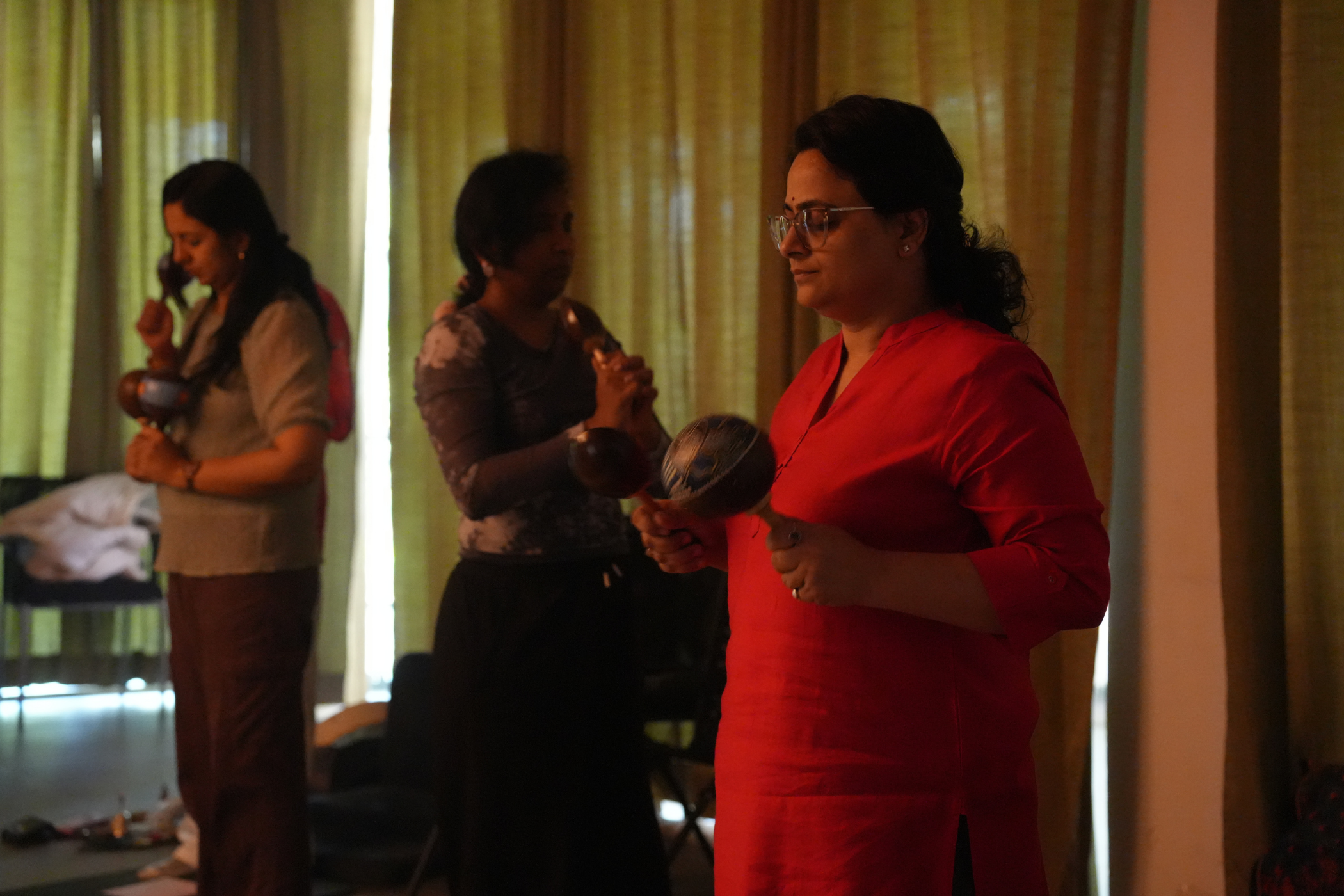
The Drum, Not Drugs
No psychoactive plant or substance is used, supplied or recommended at any point in this training.
We work with the drum and rattle, as a great many traditional cultures always have — and as the founder of modern core shamanism established.
Residential, and Genuinely Away
Five days in open country south of Bangalore, at a venue Soul Consciousness Lab® has taught at for over a decade.
There are no televisions. That is not an oversight — it is why the venue was chosen.
Field-Learned, Across Traditions
Dr. Rashhi has trained on the ground within several living traditions — core shamanism through the Foundation for Shamanic Studies, Andean and P'aqo practice in Peru, Celtic lineage in Ireland, and Mexican tradition.
That breadth is what allows a complete practice rather than one second-hand method.
Six Months of Practice, Then Support for Life
The five days open into a structured six-month practice period — a weekly circle, a daily practice guide, monthly live sessions with Dr. Rashhi, and a practice log that earns your place at Level 2.
After that the support continues, at no cost, for as long as you practise.
This training is not designed for casual interest
It is for those ready to learn deeply, practise sincerely, and take responsibility for the work they step into.
The pathway runs across four progressive levels, from foundation to advanced practice — though there is no obligation to continue beyond the first.
Speak to a past student before you apply.
Ask us and we will put you in touch. You will hear about the training from someone with no reason to sell it to you.
Apply for this batch →Trusted by Serious Seekers Across Countries
Participants have come from seven countries and more — therapists, healers, coaches and seekers, many of whom have continued into the advanced levels.
Recommendation figure from post-programme participant feedback. Countries represented across shamanism batches to date.
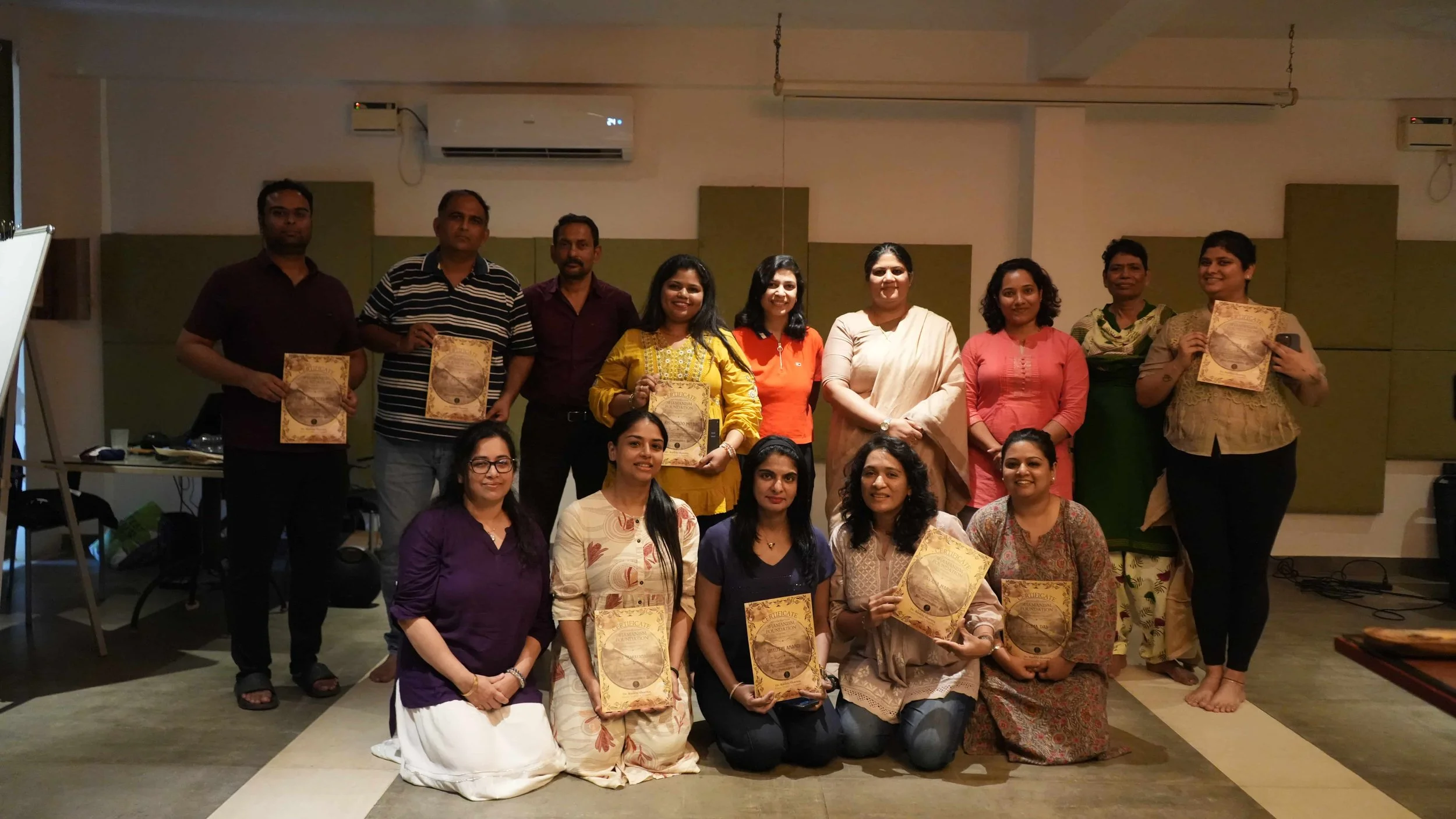
You are welcome to speak with past students before joining.We believe clarity comes from real experience, not just words.
Training Pathway
The 4-Level Shamanic Practitioner Pathway
This training is not a one-time experience.
It is a structured, progressive pathway, designed to take you from foundational understanding to advanced practice — step by step.
Each level builds on the previous one, allowing you to deepen your experience, stabilize your practice, and develop the clarity required to work responsibly with yourself and others.
Foundation Program
This is where the journey begins.
You are introduced to the core principles of shamanism through direct experience, including shamanic journeying, power animal connection, spirit allies, and working with nature and non-ordinary states of consciousness.
The focus at this stage is to build a stable foundation, learn how to enter and return safely from deeper states, and begin developing sensitivity to the work.
Expansion Program
At this level, your practice begins to deepen.
You move into more advanced journeying, energy work, extraction practices, early stages of soul retrieval, and deeper interaction with spirit allies and healing processes.
The work becomes more structured, and you begin to understand how to hold space not just for yourself, but within a guided process.
Advanced Program
This level expands your capacity to work across multiple dimensions of shamanic practice.
You engage with ancestral work, ritual and ceremonial processes, deeper soul-level work, land and space clearing, and advanced integration of techniques across traditions.
The focus here is on depth, stability, and maturity in practice, allowing you to move beyond technique into understanding the nature of the work itself.
Practitioner Program
This is the stage where the work begins to extend outward.
The focus shifts to professional application, ethics, responsibility, and working with others in a structured and safe manner.
You learn how to navigate real-life situations, understand boundaries, maintain energetic clarity, and approach the work with the seriousness it requires.
Progression and Continuity
Each level is designed to be experienced in sequence, allowing your understanding to unfold naturally.
This progression ensures that the work is not rushed, and that every step is integrated before moving deeper.
Can You Join Level 2, 3, or 4 Without Level 1?
Yes — but not automatically.
If you have prior training in shamanism from other systems or teachers, you may apply to join higher levels.
Each case is reviewed individually based on:
- Your previous training and experience
- Your ability to work with core practices
- Your emotional and psychological readiness
- Your capacity to participate in a group learning environment
This ensures that the learning space remains stable, aligned, and safe for everyone involved.
This pathway is not designed to be fast.
It is designed to be complete, grounded, and lived — not just learned.
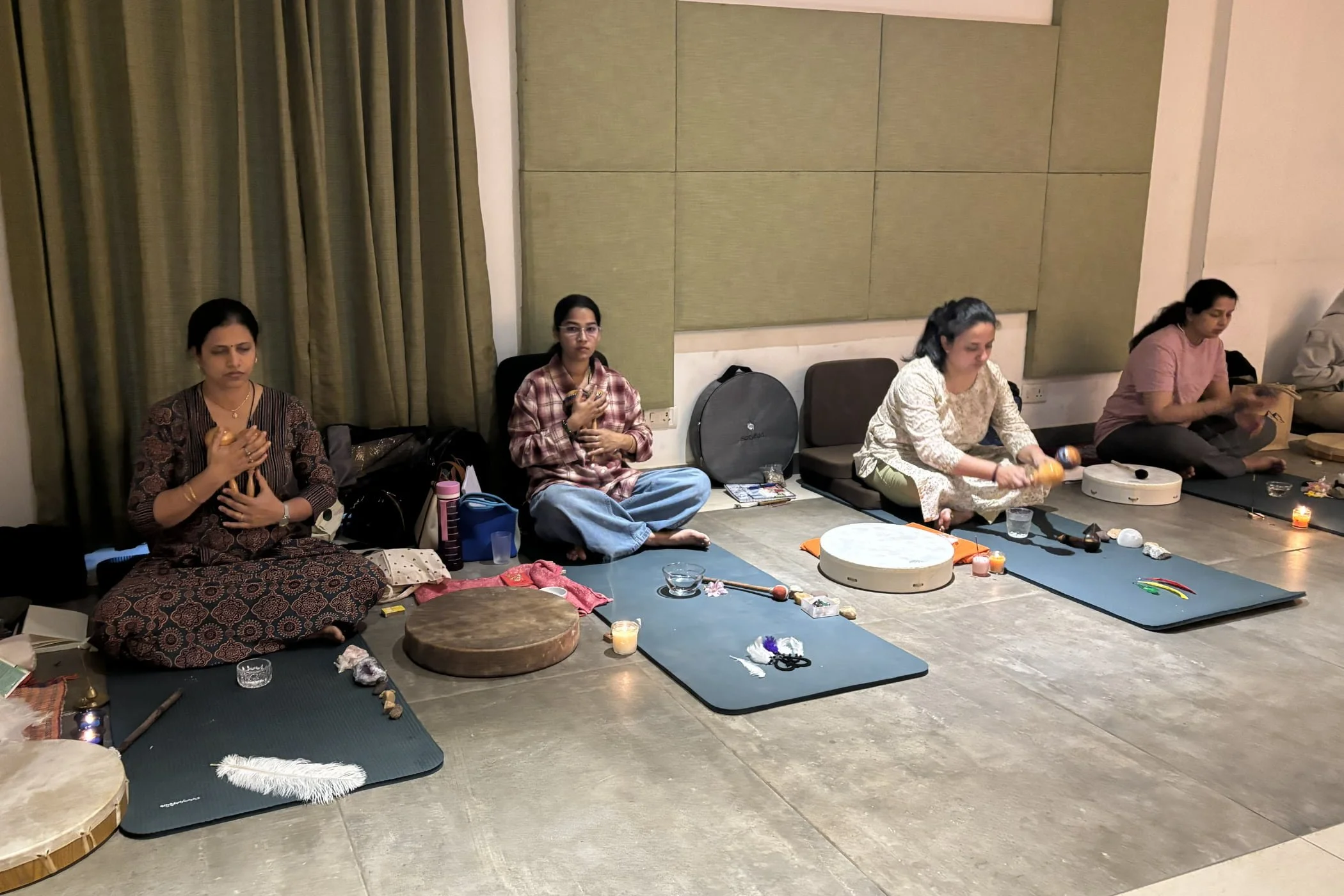
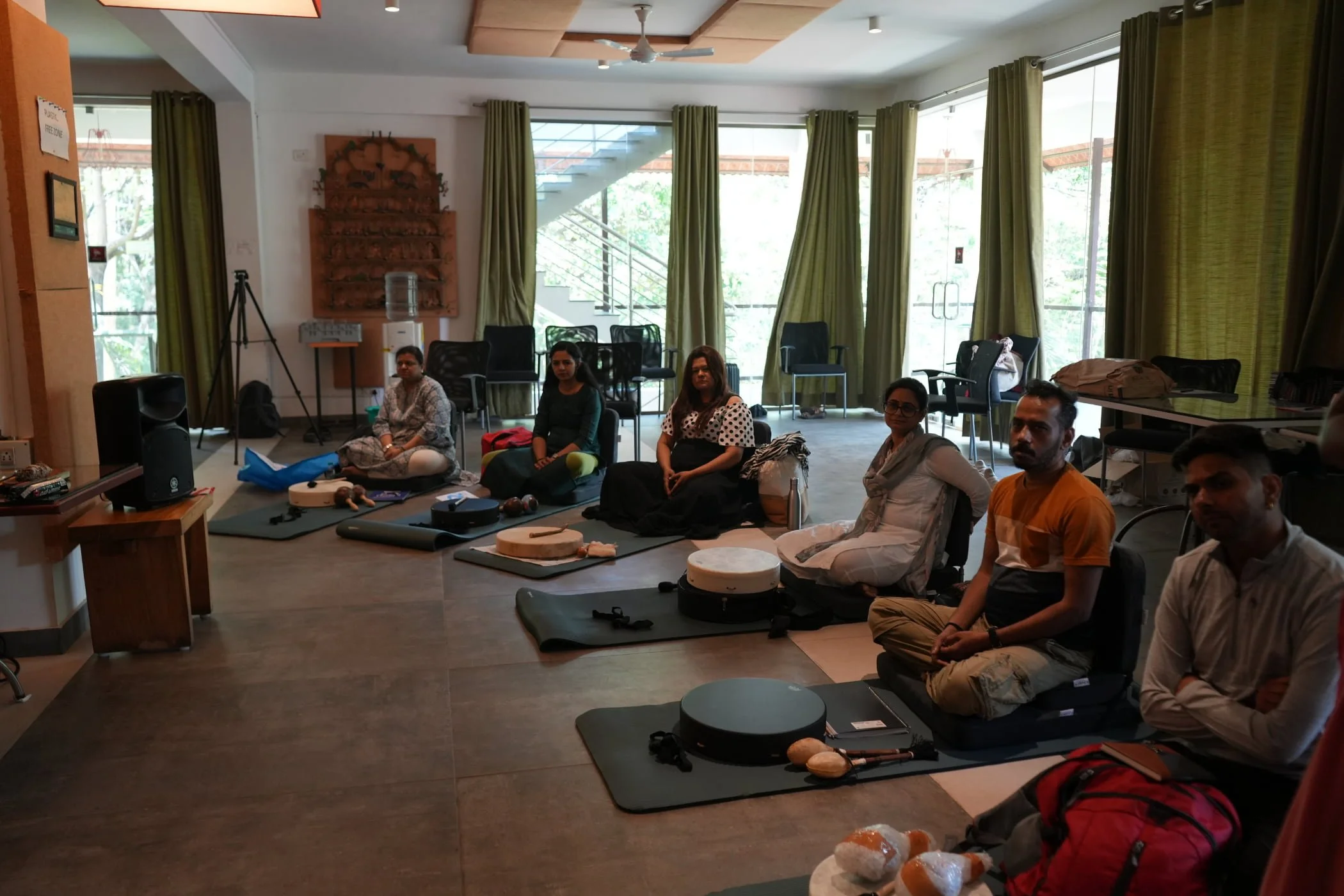
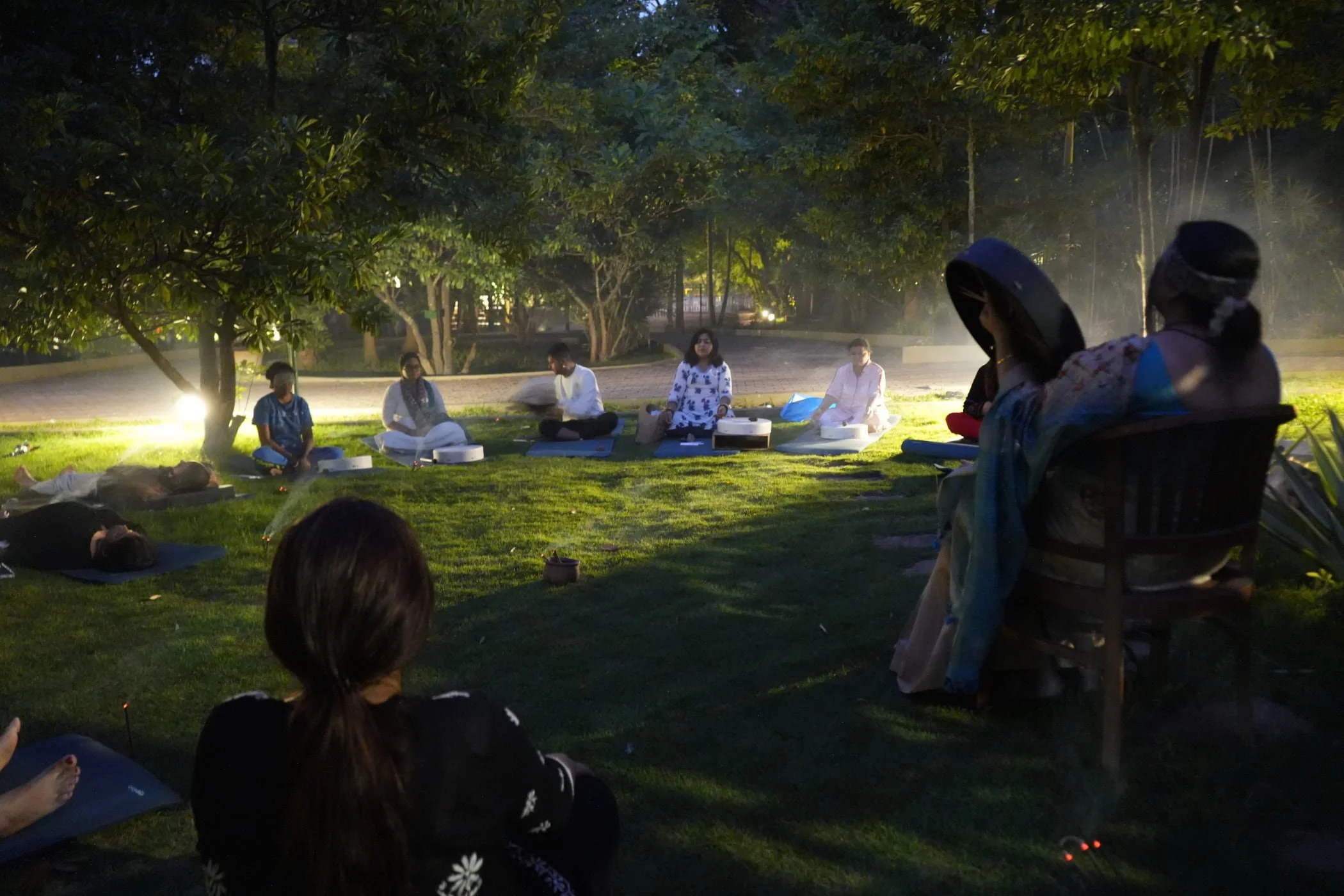
Are you already practicing Shamanism, and want to advance your practical skills and learn from Dr Rashhi Sharma? If yes…
Curriculum Overview
What You Will Learn
This training is not limited to techniques or isolated practices.
It is a multi-layered learning process, where you develop the ability to work with consciousness, energy, nature, and the unseen dimensions — through direct experience, guided practice, and repeated integration.
Each level introduces new dimensions of the work, while deepening your ability to perceive, interpret, and apply what you experience.
Foundation: Entering the Shamanic Path
At the foundational level, you begin by understanding the core structure of shamanic practice — not intellectually, but through direct experience.
You learn to:
- Enter non-ordinary states through step-by-step guided shamanic journeying
- Understand the structure of shamanic reality — lower, middle, and upper worlds
- Connect with power animals and begin working with their energy for healing and guidance
- Establish relationships with spirit allies and supportive intelligences
- Develop sensitivity to nature, elements, and energetic environments
- Begin working with shamanic divination and intuitive perception
- Explore dreamwork and symbolic communication
- Understand the medicine wheel and its application in life
- Participate in community-based healing and group processes
At this stage, the focus is not mastery —
it is stability, safety, and connection.
Expansion: Deepening Healing Work
Once the foundation is stable, the work begins to deepen.
You move from personal experience into active healing processes.
You learn to:
- Perform shamanic extraction and energy clearing practices
- Understand how shamanic tradition works with energetic intrusions and disturbances
- Begin structured work in soul retrieval processes
- Engage with psychopomp work, supporting transition and death-related processes
- Practices for energetic boundaries and self-care
- Traditional practices for clearing and energetic hygiene
- Work with fear, especially around death and transition
- Participate in rituals for the departed and support for grieving systems
- Explore stellar realms, celestial connections, and expanded consciousness frameworks
- Establish deeper communication with non-physical intelligences
At this stage, you are no longer just exploring —
you are beginning to work with responsibility.
Advanced: Multi-Dimensional Practice
At the advanced level, the work expands beyond technique into depth, structure, and integration across traditions and dimensions.
You learn to:
- Work with ancestral dimensions and inherited patterns
- Conduct rituals and ceremonial processes with deeper understanding
- Integrate practices from multiple shamanic traditions, including Andean, African, Quechuan, and others
- Engage in advanced healing work, including energy extraction, soul retrieval, ancestral work, and working with generational patterns
- Perform land and space clearing
- Work with elemental forces, including mountains, rivers, trees, and natural systems
- Develop astral perception and spirit communication clarity
- Learn fire rituals, divination methods, and directional invocation
- Strengthen connection with multiple spirit allies for guidance and support
- Begin creating your own medicine tools and energetic anchors
At this stage, the focus shifts from “learning techniques” to
understanding the nature of the work itself.
Practitioner: Application & Responsibility
This is where the work becomes real.
You move from learning and practice into application, responsibility, and integration into life and work with others.
You learn to:
- Establish clear energetic boundaries and safeguards
- Work with complex emotional, ancestral, and multidimensional patterns
- Work with familial and inherited patterns through structured processes
- Work with plant spirits and natural intelligence systems
- Engage in deep healing practices across timelines, including past, present, and future
- Understand multidimensional realities and shifting states of perception
- Apply recapitulation processes as taught in shamanic tradition
- Support individuals through life transitions, identity shifts, and healing journeys
- Develop your ability to hold space for others responsibly
- Work with future self guidance and expanded awareness frameworks
At this stage, the question is no longer “how to do the work” —
it is how to carry it responsibly.
Important Note
Not every concept is taught as information.
Many aspects of this work are understood only through direct experience, which is why the training is designed as practice-based and immersive, not theoretical.
Bottom Line
You are not being taught a set of techniques.
You are being guided to develop the ability to perceive, navigate, and work with realities that cannot be understood through logic alone — but must be experienced, stabilized, and lived.
What You Are Committing To
The Shape of the Five Days
These are long days. We say so plainly, because the people this training suits are the ones who want to know that in advance.
Practice begins before breakfast and the group is with Dr. Rashhi through the day. Evenings are yours to rest, and the night carries its own practice. Sixty hours across five days is not a figure we have stretched — it is what the days actually contain.
What follows is the rhythm of a day and the arc of the work. What you will not find is an hour-by-hour agenda, and the reason for that is worth reading.
A Day, From Beginning to End
This is the rhythm of days two through four. Days one and five differ — see below.
Individual practice begins
You start alone, before the day has filled up. This is where personal practice is built, and it is counted in your hours.
Breakfast
Served from 8:15, in the dining area.
Into the hall with Dr. Rashhi
The group gathers and the day's work begins. From here you are guided and supervised directly — twelve people, one trainer, all day.
Lunch
A pause between two and three. Then back to the hall.
The day's guided work closes
Dr. Rashhi leaves between six and six-thirty. The evening that follows is yours — to rest, to walk, to talk with the others, to let the day settle.
Dinner
Late, deliberately. Nobody is rushing anywhere afterwards.
Night practice, and the routine before sleep
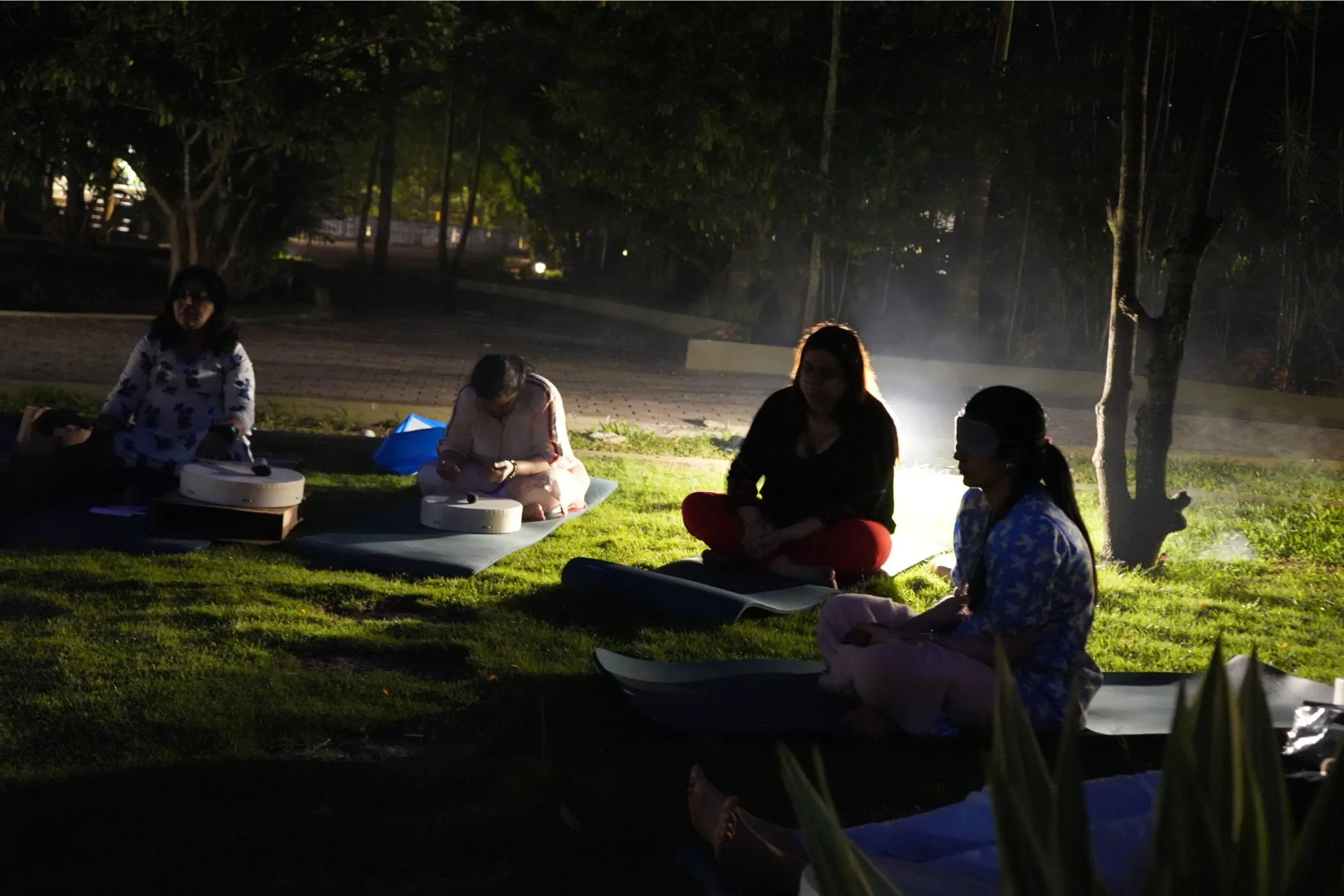
Practice continues into the night — on some nights until around eleven — and there is a routine to follow before sleeping. In this tradition the night is not time off from the training. It is part of it.
Day one begins at 11:00 am, so that those travelling in on the morning of the 25th can arrive, settle and still start with everyone else. It runs through to six.
Day five closes at 6:00 pm and everyone leaves together. Please do not book travel that requires you to leave earlier — the closing of a programme like this matters as much as its opening, and certification requires the full five days.
Why We Do Not Publish an Hour-by-Hour Agenda
Because there isn't one.
Dr. Rashhi does not teach to a clock in any Soul Consciousness Lab® programme — not in shamanism, not in Past Life Regression, not in mediumship or QSR™. There is no schedule saying this method by eleven, the next by one.
The theory in these trainings is close to zero. Nothing is taught as a concept to be understood and moved past. Every method is entered, experienced, discussed, and entered again — and the group does not move on until every person in the room can do it.
Not until most of the group is comfortable. Not until the confident ones have it. Until the last student says they have understood.
This is a safety standard before it is a teaching preference. A practitioner who half-learned a method will one day use it on a client. Dr. Rashhi wants to have watched you do the work in front of her — entering safely, returning safely, understanding what happened — before you are taken anywhere further.
Which means the shape of the week genuinely changes from batch to batch. Every group has its own energy. One batch moves quickly through journeying and needs two days on something another group absorbs in an afternoon. That is not a scheduling failure. It is the method working as intended, and it is the difference between a training you attended and a training you can practise from.
We have seen programmes elsewhere run to a curriculum: complete the journey, brief discussion, next topic, on to the close. That is not how this is taught, and it is not what you are paying for.
In This Room, Everybody Speaks
Dr. Rashhi has trained with teachers across several countries, and she describes herself as an introvert. Opening up in a group did not come naturally to her, and she found it hard to say aloud what she had experienced.
She also noticed what happens in most training rooms. The teacher asks who would like to share. The same few speak. The quiet ones sit through an entire programme without once opening their mouth — often confused, often holding a question they never ask — and the teacher does not look their way.
Everyone shares. Nobody stays silent.
This is a rule here, and it exists because she was that person in the room.
Sharing matters because assumption is the real danger in this work. You can learn a great deal from what others experienced — but what matters most is what happened to you, in your own journey, and whether what you did was sound. That cannot be assessed if you never say it.
So each person speaks, and Dr. Rashhi listens — patiently, without hurry. Where something needs correcting, she corrects it there and then. Where it was well done, you hear that too, and you know to keep going.
Discussion is not timed. It runs as long as the questions run. She will not close a subject because a clock says so — though she may say honestly that a topic needs more room than five days allow, and that it will be given more at the next level.
Nothing Is Left Unresolved
Dr. Rashhi does not set an exercise and step away. She stays with the group throughout, and every practice is followed by discussion before anything else begins.
That matters because this work asks for energy and patience, and there are stretches where you genuinely cannot tell whether what you are doing is right. If something did not go as expected, or you lost your way partway through, you say so and it is worked through then — while it is still fresh, and while the group is still in it.
A difficulty is addressed on the day it happens, not carried home and left open until the next level.
Nobody here is left to work it out alone.
The Arc of the Work
The work moves through five movements, in this order — nothing later is possible without what came before it. Where each one falls across the five days depends on the group.
Arrival & Grounding
Opening the Journey
Working With Spirit
Nature & Ceremony
Integration & Return
What happens inside those hours is taught in the room. We publish the shape of the days so that you know exactly what you are committing to. The practices themselves are learned through direct experience, in sequence, with supervision, and at the pace the group needs — which is precisely what a timetable cannot carry, and the reason this training is residential rather than written down.
If that is the kind of training you have been looking for
25 – 29 September 2026 · Bangalore · 12 places · applications close 15 September
Each Step Guided. Each Process Monitored. Safety and Integrety. Learn under Direct Guidance.
Readiness & Alignment
Who This Training Is For — and Who Should Not Join
This Training Is For You If
This training is designed for people who feel a genuine calling toward deeper work — not curiosity alone, but a willingness to engage sincerely.
- You are on a spiritual path and want a deeper connection with nature, consciousness, and the unseen
- You are a healer, therapist, hypnotherapist or energy practitioner looking to expand into shamanic work
- You are a coach, counsellor or facilitator wanting to bring spiritual dimensions into your practice
- You are seeking personal healing, clarity, grounding and inner alignment
- You are drawn to working with spirit allies, ancestral work and nature-based practice
- You want a structured, step-by-step pathway rather than fragmented learning
No prior experience is needed. What is needed is openness, sincerity, and a willingness to practise.
This Training Is Not For You If
To protect the depth and safety of the group, this training is not suitable if you are looking for:
- Quick fixes or instant results
- A casual workshop, retreat or “spiritual experience”
- Passive learning — here, everyone practises and everyone speaks
- Power, control or abilities without responsibility
- Trend-based or commercialised spirituality
- A way to avoid deep self-exploration or emotional work
- Training without group processes, ritual or shared learning
- Learning without consistent practice and integration
- Holding sensitive spaces without ethical boundaries or responsibility
Talk to Us First If
Immersive work can intensify what a person is already carrying, and there are moments in a life when depth is not what someone needs. None of the following rules you out — but please tell us at the point of applying so we can talk it through honestly.
- You are currently in acute emotional or mental-health crisis
- You are receiving psychiatric or psychological treatment
- You have experienced psychosis, mania or a dissociative condition
- You have had a recent bereavement or major life shock
- You have a history of seizures or a neurological condition
- You are recovering from serious illness or surgery
- You are taking medication that affects alertness or sleep
- Anything about long days and short nights concerns you
We will discuss it with you properly, and where it is right we may suggest a later batch. That is not a rejection — the work will still be here, and you will get far more from it at the right moment.
Health disclosure is required at enrolment. This is set out in our Training Terms & Conditions, and nothing you tell us goes further than the people who need to know it.
Participants must be 18 or over.
What the Work Involves
So that nothing comes as a surprise, shamanic training can involve:
- Meeting deep emotional patterns and unresolved experiences
- Working with altered states of consciousness
- Engaging with symbolic, energetic and non-linear processes
- Taking part in group ritual, journeys and shared practice
- Long days, early mornings and practice continuing into the night
Participants should be able to take part in immersive practice, open to supervised learning, and willing to approach the work with respect and ethical awareness.
This training is not for everyone — and that is intentional.
It is for those ready to step into the work with sincerity, responsibility and respect.
Where You Will Stay
Five Days Away From Everything Else
The training is held at Discovery Village, Kanakapura — a resort set in open country south of Bangalore, away from traffic, signal and the pull of ordinary routine.
The venue matters more than it might seem. This work asks for sustained attention across five days, and that is only possible when nobody is commuting, checking messages, or returning to a household each evening. You arrive, and for five days there is nowhere else to be.
Everything happens on site: sessions, meals, rest, and the practice that continues into the evening and the early morning.
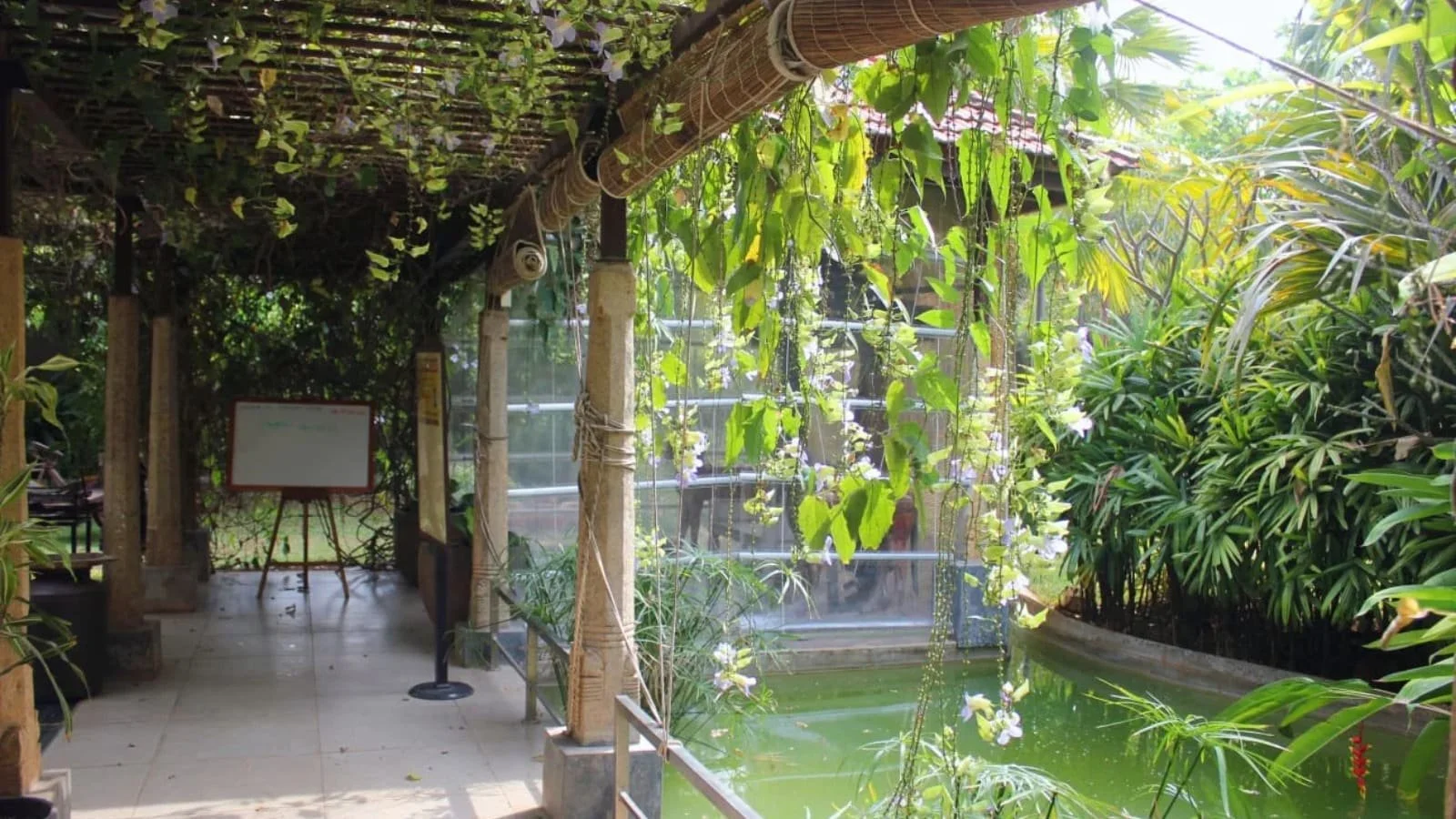
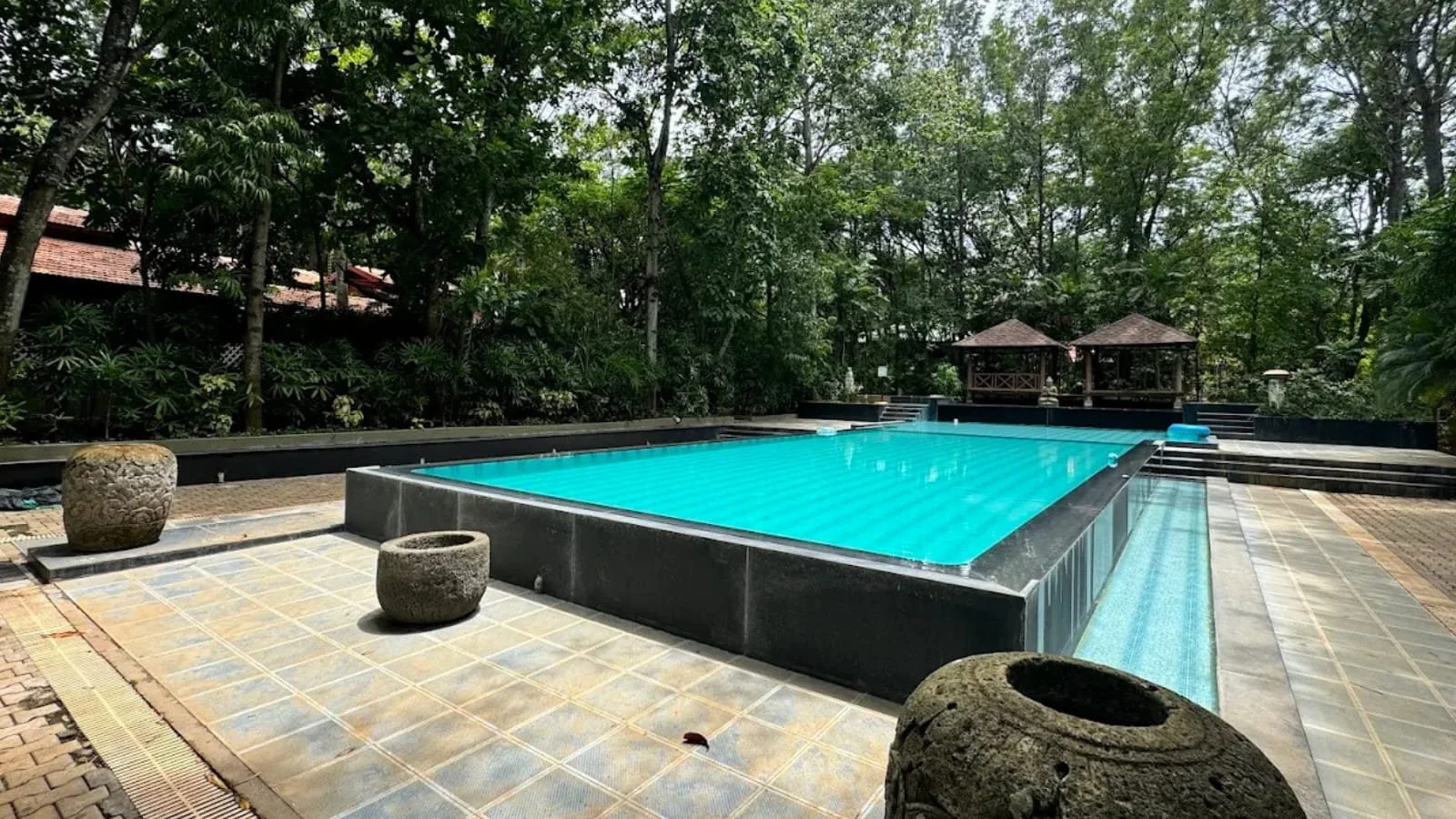
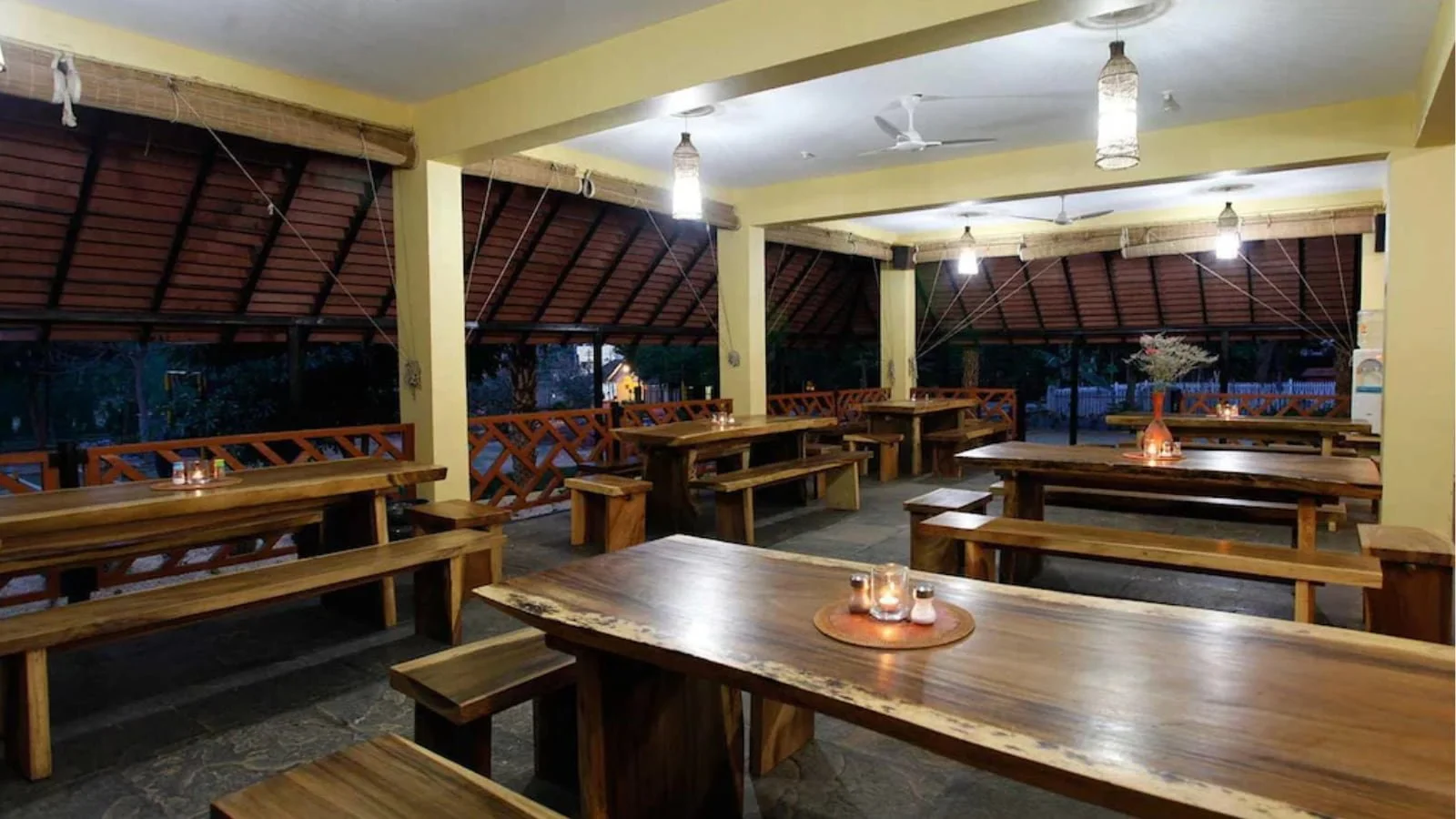
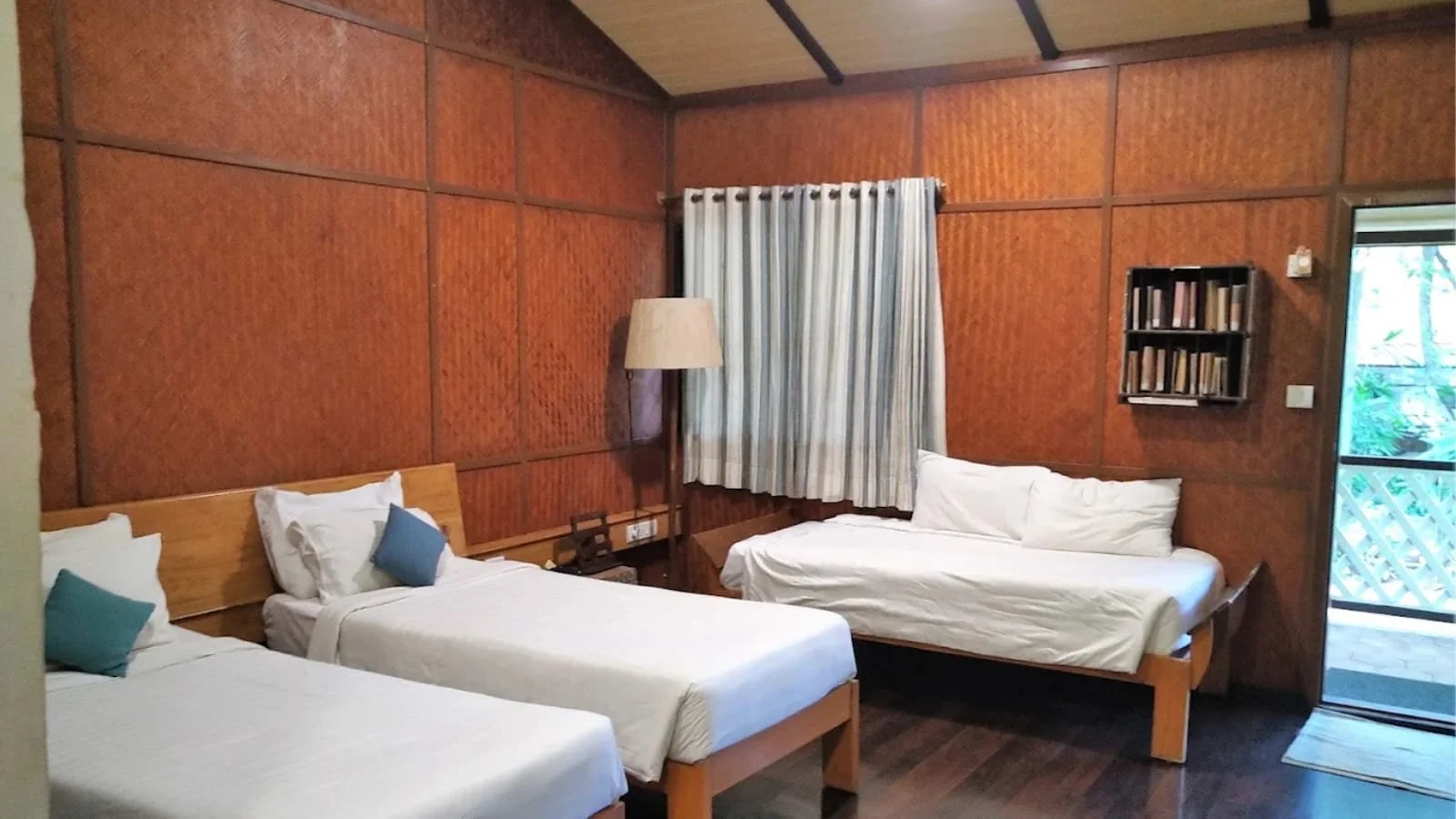
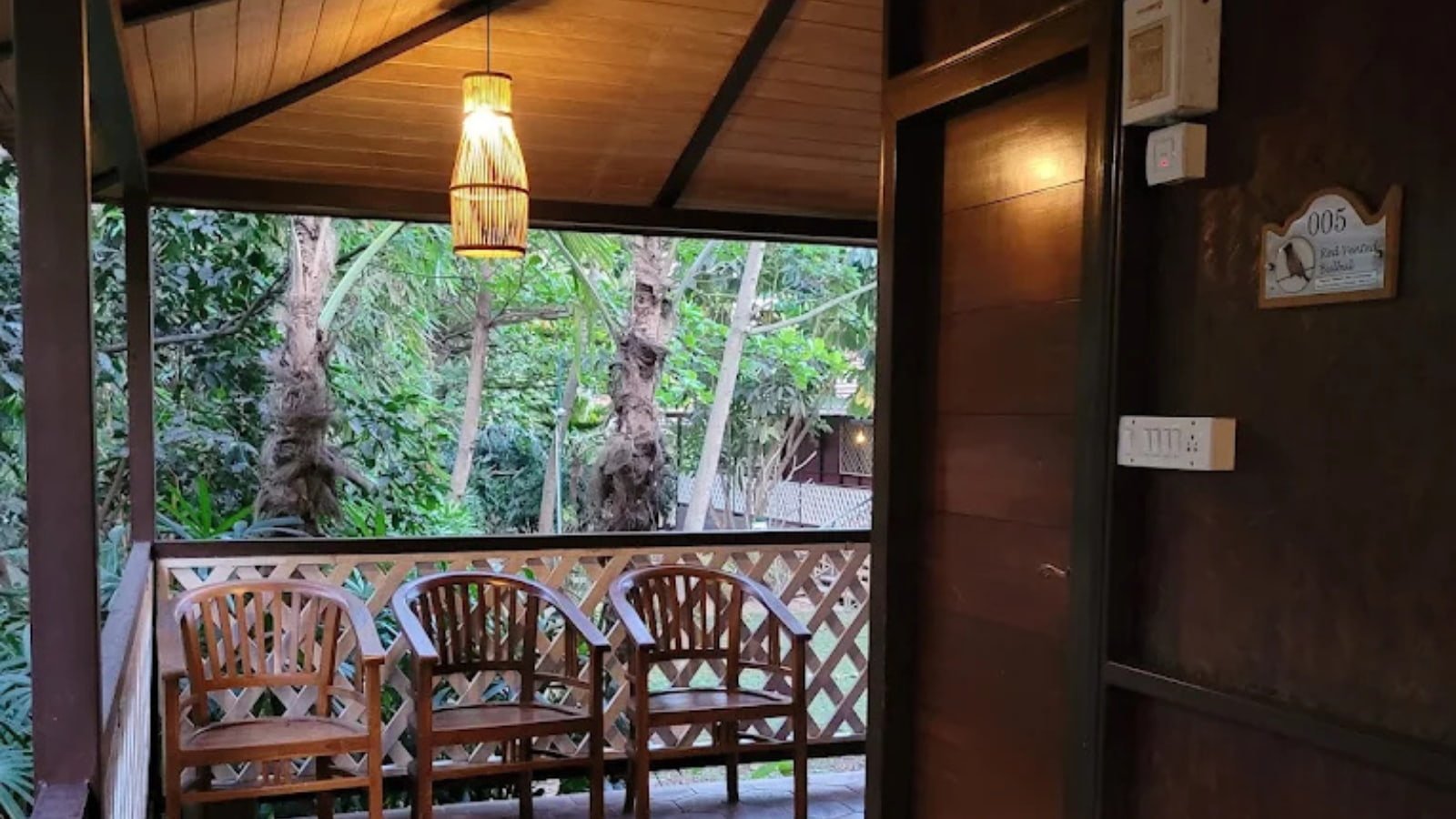
The Grounds
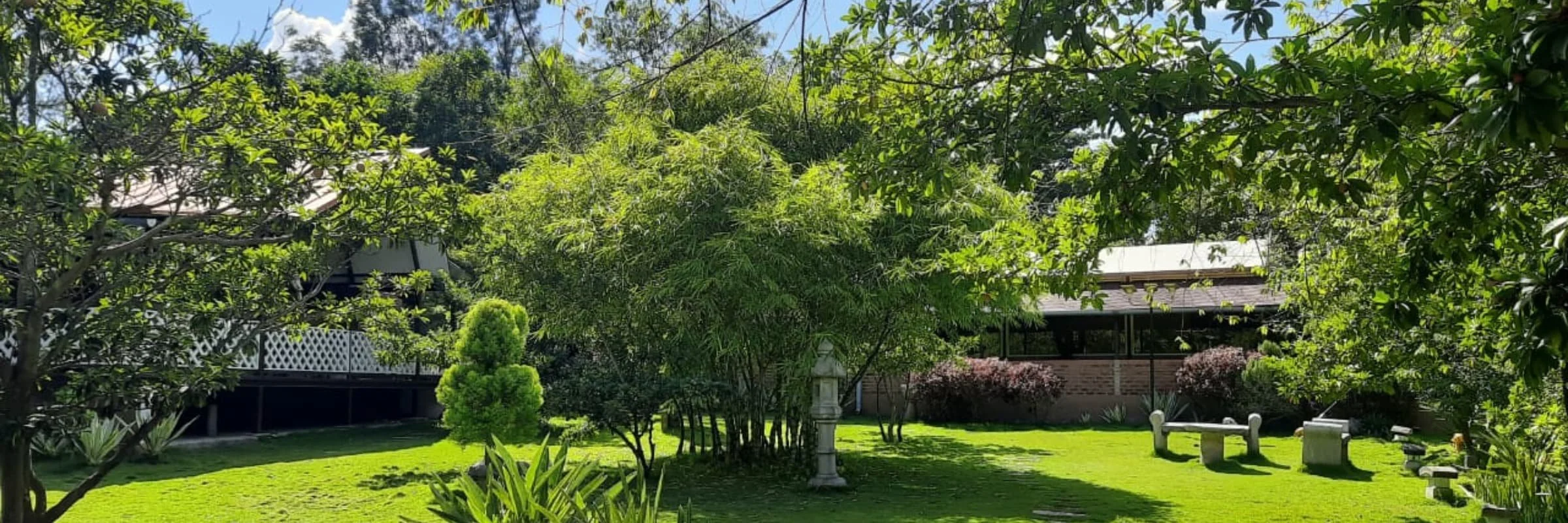
The resort sits in mature, planted land — the setting is as much a part of this training as the sessions held within it.
- Over 100 species of plants and trees across the property
- Chikoo orchards, bearing fruit
- A large pond and a fish pond
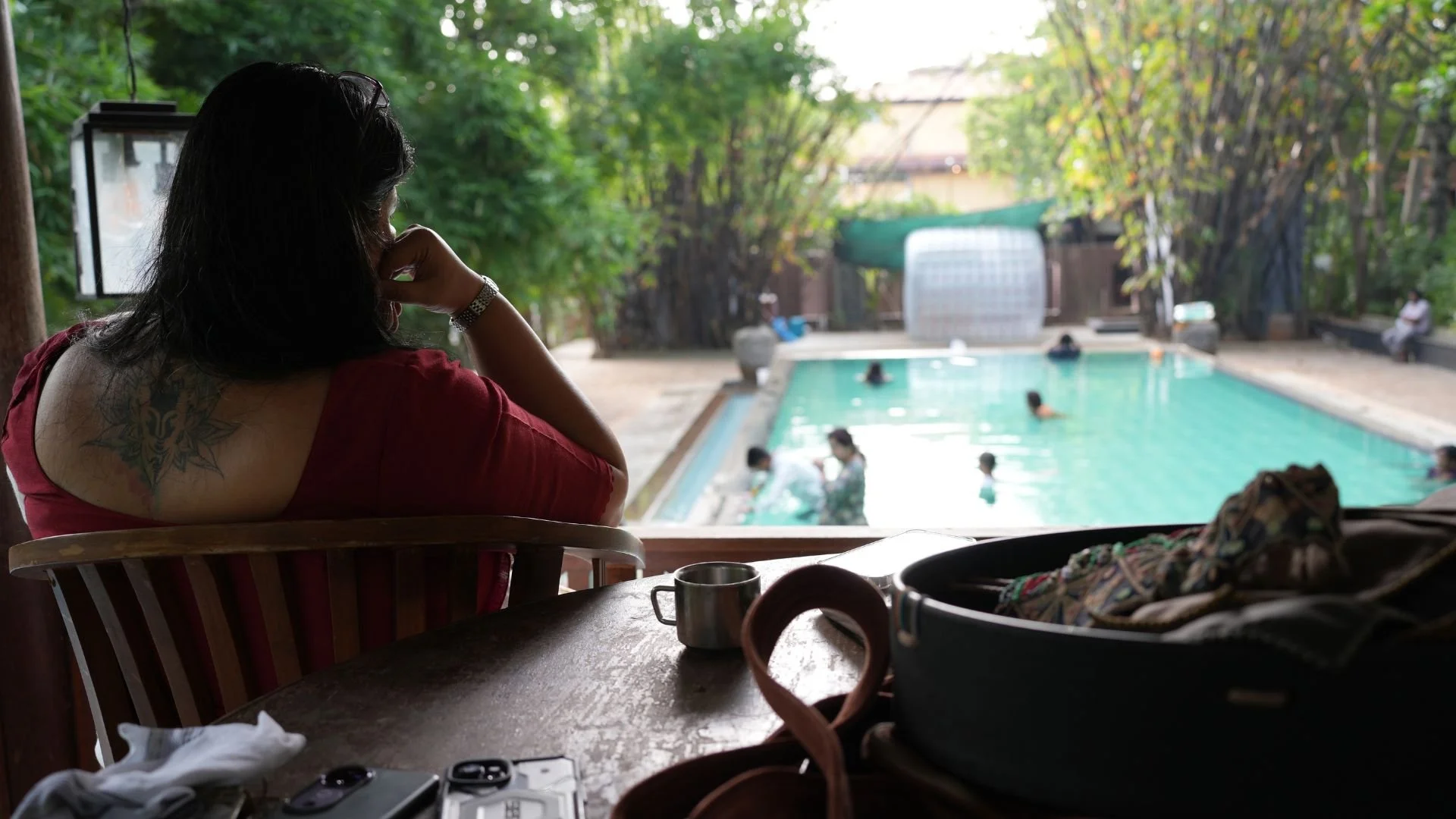
- Two swimming pools, large and small
- An outdoor amphitheatre
- Fourteen cottage villas
- Open grounds, including cricket and badminton
The resort offers adventure and leisure activities to its guests. These are not part of the training programme, and the days are full — but the grounds are yours to walk in, and many participants find the early mornings among the trees are where a good deal of the work settles.
Getting There
Discovery Village, Kanakapura
Kanakapura Main Road, near Nandi Institute of Technology,
Vadarahalli, Karnataka 562112
Open in Google Maps →
70 km. Around 1½ hours late at night when the roads are clear; allow 2 to 2½ hours at peak times. The route crosses the city from north to south.
35 km from KSR Bengaluru City Railway Station (Majestic) · around 1 hour by taxi via Kanakapura Main Road and NH 948.
If you wish to arrive on the evening of 24 September, that can be arranged. The additional night is payable separately and is not included in the programme fee.
Plan your travel to arrive in good time on 25 September. The programme opens on the first afternoon and late arrival means missing the grounding that everything afterwards is built on. Tell us your arrival details once your place is confirmed and we will help you plan the last stretch.
Travel to and from Bangalore is not included in the fee. Please book refundable tickets where you can — our Training Terms explain why.
Pets are not permitted on the premises. Discovery Village is independently owned and is not operated by Soul Consciousness Lab®. We choose our venues carefully, but the resort's own facilities, rules and policies are its own.
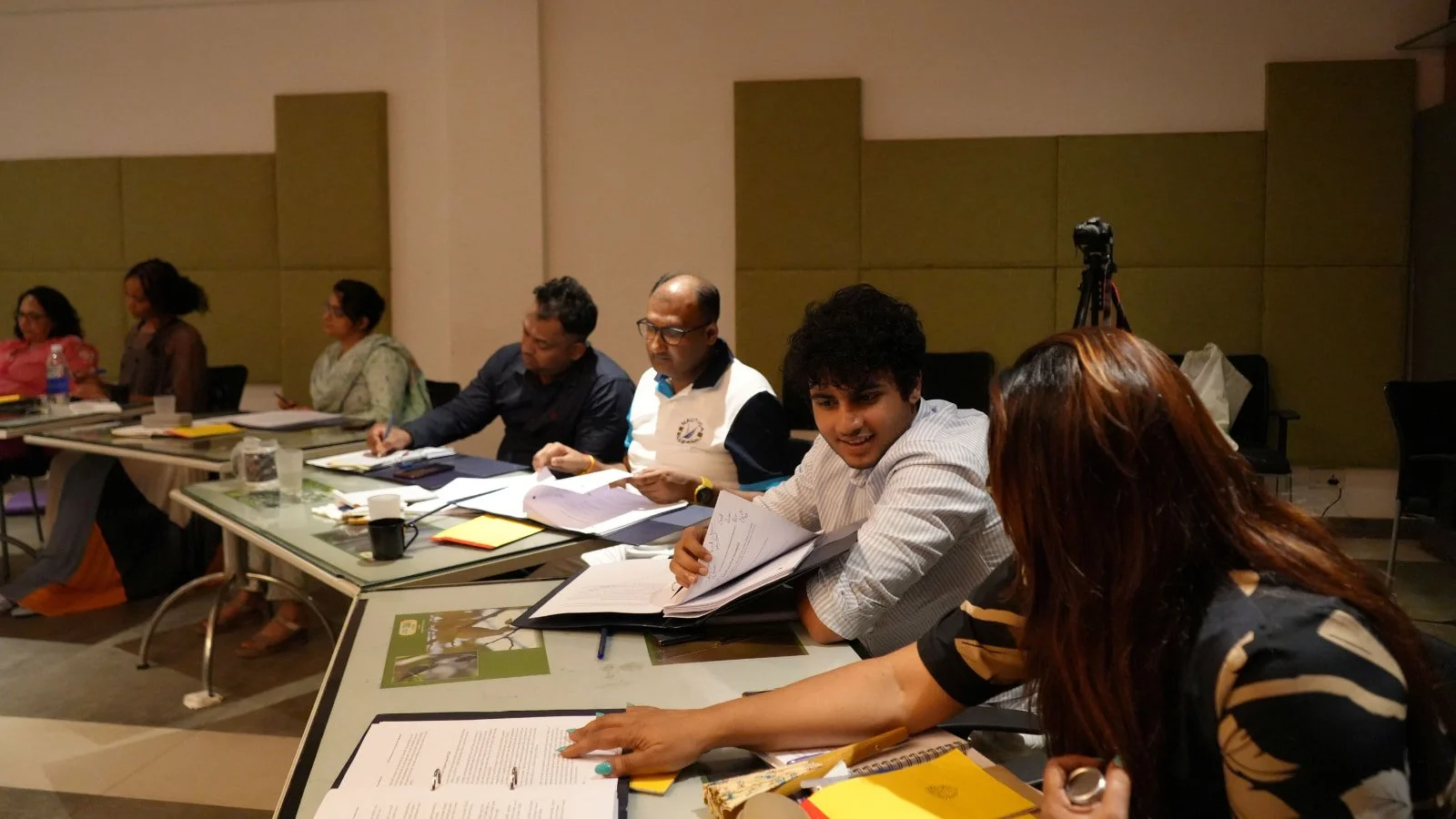
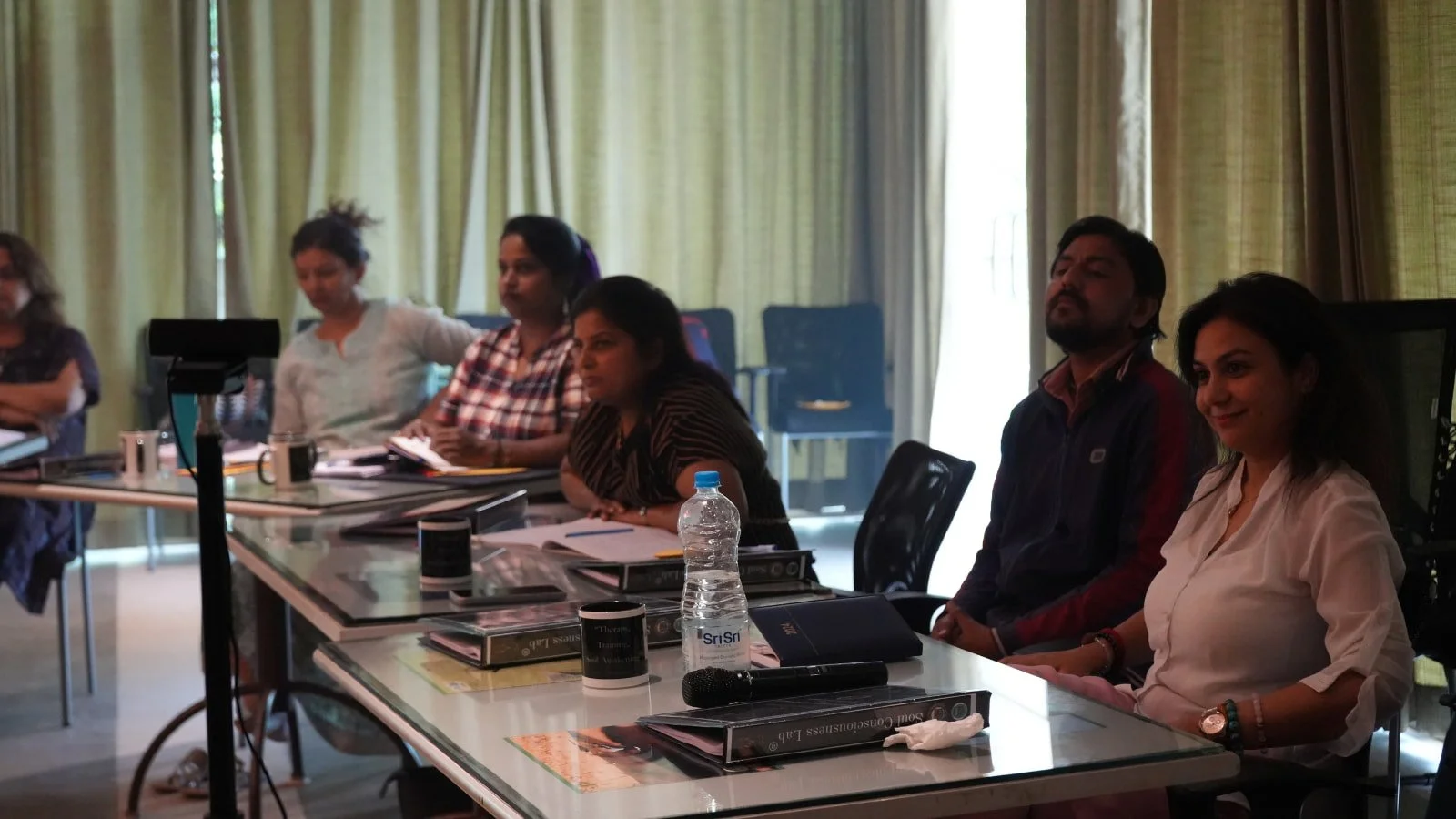
The Nights Are Part of the Training
In most courses, the day ends and you go to your room. Here, the night is taught.
Dreams matter in shamanic tradition, and Dr. Rashhi teaches participants to carry awareness into sleep rather than surrendering it — how to set intention before the night, how to hold what comes, and how to bring it back. The dream work and the discussion that follows it are part of the programme, and they are counted in the certified hours.
This is also why there are no televisions at this venue. It is not an oversight or a shortcoming; it is why the venue was chosen. A television is an invitation to leave — to step out of the state the day has built and back into ordinary distraction, in exactly the hour before sleep when it matters most.
For five days, what surrounds you is trees, water, open ground and the group you are working with. That is what a residential programme is for, and it is the part that cannot be replicated anywhere else.
A Room That Has Been Held for Over Ten Years
This is not a hall booked for the week. Soul Consciousness Lab® has taught at this venue for more than a decade — and not only shamanism.
Past Life Regression, clinical hypnotherapy, Out-of-Body Experience, the Monroe Institute programmes, QSR™ and mediumship training have all been held in the same space. Every one of them opens with meditation, often more than once a day: simple stillness, and the deeper work of calling guides, teachers and helping presences.
Ten years of that, in one room.
Participants frequently remark on the room itself. Several have said on camera that they settled into states of meditation here within minutes — states that had previously taken them considerably longer to reach elsewhere.
This is what participants have described of their own experience. It varies between individuals, and no particular experience is promised or guaranteed.
In shamanic tradition, place holds what is done in it. We make no claim beyond that — only that this is a room we know well, that has held serious work for a long time, and that we return to deliberately rather than by convenience.
We Are Not the Only Ones Who Chose This Road
Kanakapura Road, running south out of Bangalore, has drawn a remarkable concentration of contemplative institutions — several of them among the largest in India.
The Art of Living International Center
The global headquarters of Sri Sri Ravi Shankar's foundation, established here in 1986, at the 21st kilometre.
Heartfulness CREST
The Shri Ram Chandra Mission's centre at Kaggalipura, on the same road.
Pyramid Valley International
One of the largest meditation pyramids in the world, further along the same stretch.
We have no association with any of these organisations, and we make no claim that proximity to them confers anything. But it is worth noticing: when institutions of that scale chose where to build, several independently chose this same corridor of land south of the city. Ours is a much smaller room on the same road, and we have taught in it for over a decade.
The Space
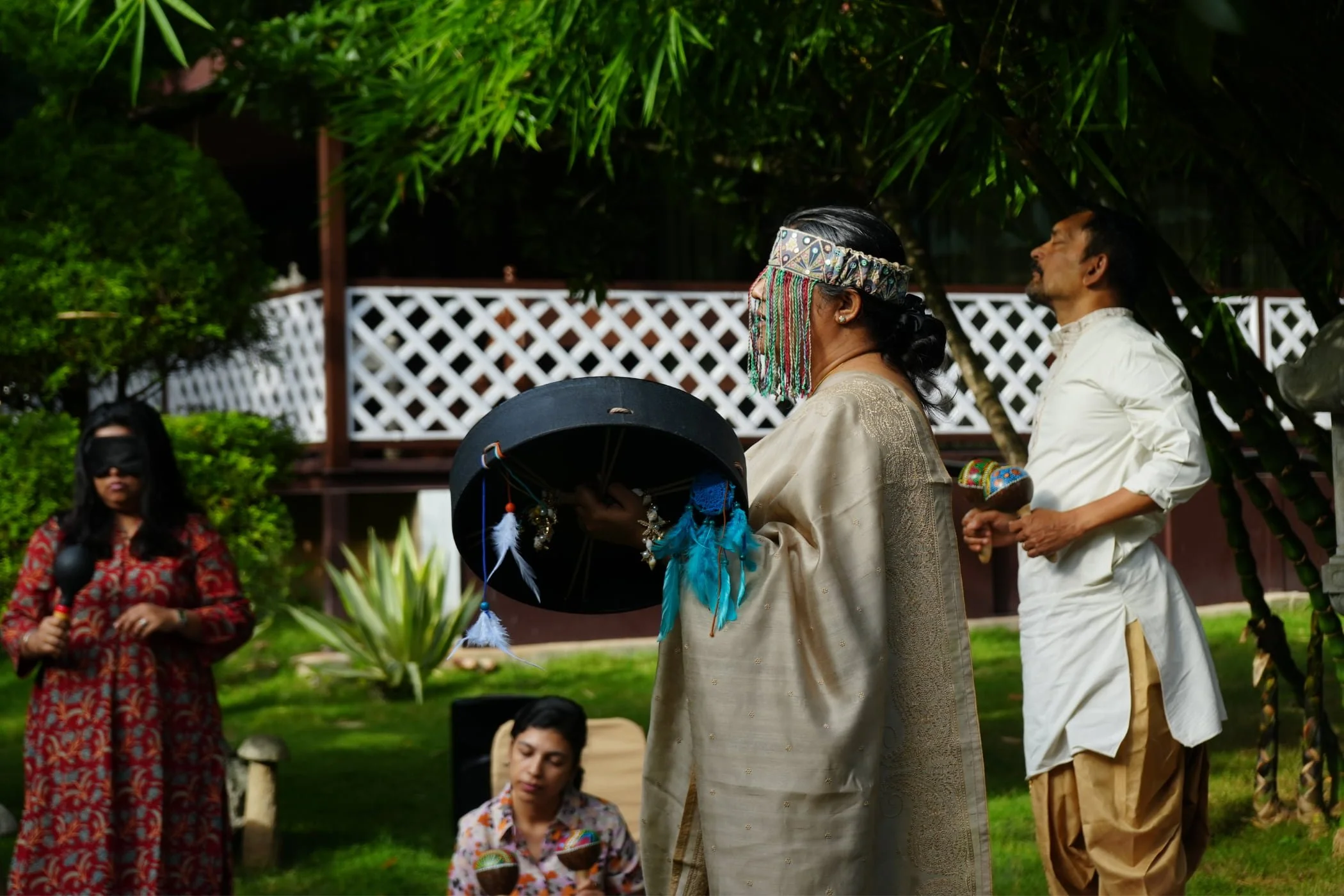
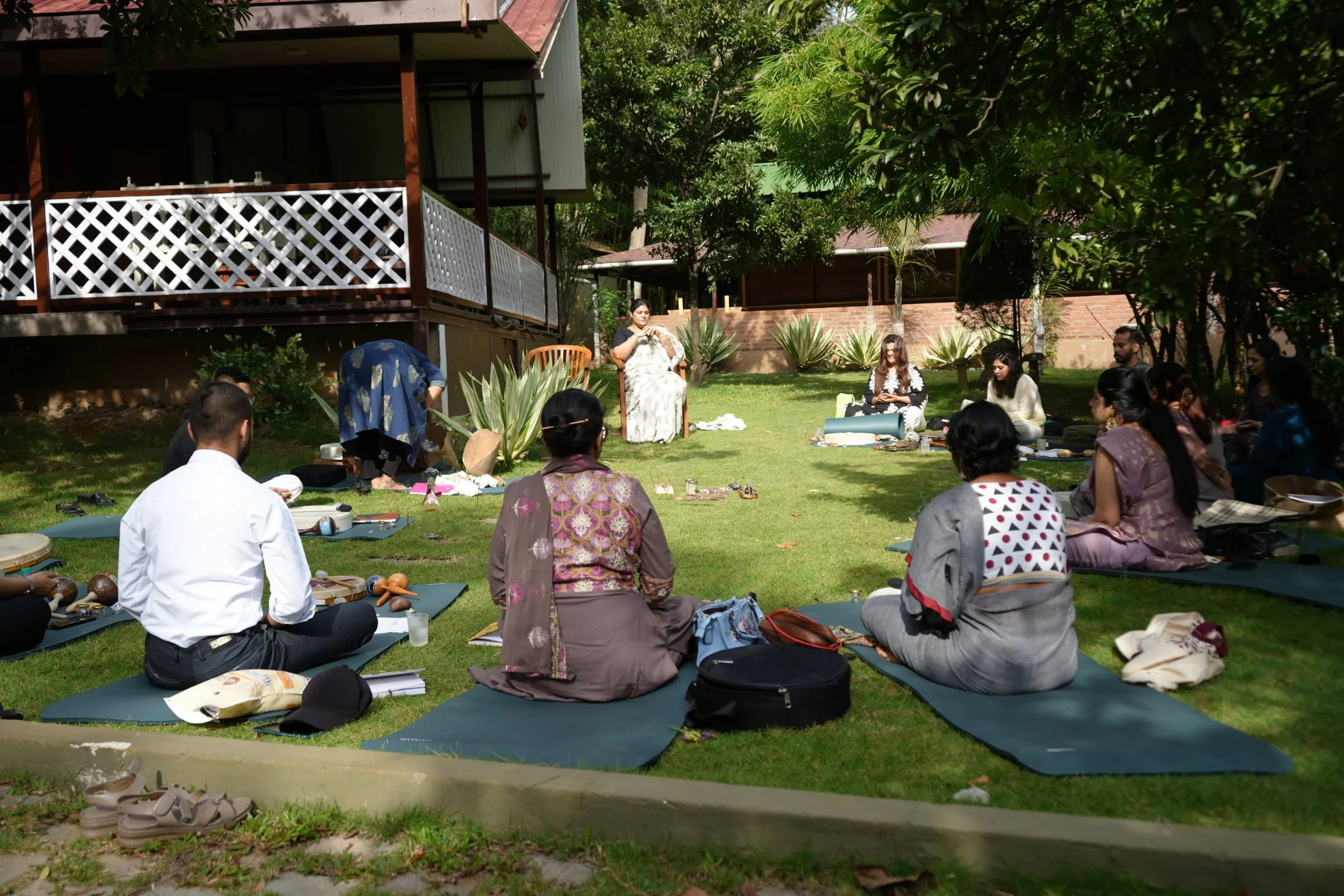
Sessions run both indoors and outside. Much of the work happens in the open — under trees, on open ground, in the early light.
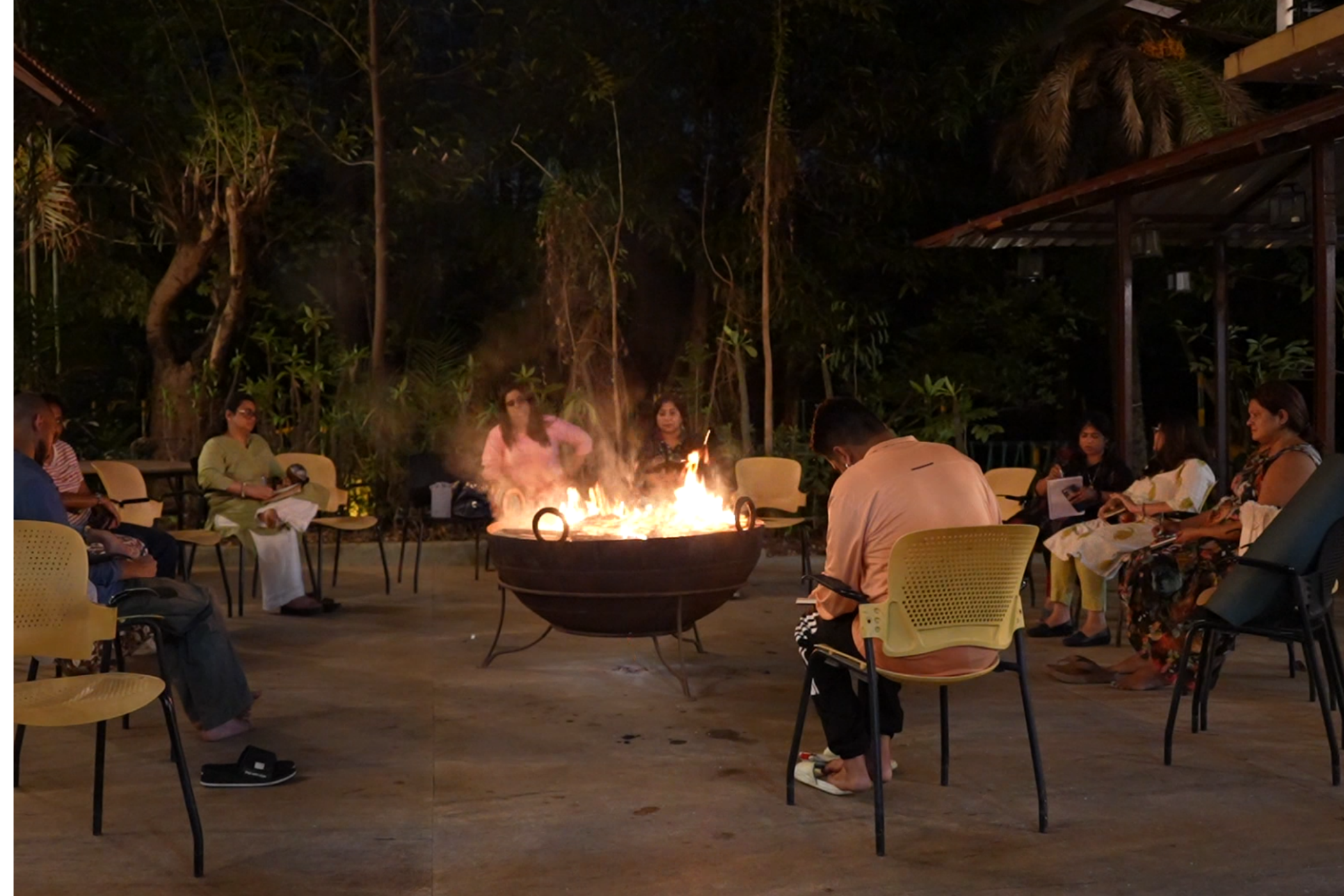
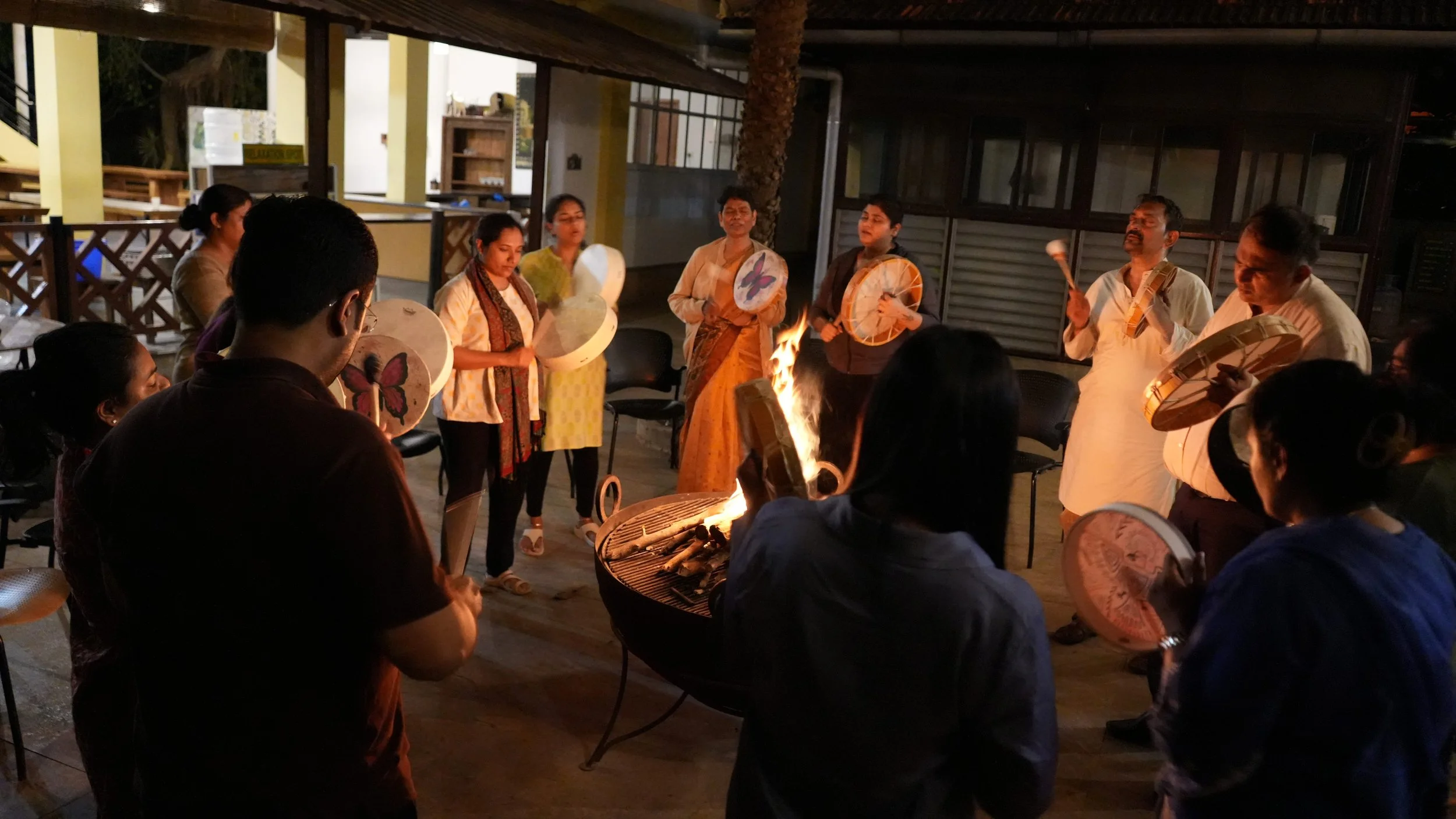
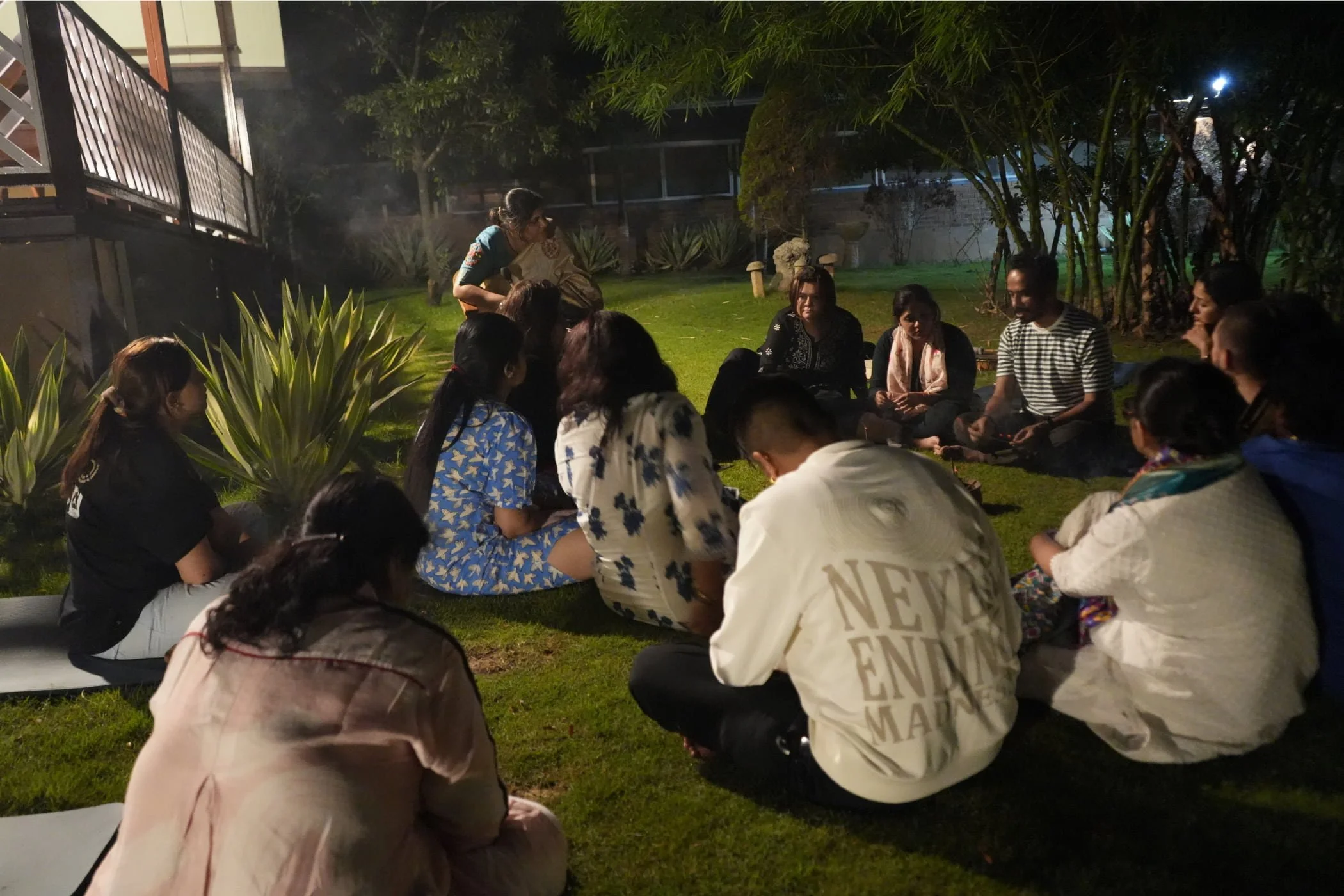
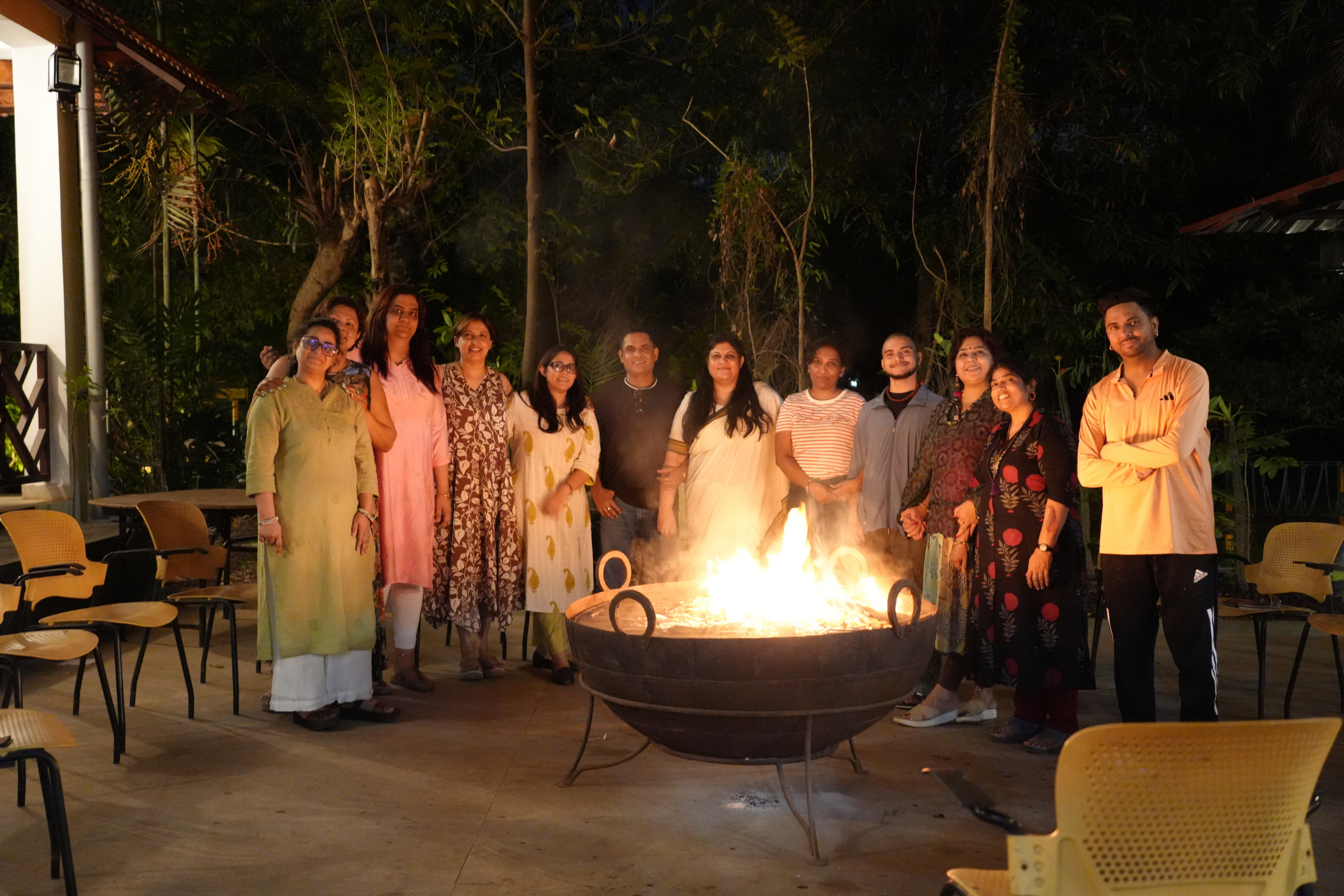
Evening circles gather around fire. This is not decoration; working outdoors is part of how the tradition is learned, and it is one of the reasons this training cannot be done online.
Your Room
Accommodation is on site for all four nights. Every room is the same — three single beds, an attached bathroom, and a small balcony — with housekeeping throughout your stay.
The only difference is how many people are in it. Twin sharing means you and one other participant, each with your own bed. Single occupancy means the room and balcony to yourself.
Sharing suits most participants; a good deal of what people take from these five days comes from the conversations between sessions. Single occupancy is there for those who need solitude to integrate.
The Food
Five meals a day, all cooked fresh in the resort's own kitchen — breakfast, mid-morning tea, a vegetarian and non-vegetarian buffet lunch, high tea with local snacks, and dinner.
Long days of practice need feeding properly, and food you have not had to think about is part of what makes five days of this possible.
Dietary requirements are arranged — tell us when you apply.
The Question We Are Asked Most
Why We Do Not Teach Shamanism Online
Shamanism is widely available online in India, often at a fraction of what a residential programme costs, and often promising advanced levels within weeks. People ask us, fairly: why not? And sometimes, less comfortably: is your trainer not able to?
It is a reasonable question and it deserves a straight answer rather than a defensive one.
We cannot speak for any other programme, and we will not try to. What we can do is explain what this particular training requires, and why those requirements cannot be met through a screen.
And to be fair about it: a screen is not useless. Someone can be introduced to journeying online. A first guided journey, a basic sense of the state, an idea of what the work is — all of that can travel. Our own graduates hold their weekly circle on Zoom.
The difficulty is everything after that. Soul retrieval, extraction, psychopomp, depossession and disentanglement, work in the middle world, divination with physical tools, ceremony, and the initiations that carry the practice — none of it is introductory, and none of it is learned by watching.
Level 1, Discovery Village. Sessions run indoors and out, from before breakfast into the night.
People do become ungrounded — and someone has to catch it
Shamanic practice means deliberately entering a non-ordinary state and deliberately leaving it. The leaving matters as much as the entering, and it does not always go smoothly.
We have seen participants come back ungrounded. It is not rare and it is not dramatic — but it needs a trainer who can see it in the room and bring the person back properly, in the moment.
The lower and upper worlds are relatively forgiving. The middle world is not. It is the most demanding of the three and the least suitable for anyone working without direct guidance and without having watched it demonstrated first.
You watch it done, then you do it on each other
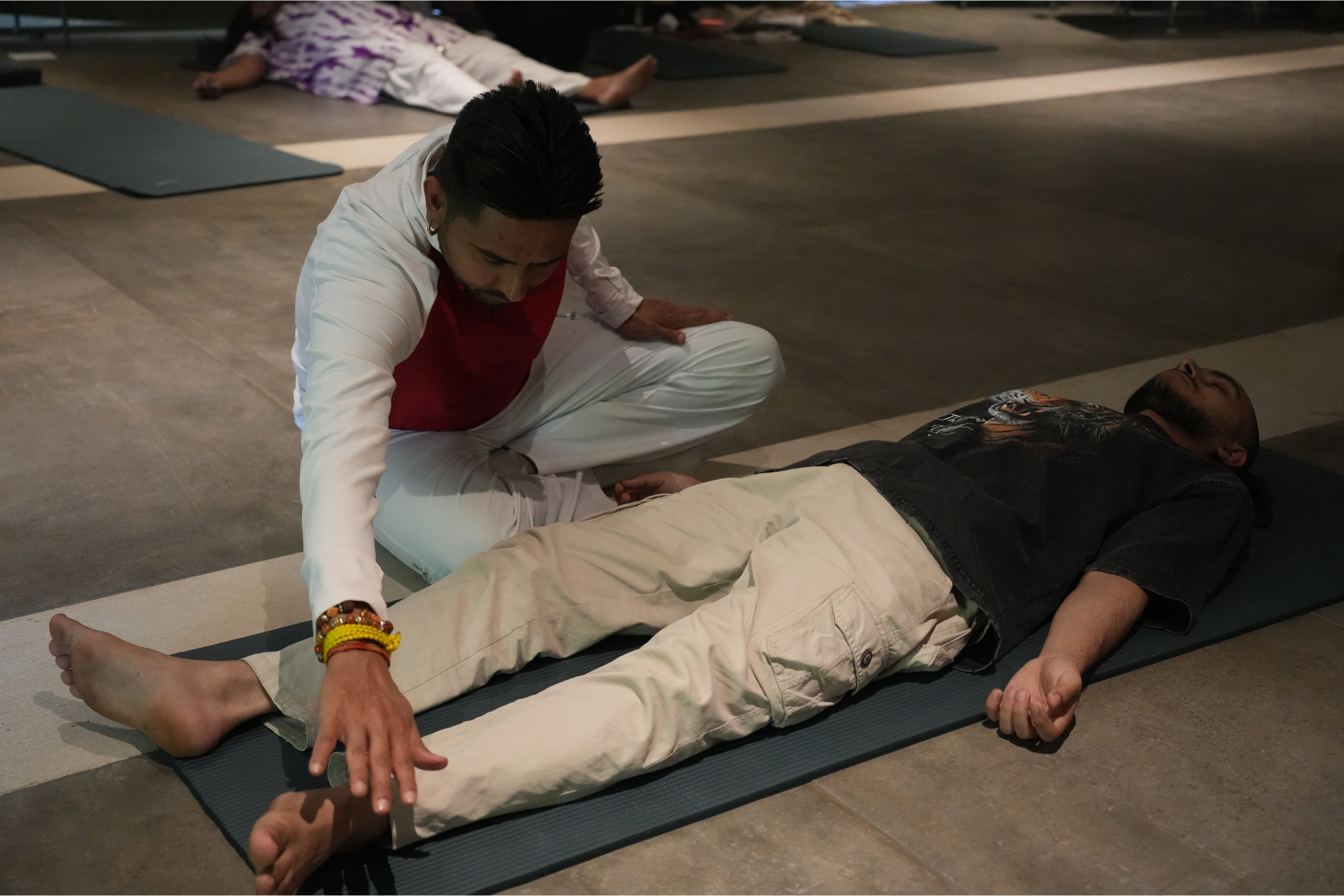
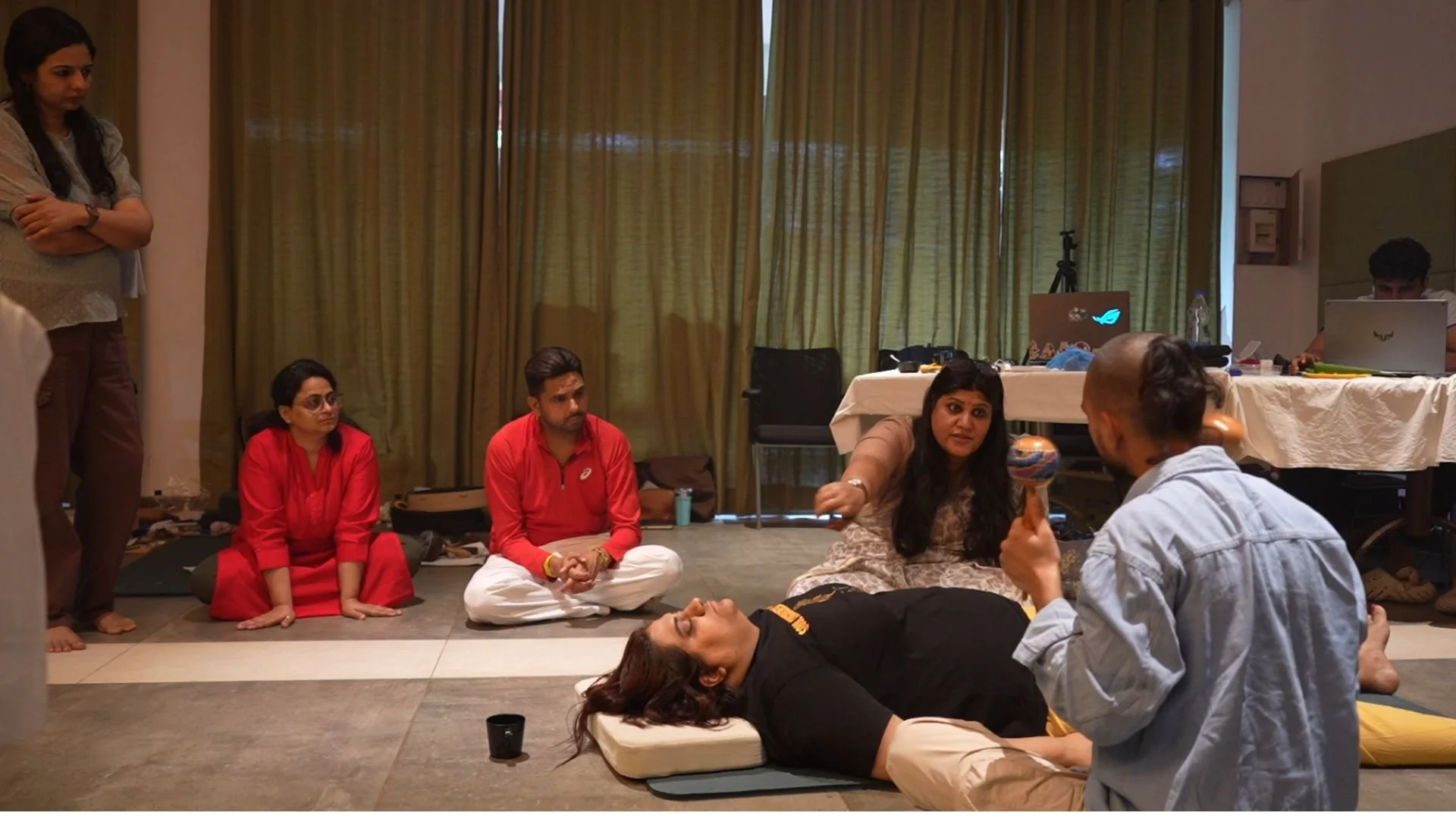
Nothing here is taught as an idea. Dr. Rashhi demonstrates the method first, on a real subject, with the whole group watching closely. Only then does the group work in pairs.
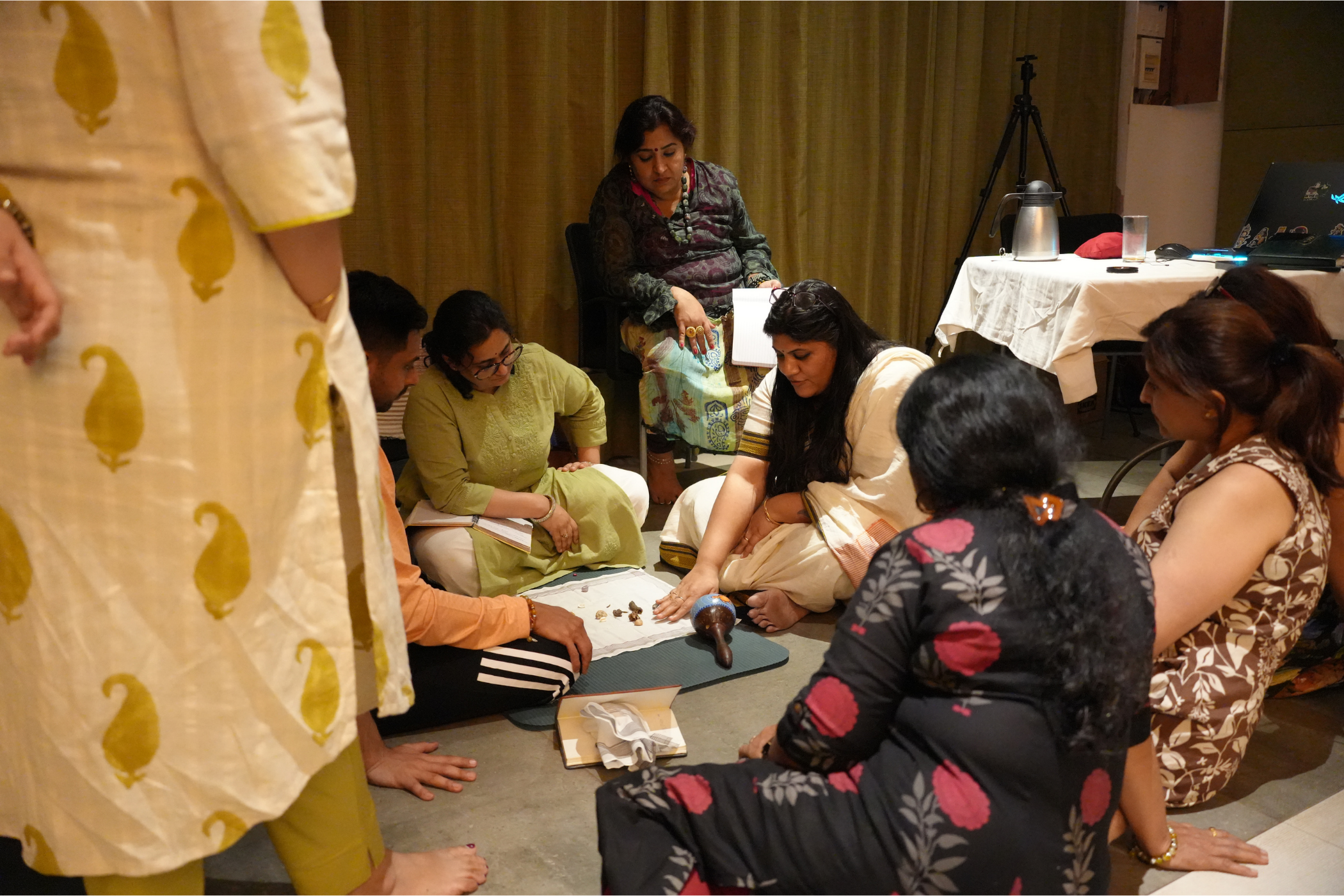
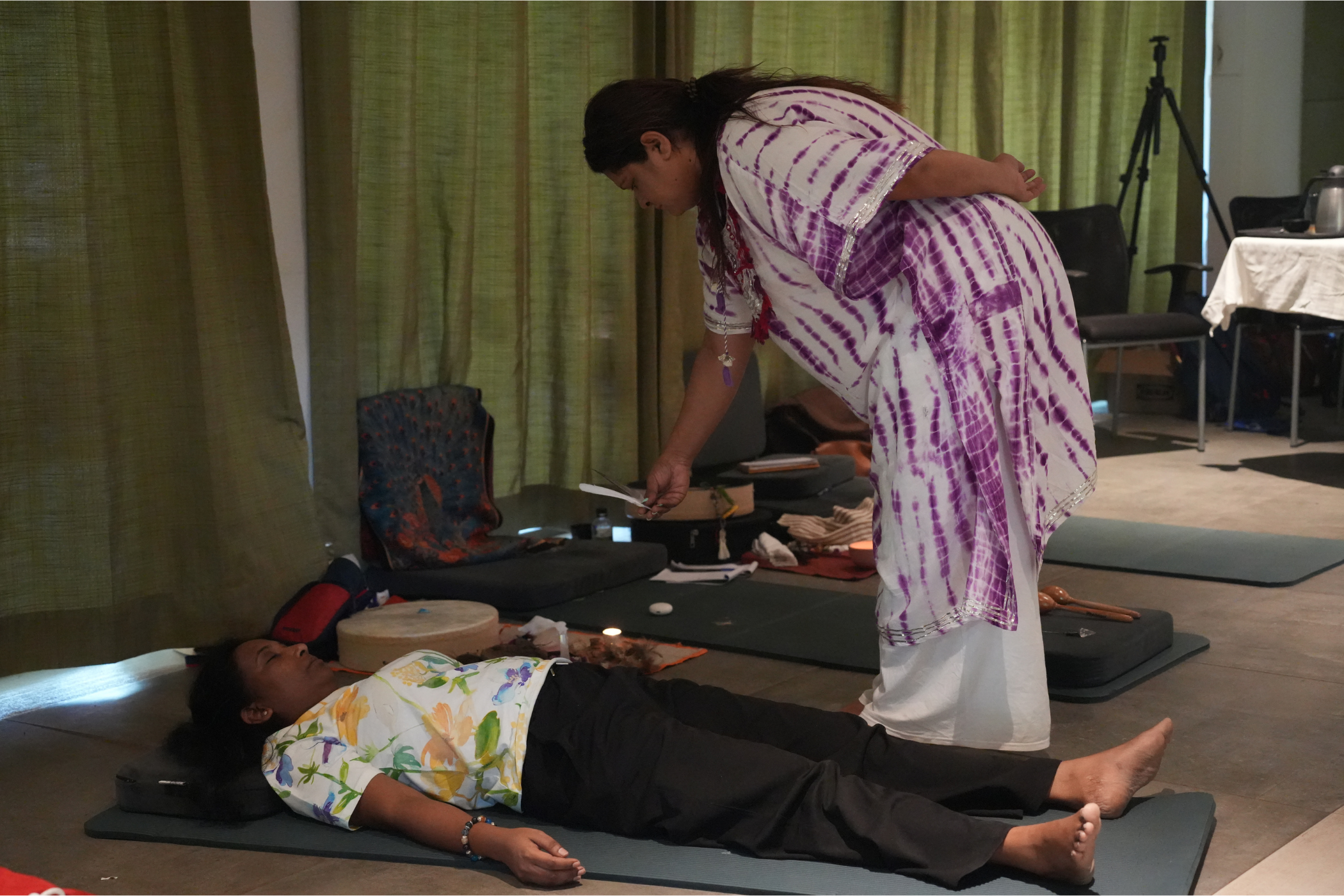
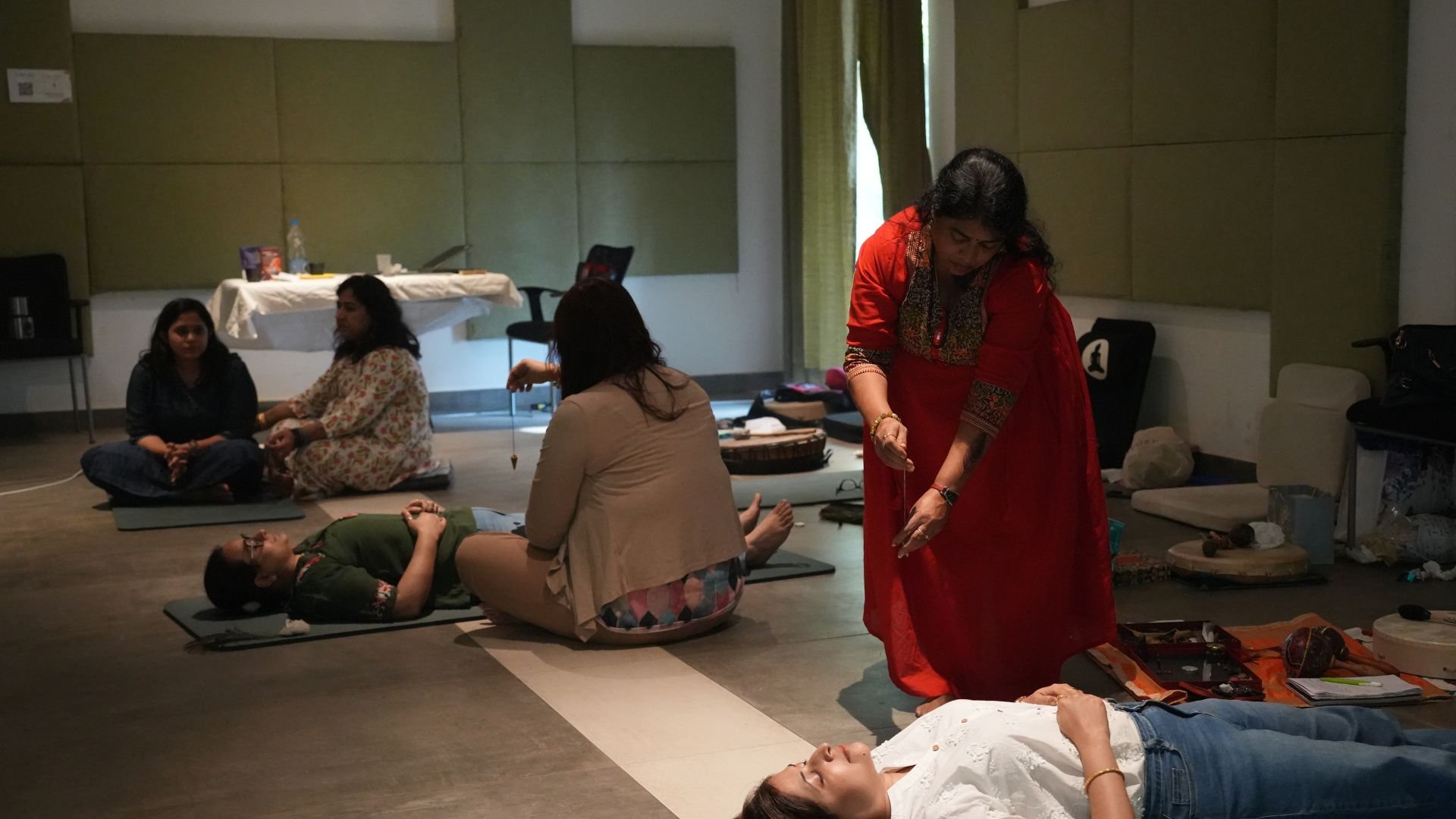
And that work is physical. Participants lie down for each other. They work close to the body, scanning with their hands and with divination tools, while others stand near enough to watch exactly what is happening with the person receiving.
You cannot practise that on someone who is in a different house, and you cannot learn it by watching a thumbnail.
The initiations happen in the trainer's presence
Shamanic practice carries a great many initiations, and they are not ceremonial decoration — they are how the practice is entered.
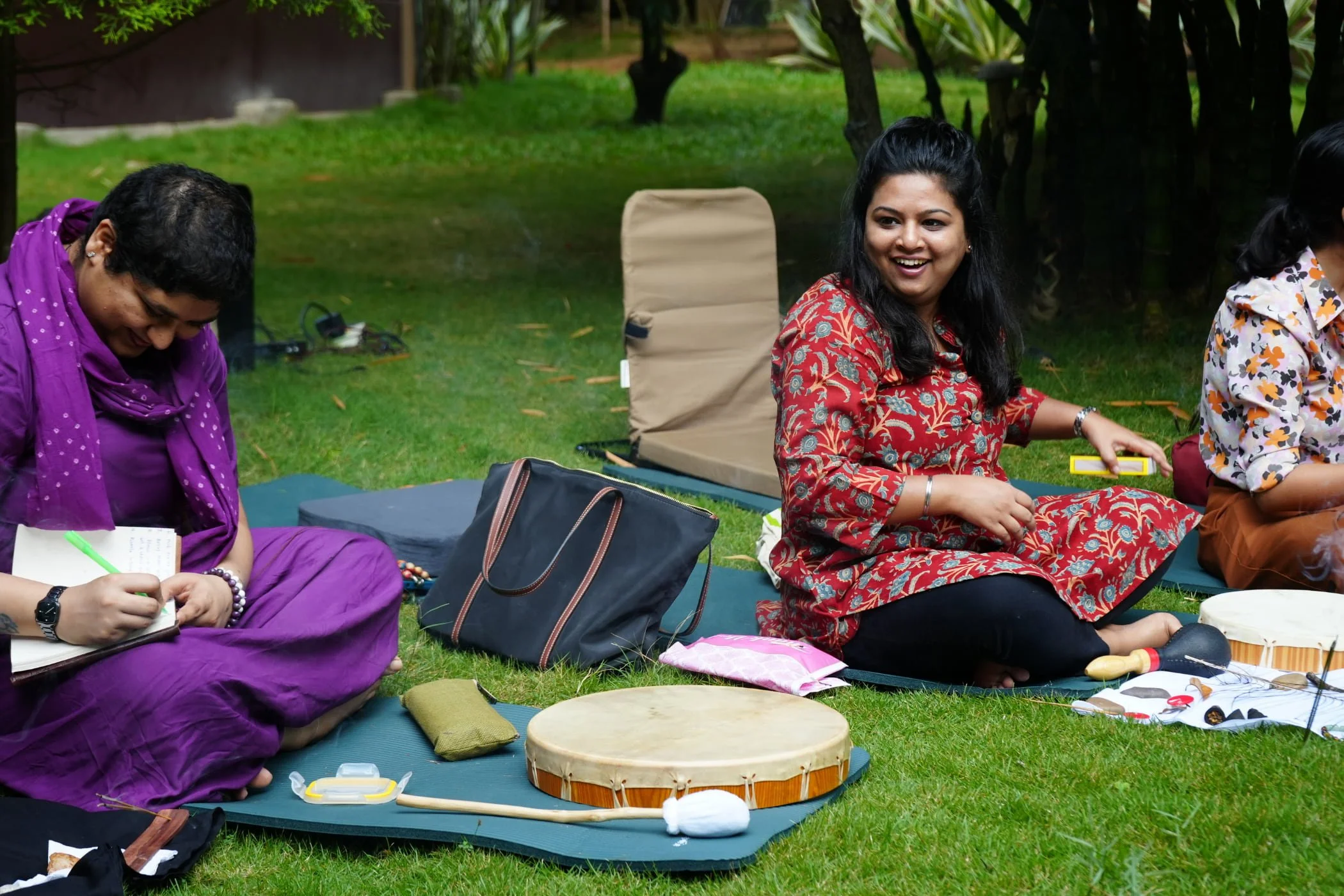
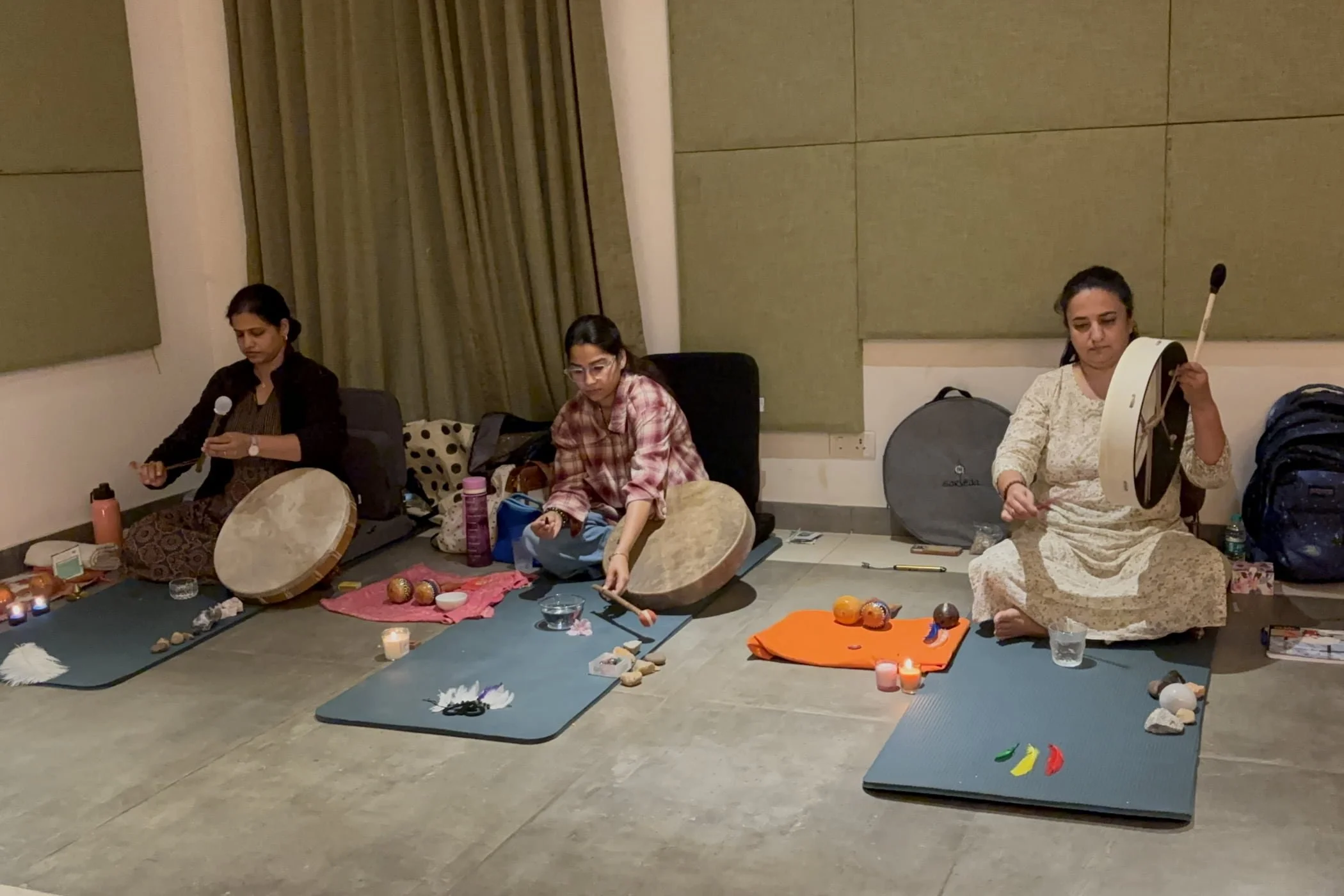
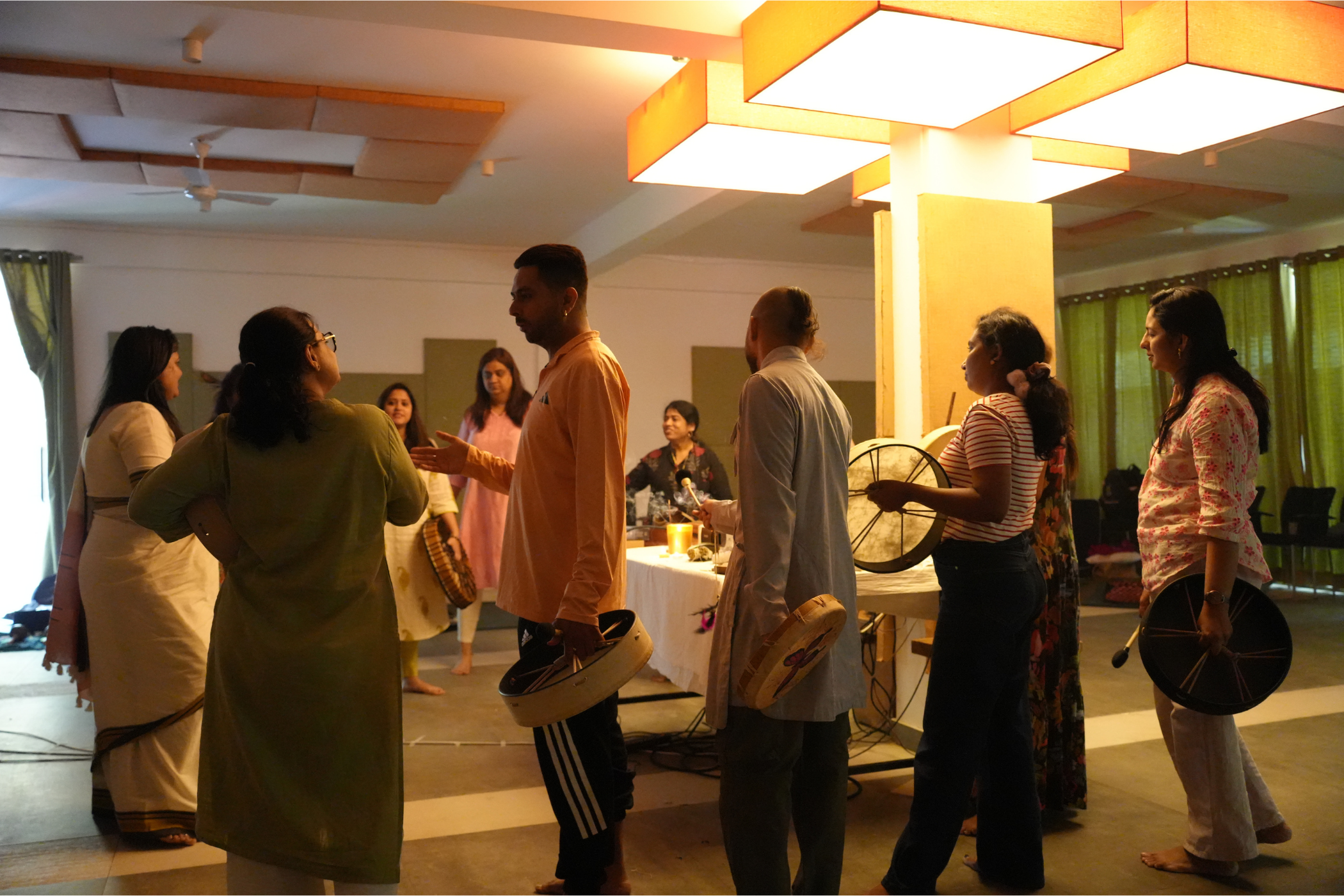
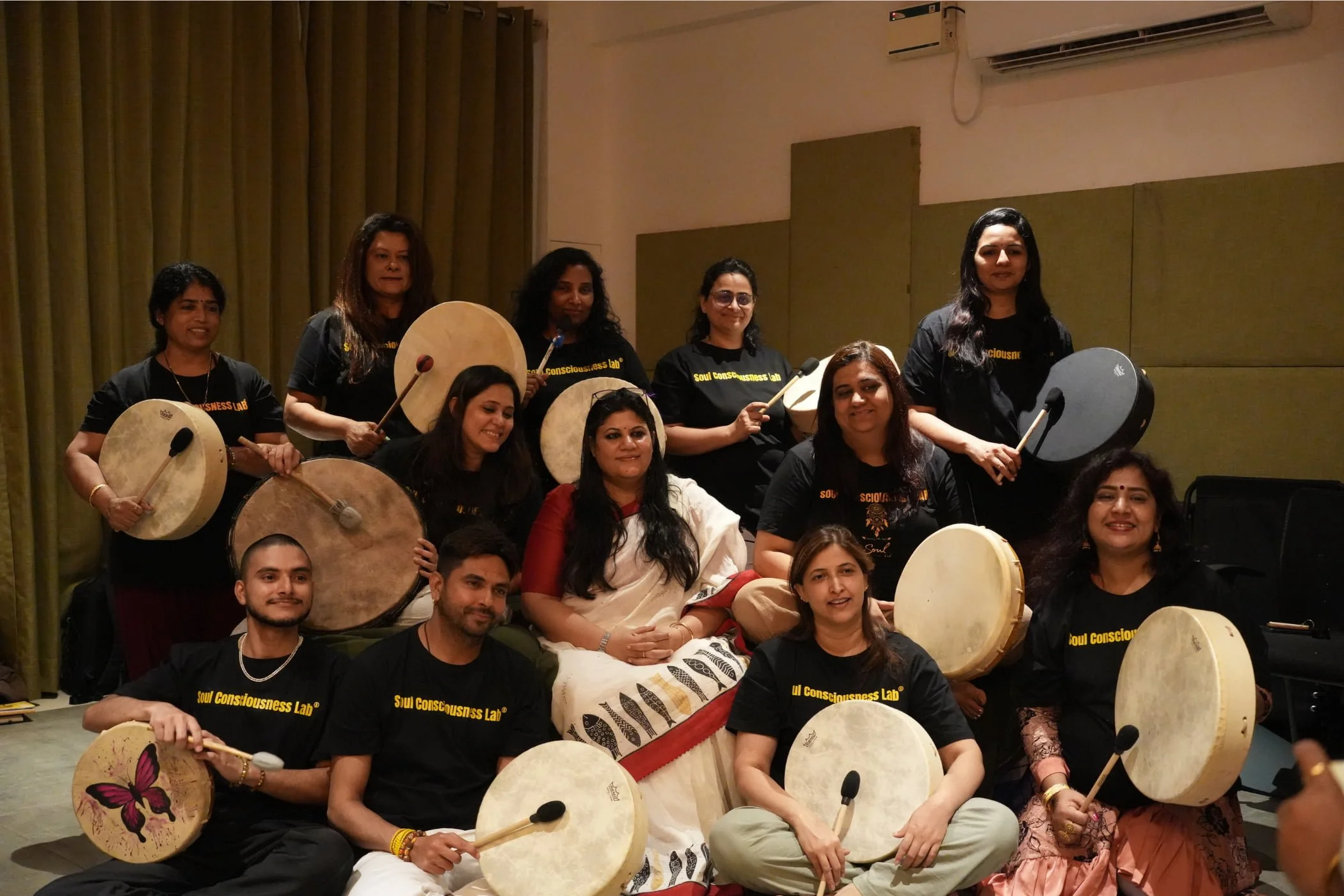
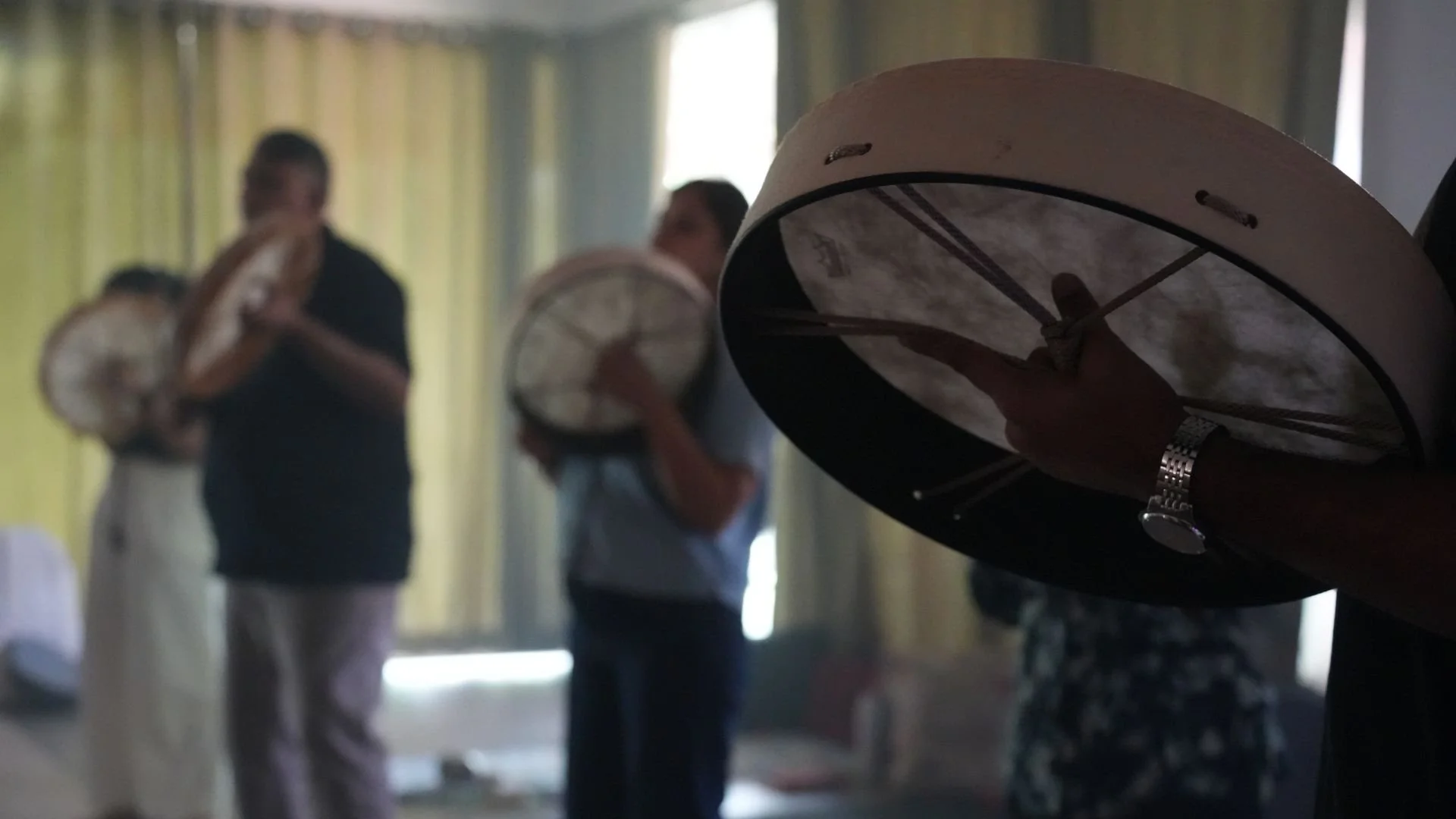
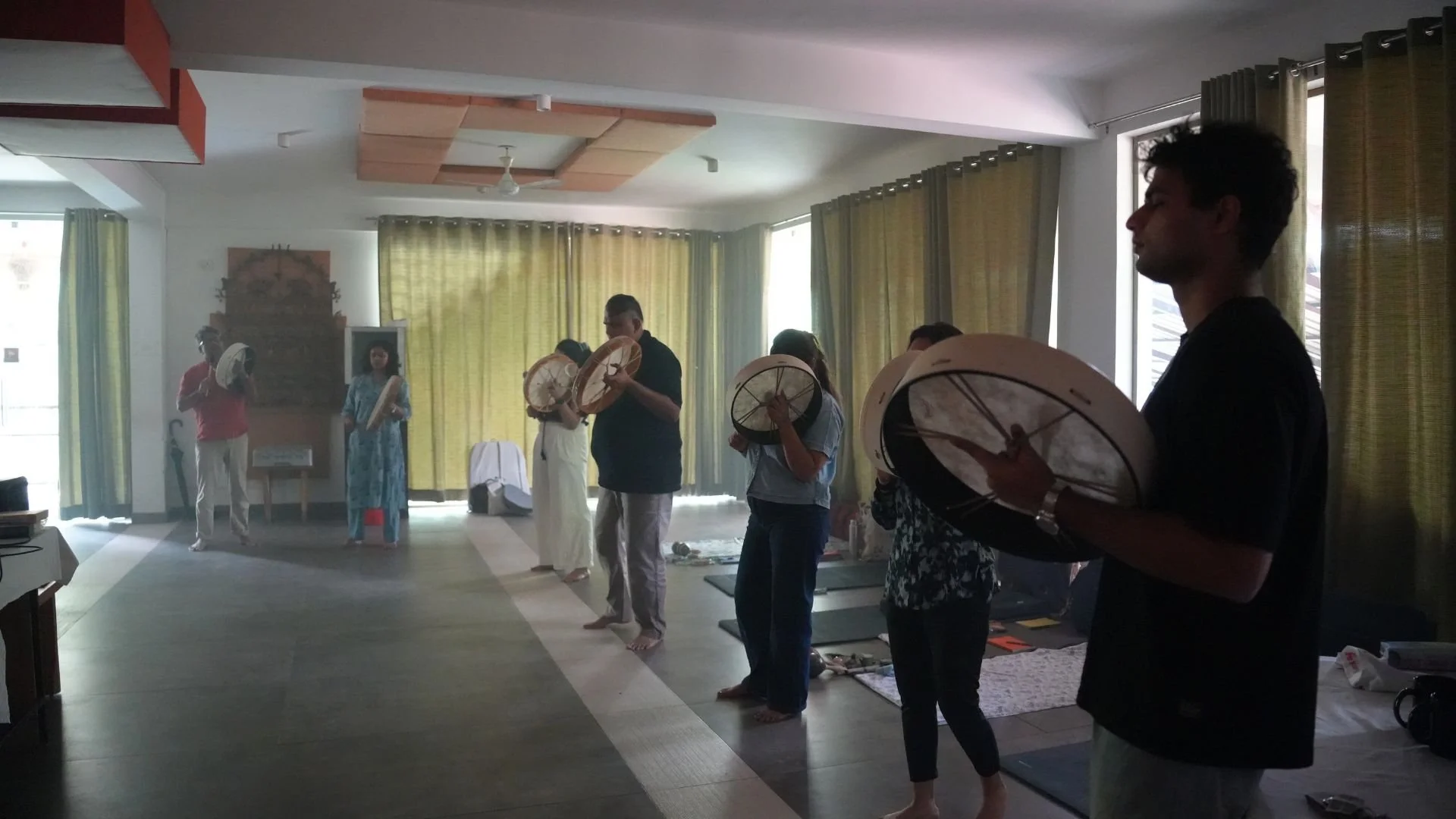
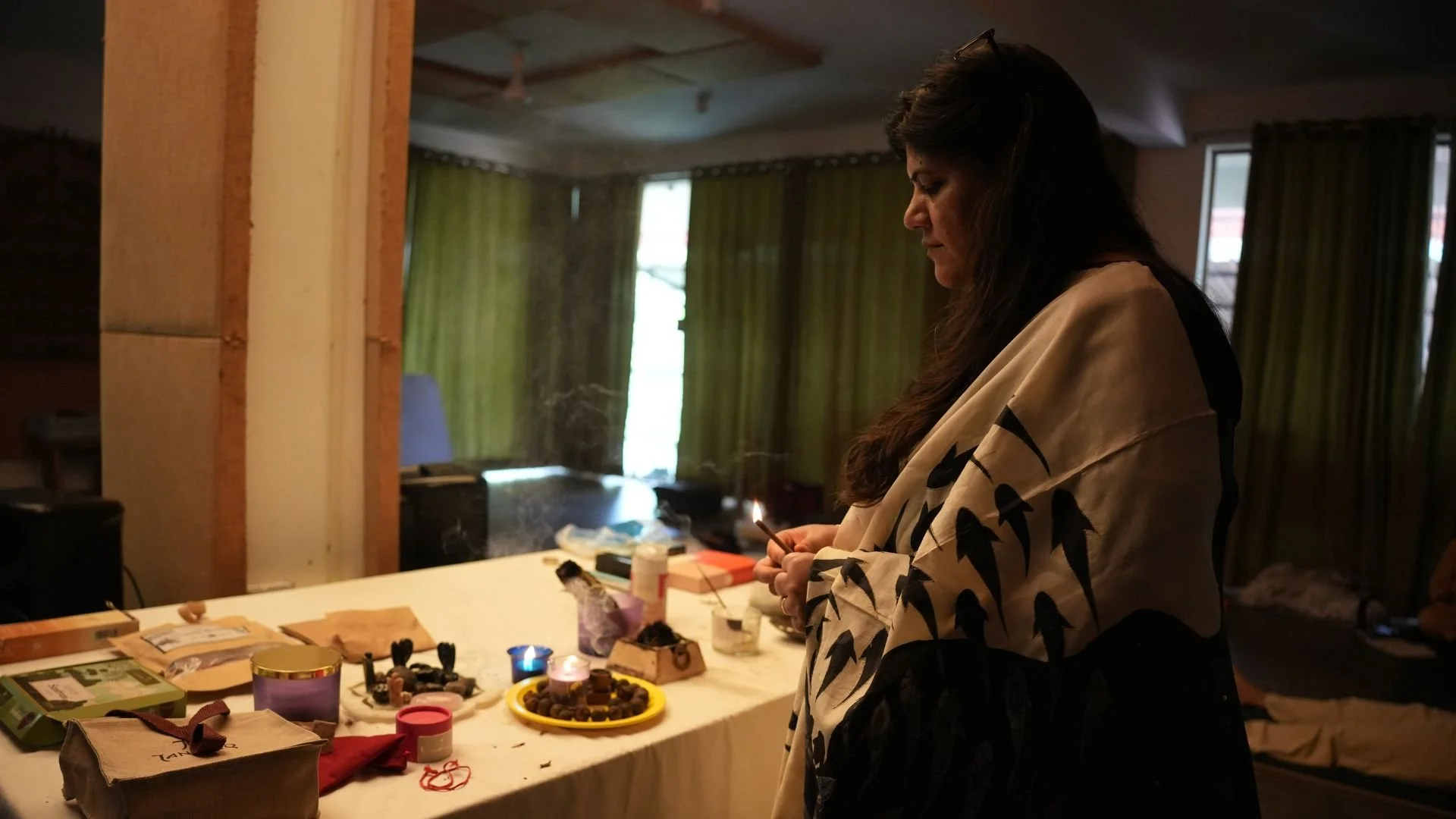
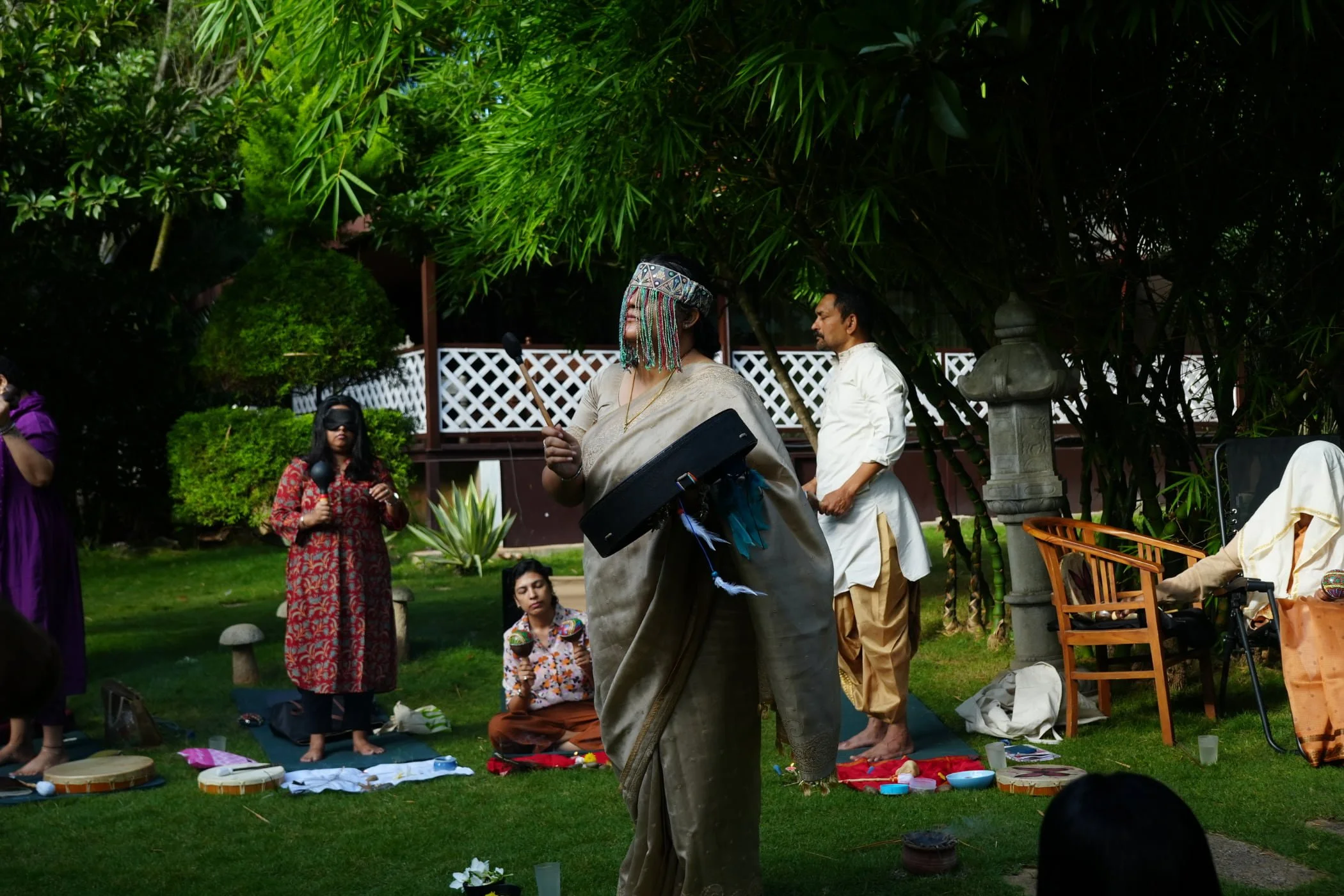
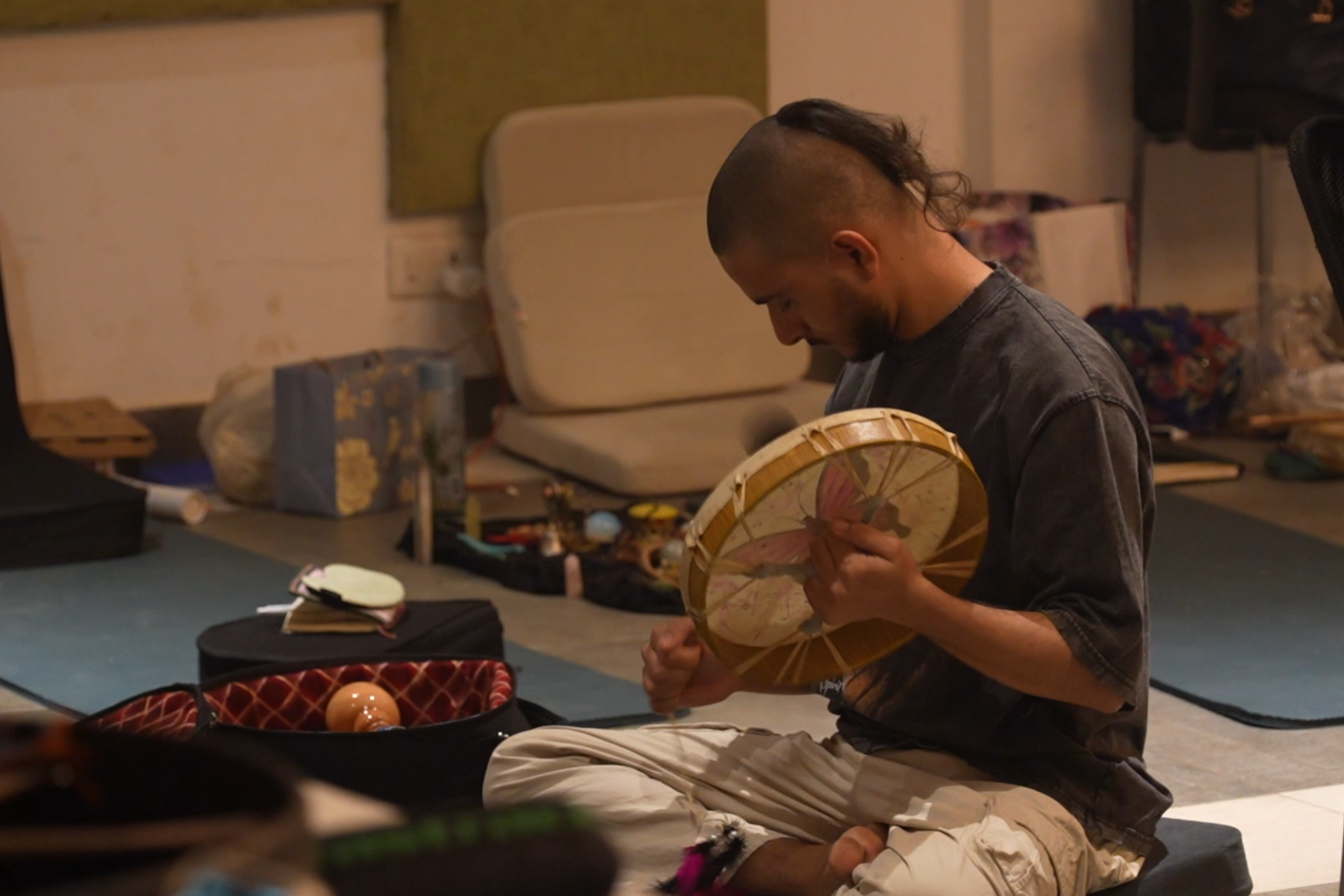
The drums are initiated. The rattles are initiated. There is smoke initiation. The crystals and the tools each participant has gathered are initiated. There is a drum circle where the whole group drums together and the trainer initiates the drums within it.
Every one of these happens with the trainer present. We do not know of a way to do that through a screen, and we would not want to invent one.
The drum circle. Drums, rattles and gathered tools are initiated with the trainer present.
The altar is gathered from the land you are standing on
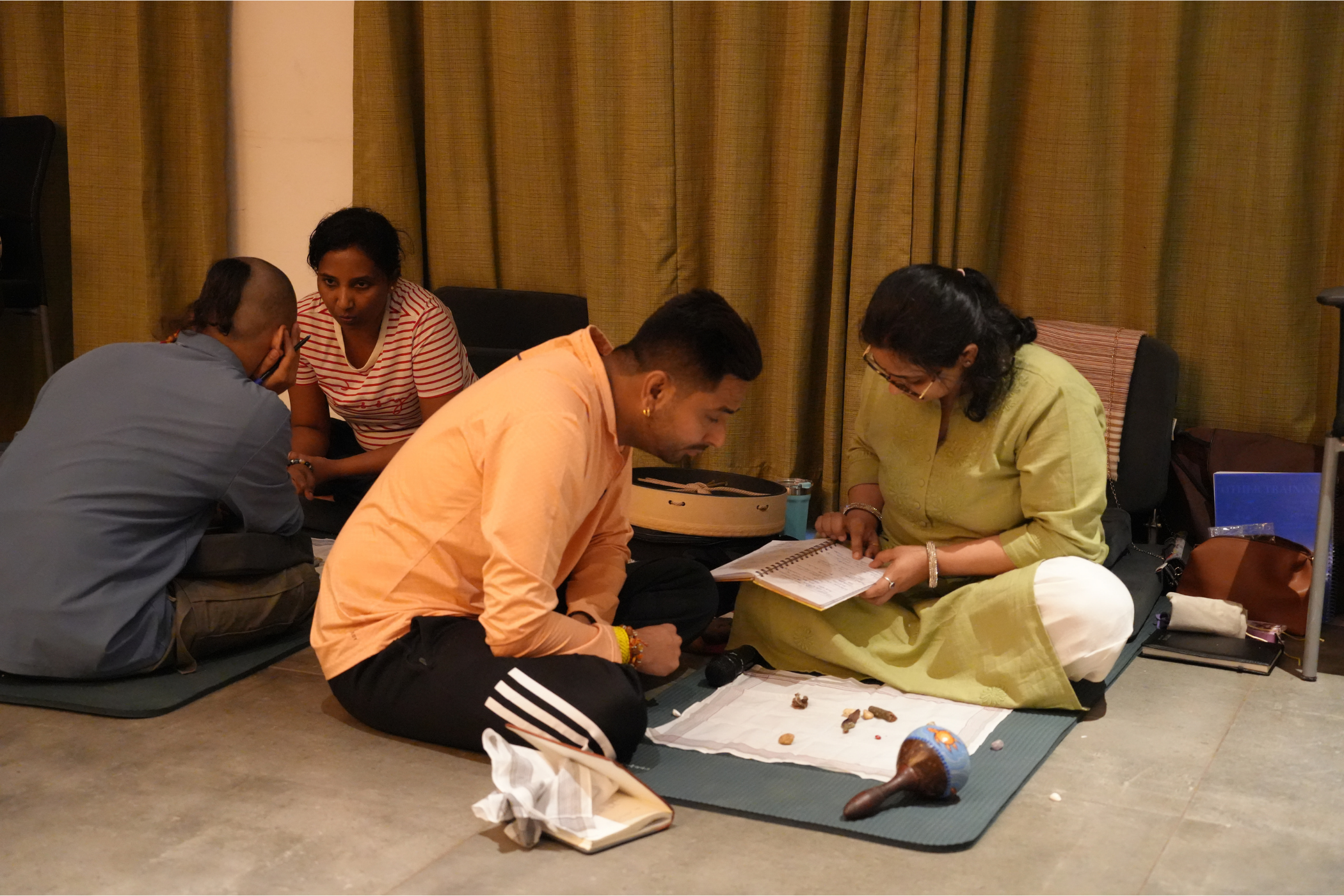
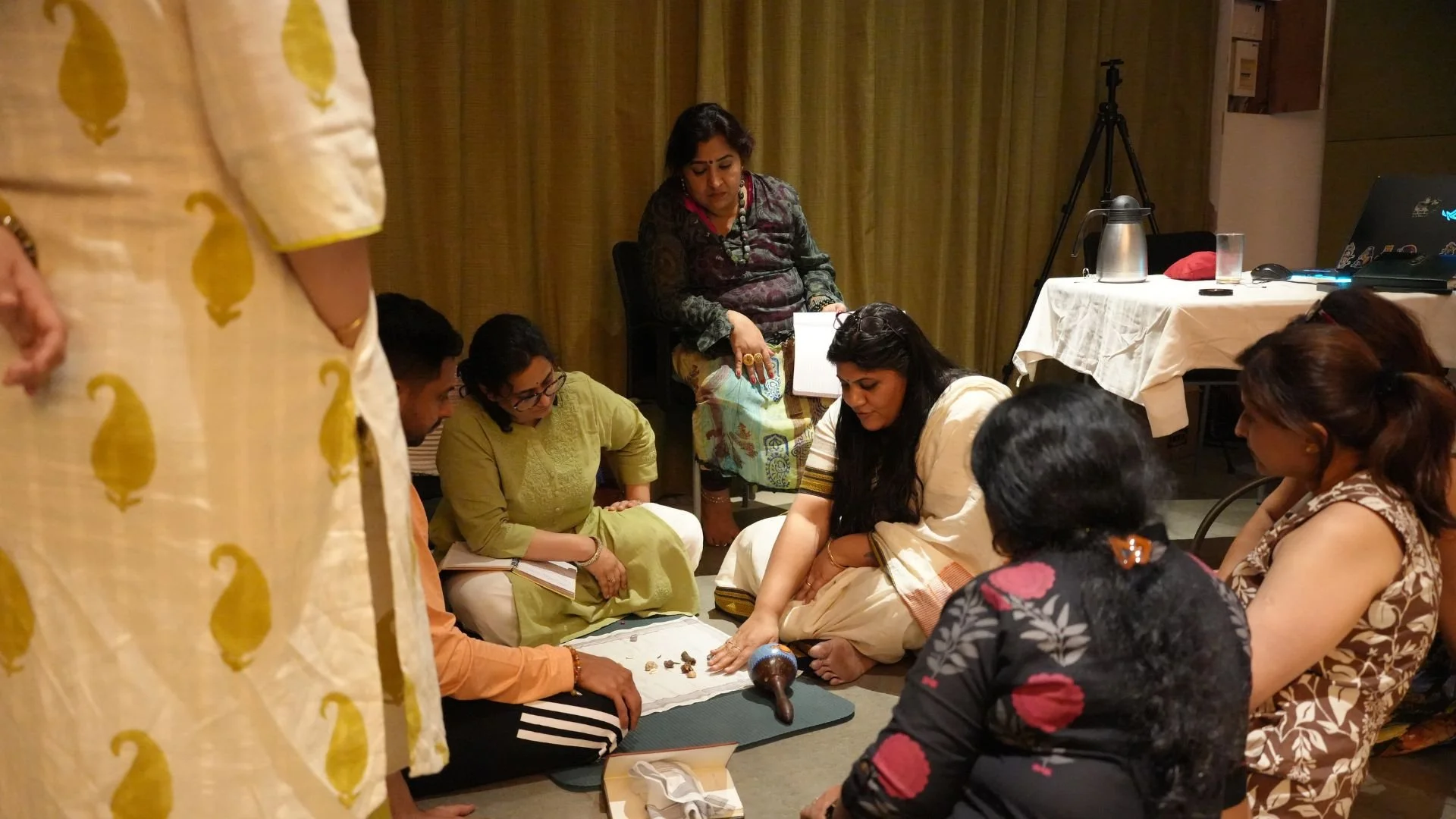
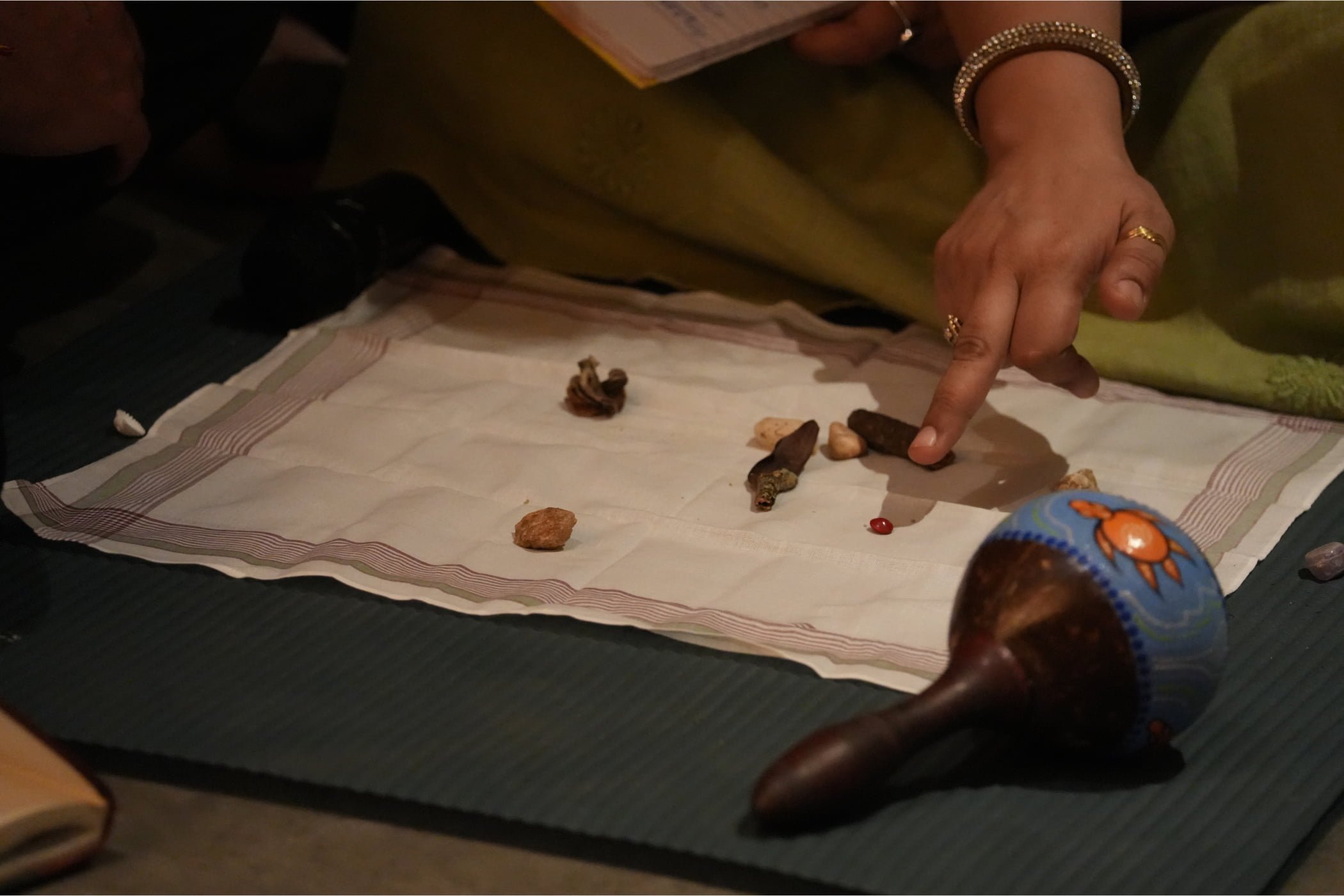
Participants build their altar from what they collect — going out into nature, connecting with it, and bringing back what is offered. That gathering is itself part of the training.
Divination is done with trees, with flowers, with stones, with earth, with fire. Participants also work directly with plants — going out among the trees at the venue, connecting with a plant, and learning what it offers for healing. Nothing is ingested at any point. This is relationship with the plant, not consumption of it.
Relationship with the natural world is not a topic in shamanism; it is the substance of it.
A recording of a fire is not a fire. Watching someone drum is not drumming beside them.
Altars are built from what participants gather. Divination is done with trees, stones, earth and fire.
Nothing is left unresolved — and that needs the room
The group here does not move on until every person can do the practice. That is only possible when the trainer can see each participant work, and correct them in the moment.
If someone loses their way partway through, it is addressed while it is still happening, not after they have logged off and gone to make dinner.
Someone has to hold the space
Middle world work in particular requires a container. The trainer creates and guards that space for the duration — so that the group can work without anything unwelcome entering it.
And when someone does come back ungrounded, grounding is done on the land itself — feet on earth, among trees, in the place the work was done. That is not a step that can be skipped, and it is not one that a video call can offer.
A home is not a container
Set aside everything else for a moment and consider the practical reality. Drumming aloud. Rattling. The power animal dance. Lying down for an hour undisturbed. Working past ten at night, then again before dawn.
Most people cannot do that at home — with children in the next room, a doorbell, a household carrying on around them. They hold back, and holding back is the one thing this practice cannot survive.
It is not a failing on their part. It is simply what a house is.
The group is part of the method
Participants journey together, practise on each other, and share what came — every person, every time. What you learn from hearing eleven other people describe the same journey differently is not a supplement to the training. It is a large part of it.
The nights matter too: shared practice, dream work, and the discussion the next morning. None of that survives being spread across eleven separate houses.
Practice in pairs, with the group observing. None of this transfers to a screen.
We are not the only ones who say this
The Foundation for Shamanic Studies — founded by Michael Harner, the anthropologist who brought core shamanism to the modern world, and the body that certified Dr. Rashhi as a shamanic practitioner — has published its own position on this question.
FSS describes shamanism as an embodied practice, taught and passed on within a living community. Across many years of teaching core shamanism, they write, the depth of live interaction between participants, held by the power of the gathered circle, is not reproduced in an online format.
They are equally clear about what online can do: offer useful introductory information, and a glimpse of another reality — enough to help someone decide whether this is worth pursuing properly, in a circle, with experienced teachers.
That is our position too, arrived at independently. It is also why the most serious shamanic programmes anywhere in the world are held in forest, mountain or open land — not on a platform.
But You Do Offer Live Online Places on Other Programmes
We do — two to four places on Past Life Regression and NGH hypnotherapy, prioritised for applicants outside India who cannot travel. So the honest position is not that online is inferior. It is that it depends entirely on what is being taught.
Regression and hypnotherapy are conducted through voice. A practitioner works with a client's mind through spoken guidance, and that transmits over a call intact — which is exactly how most graduates will practise with their own clients afterwards. Learning it online is learning it in the medium you will use.
Shamanic work is not conducted through voice alone. It is done with fire, drum, land, body and group — and it is entered through initiations given in person. Teaching it through a screen would mean teaching a smaller version of it and calling it the whole.
Which is why our own graduates meet online after the residential training, for their weekly circle. Online is a fine place to keep a practice alive. It is not where the practice is given.
What to Ask Any Teacher — Including Us
Shamanism has no governing body anywhere in the world. Anyone may use the title, and there is no register to check a person against. That places the responsibility on you — so these are the questions worth asking, of any programme, online or residential. Ask us the same ones. A serious programme answers all of them without hesitation, and in writing.
- Who trained the trainer — and can I verify it without asking them? Not a lineage they feel connected to, or an ancestral link. A named institution or teacher, with a listing I can open myself.
- Who issued the awards and accreditations — and who founded that body? An award means something when an independent organisation gives it. It means nothing when the recipient established the organisation, or when the issuing body exists only to issue awards.
- Is what is taught traceable to a tradition, or was it invented by the teacher? Both can have value. But you should know which you are buying, and be told plainly.
- How many contact hours, and how are they counted? A number that cannot be broken into a daily schedule is not a number.
- How many people are in a group, and who supervises them? If a programme takes forty people, nobody is being watched.
- What happens if I become unsettled during a practice? There should be a specific, immediate answer.
- What am I permitted to do with clients afterwards — and what am I not? A training that sets no limits has not thought about your future clients.
- What support exists after the programme ends? Skill comes from months of practice. What happens during those months?
- Are the terms, fees and cancellation policy published before I pay? Or only after.
We publish our answers to every one of these across this site. Dr. Rashhi's certifications are listed publicly by the bodies that issued them — the Michael Newton Institute, the National Guild of Hypnotists, the Monroe Institute and the Foundation for Shamanic Studies — and you can open those listings yourself without asking us for anything. The hours, the daily schedule, the group size, the scope of practice after Level 1, the six-month support structure and our full terms are all published too. Hold anyone you are considering to the same standard.
None of this is a judgement on how anyone else teaches. It is a description of what we have found this work requires, learned across a decade of teaching it in the same room.
If a residential programme is genuinely not possible for you right now, we would rather say so honestly than sell you a version that does not work. The training will still be here.
Spiritual & Consciousness Work
Shamanism allows direct access to non-ordinary states and deeper dimensions of awareness.
This includes:
- Soul retrieval — the traditional practice of reclaiming parts of the self said to be lost after shock or loss
- Communication with spirit guides, ancestors, and helping intelligences
- Accessing the Upper, Middle, and Lower Worlds for insight and guidance
- Vision quests and purpose discovery through direct guidance
- Working with past-life material and inherited patterns as understood in shamanic tradition
- Psychopomp work — supporting transition of souls after death
This is where shamanism begins — not as belief, but as experience
Emotional & Inner Work
One of the most significant applications of shamanism is emotional and energetic work.
This includes:
- Ritual and journeying practices traditionally used with grief and loss
- Inner child work through guided journeying
- Cord cutting and release of heavy emotional attachments
- Emotional cleansing through ritual, sound, and symbolic processes
- Working with fear and difficult emotion through symbolic and ritual processes
- Practices for grounding and steadiness following difficult periods
Participants often describe a sense of release and greater steadiness. Experiences vary and no outcome is promised.
Clarity, Perception & Awareness
Shamanism works directly with perception and awareness.
This supports:
- Practices traditionally used to work with confusion and overwhelm
- Grounding and nature-based practices traditionally used to steady attention
- Gaining clarity in decision-making and life direction
- Expanding perception beyond linear thinking
- Shadow integration — working with hidden aspects of the psyche
- Developing intuitive intelligence alongside logical thinking
This is not a replacement for psychology — it works alongside it, at a different layer
Ancestral & Lineage Work
A significant part of shamanic work involves understanding inherited patterns.
This includes:
- Working with inherited family patterns as understood in shamanic tradition
- Working with ancestral spirits for guidance and support
- Working with patterns of fear, abandonment, or repetition across family lines
- Strengthening connection with lineage and roots
- Understanding inherited burdens and how tradition works with them
Many deep patterns are not personal — they are inherited
Land, Space & Environmental Work
Shamanism is deeply connected to the natural world and energetic environments.
Applications include:
- Clearing homes, land, and spaces of stagnant or heavy energy
- Blessing new homes, workplaces, or projects
- Harmonizing spaces before important life transitions
- Working with natural elements — earth, water, fire, air
- Connecting with plant spirits and nature intelligence
This is why training must be experienced in nature — not just taught
Grief, Death & Transition Support
Shamanic traditions have always worked with the process of death and transition.
This includes:
- Supporting individuals through grief and emotional loss
- Traditional practices for connection with departed loved ones
- Psychopomp work — helping souls transition peacefully
- Rituals for release, completion, and acceptance
- Working with fear of death and existential questions
This is one of the oldest and most sacred roles of a shaman
Purpose, Direction & Life Alignment
Beyond healing, shamanism supports clarity and direction in life.
This includes:
- Receiving guidance for life decisions through journeying
- Understanding one’s deeper purpose and direction
- Aligning personal and professional choices with inner clarity
- Working with repetitive life patterns
- Reconnecting with inner authority and voice
Some participants describe changes in direction following the work. This varies widely between individuals.
Advanced & Specialized Applications
As practice deepens, more advanced work becomes available:
- Time journeys (past and future exploration)
- Elemental balancing and energy harmonization
- Sacred sound and voice-based healing
- Shape-shifting and archetypal work
- Working with multidimensional perception
- Facilitating healing and transformation for others
These are not beginner-level practices — they require structured training
These describe practices within the shamanic tradition and how participants have experienced them. They are not medical or psychological treatments, produce no guaranteed outcome, and are not a substitute for qualified medical or mental-health care.
APPLICATIONS AND REAL USE CASES
What Shamanism Can Be Used For
Shamanism is not limited to spiritual exploration.
It is a practical, structured system of working with consciousness, energy, nature, and the unseen — applied across different areas of life.
Below are the primary domains where shamanic work is used, based on traditional practices and modern application.
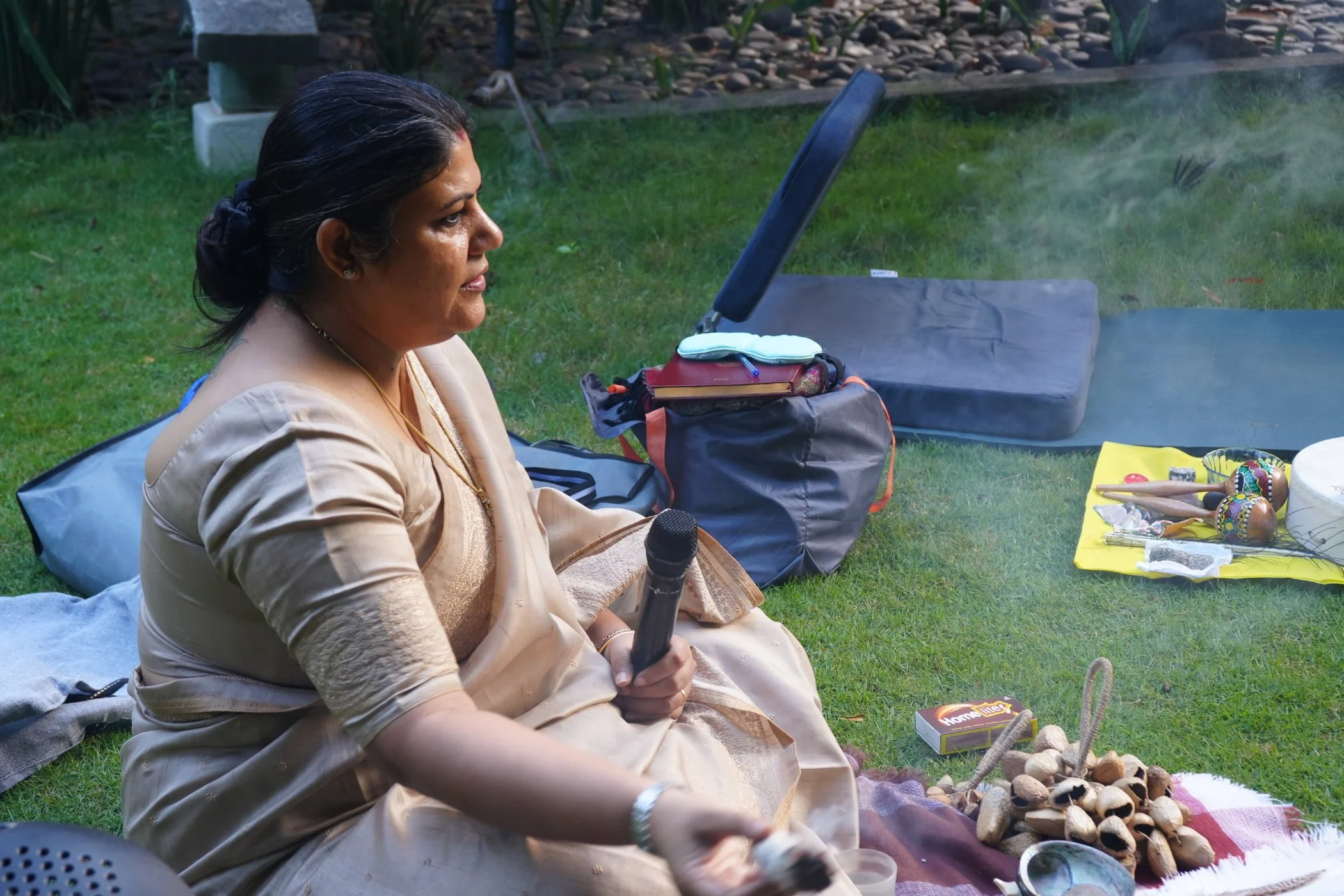
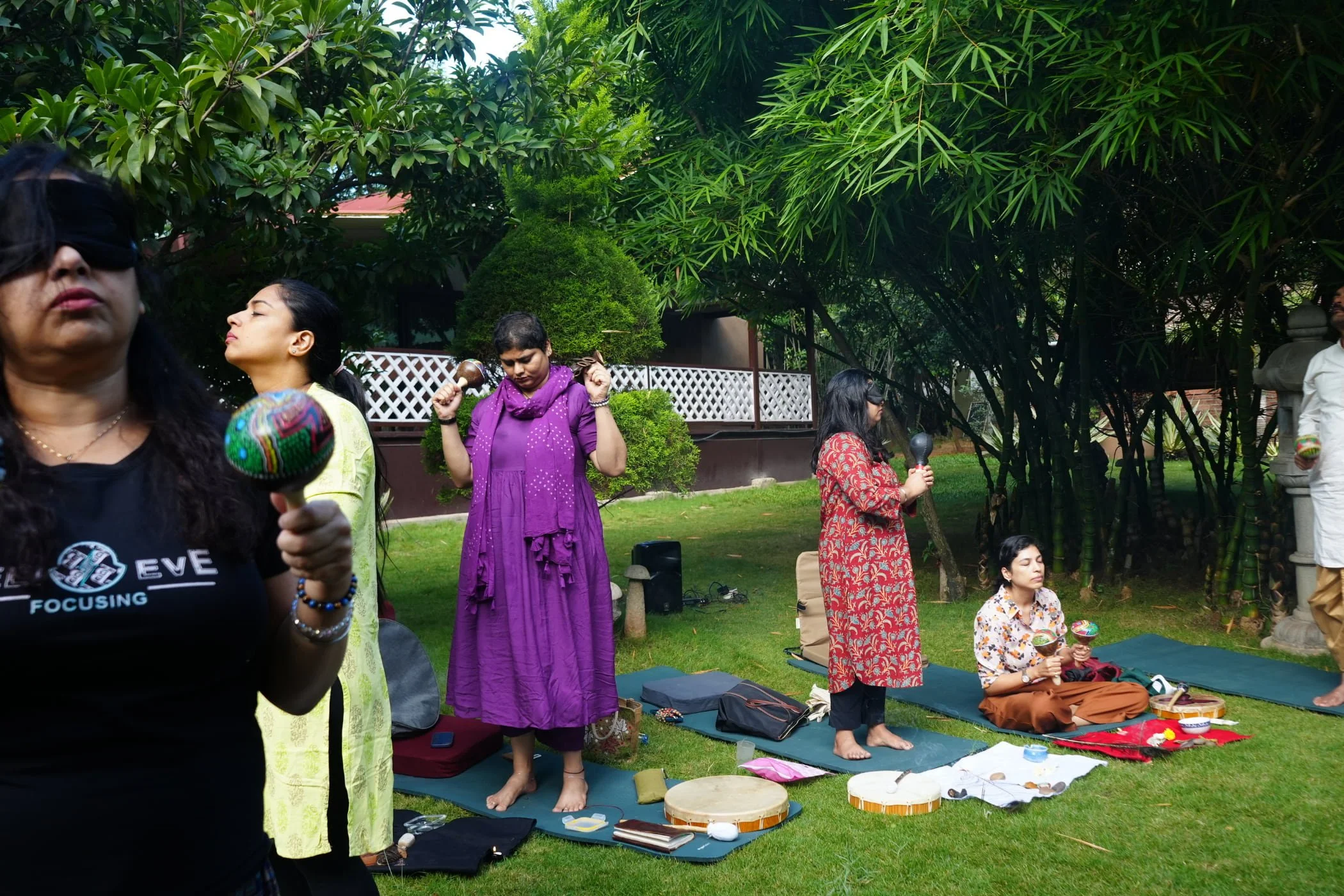
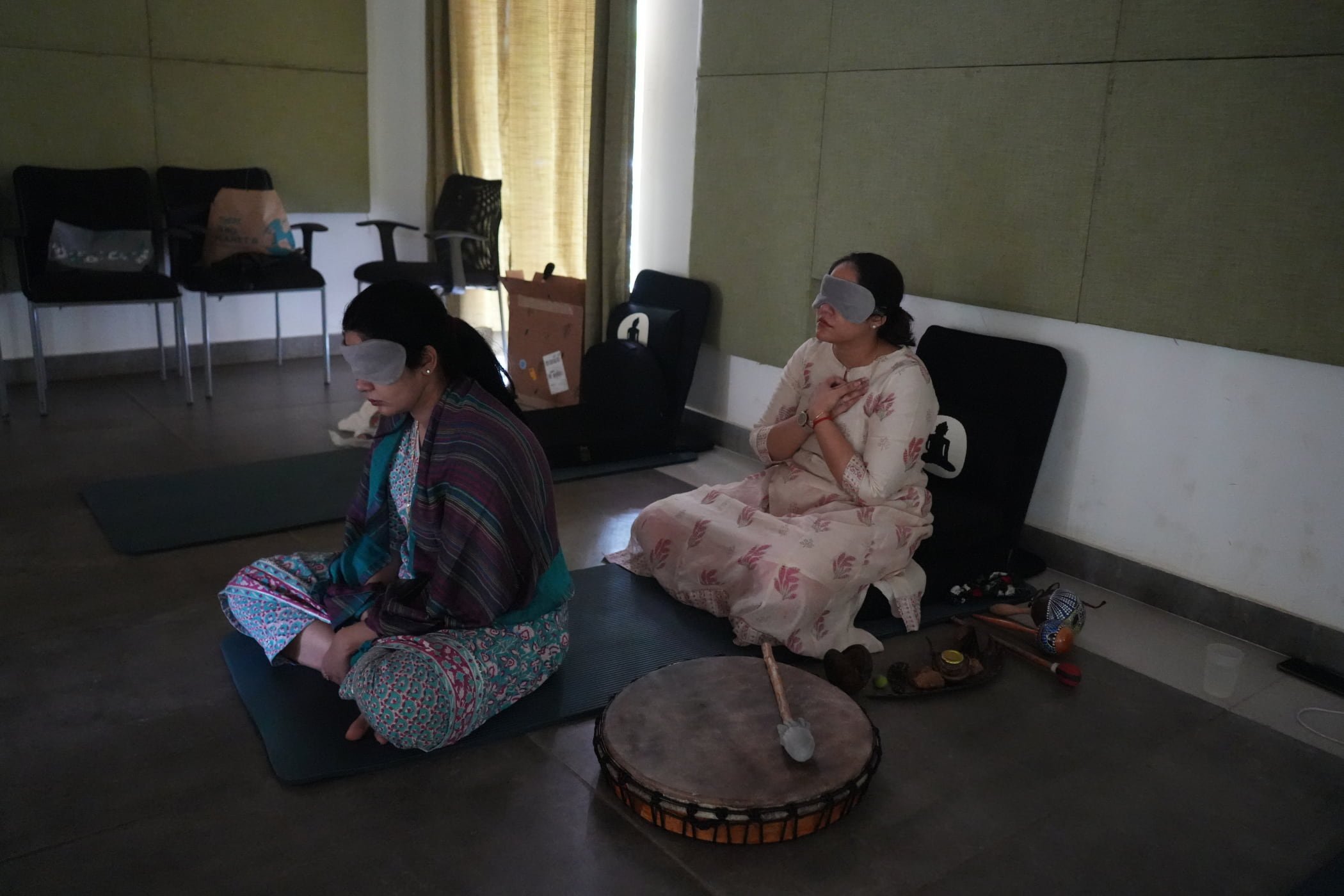
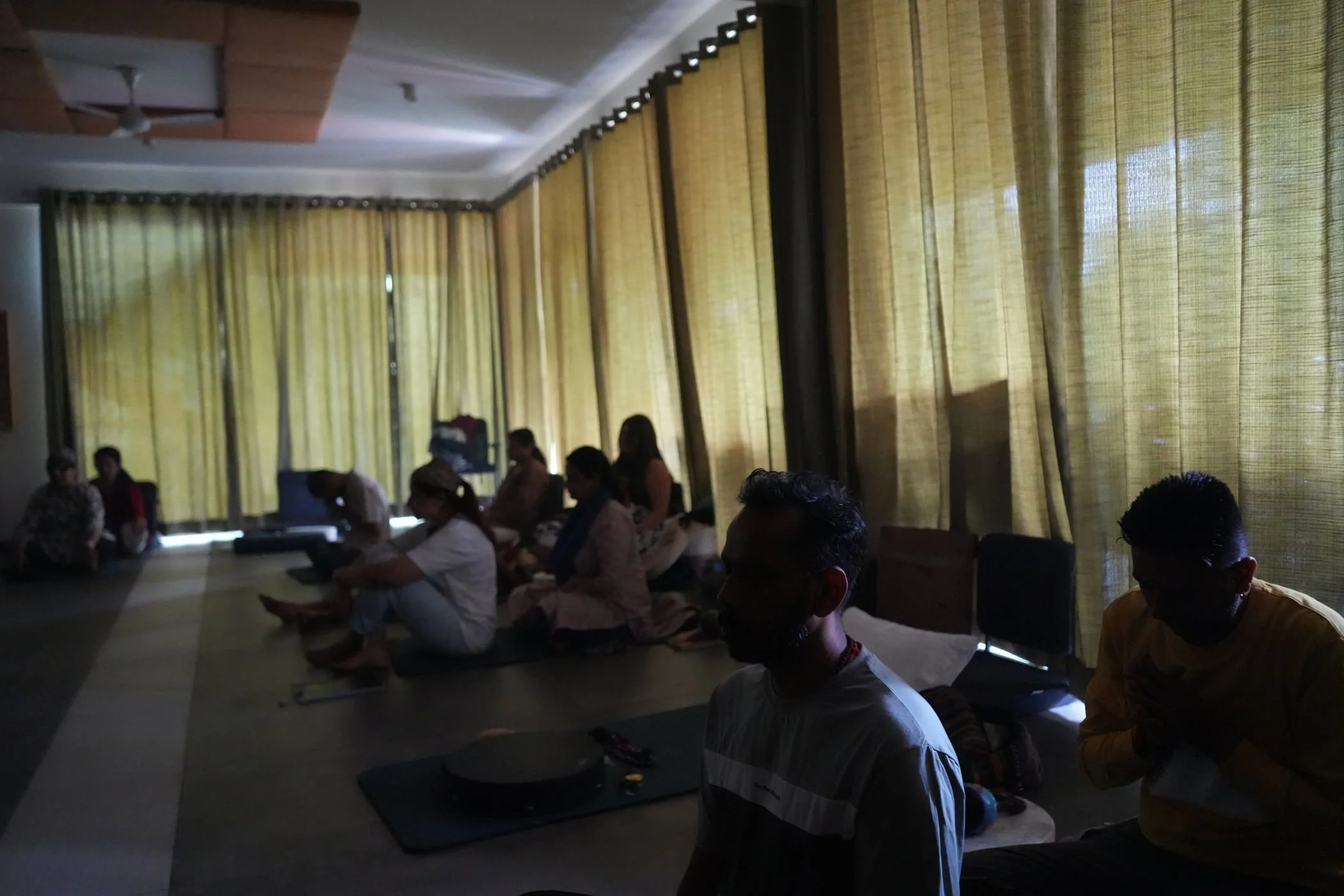
INSIDE THE TRAINING
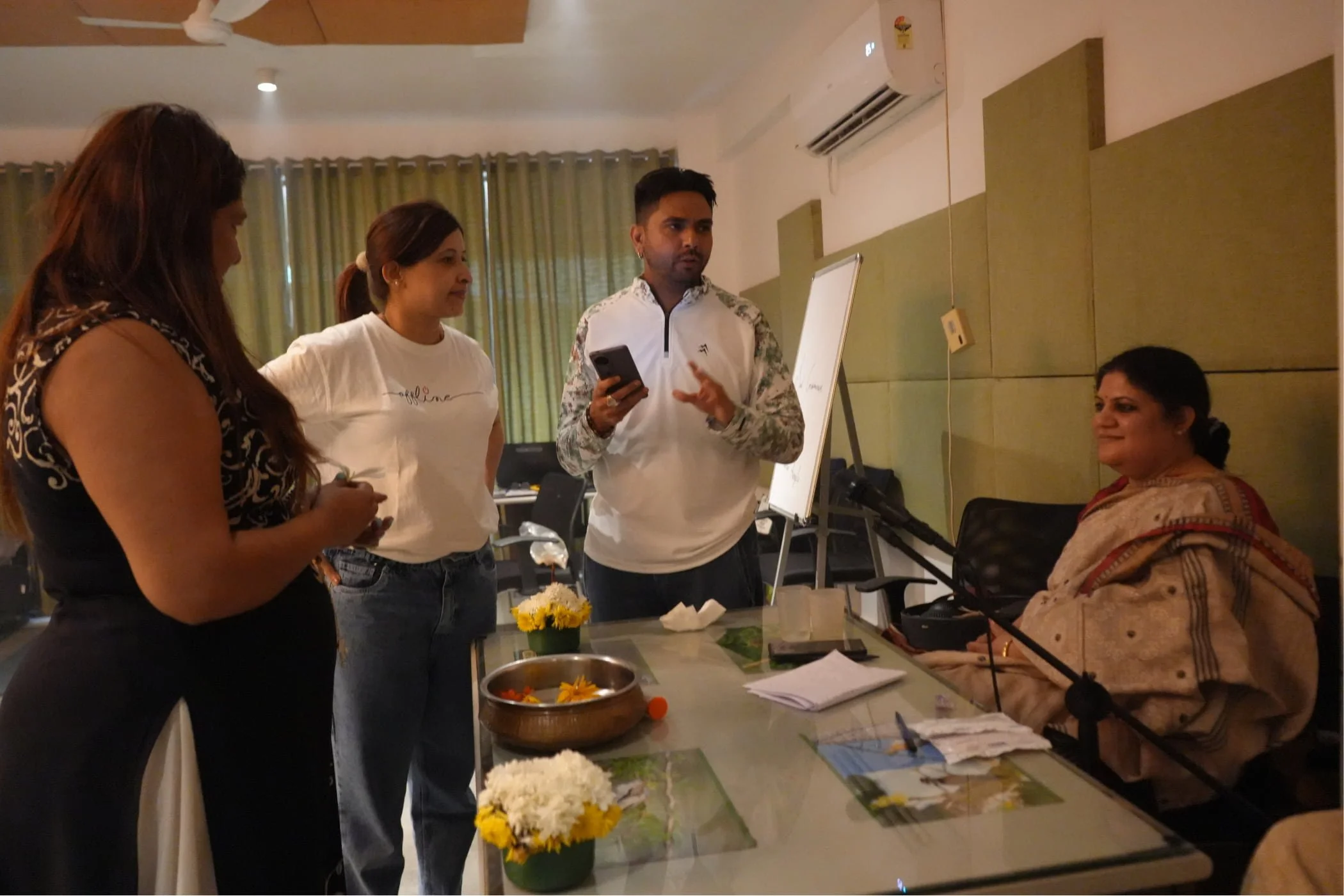
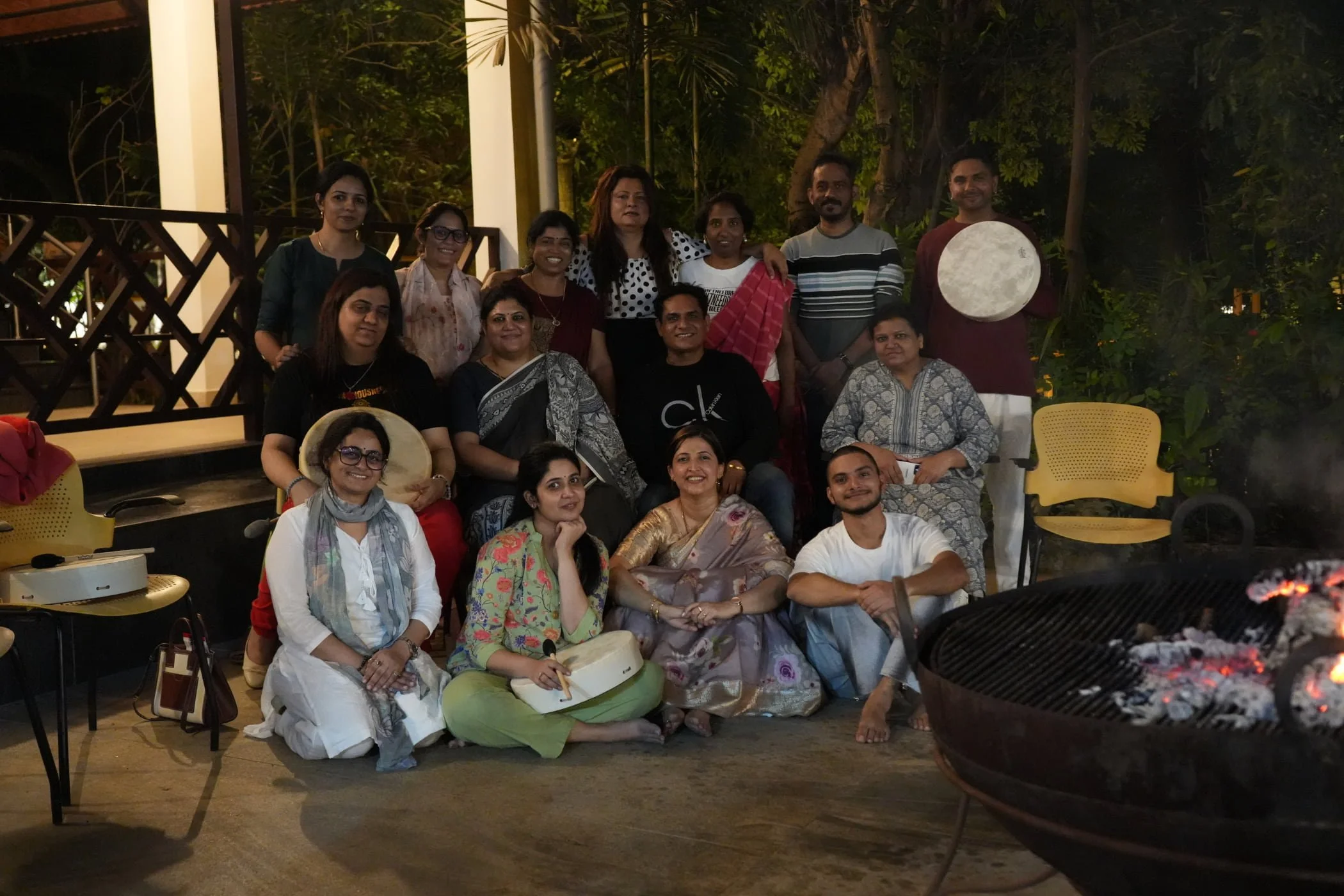
What the Shamanism Training Experience Actually Looks Like
This is not a staged or curated workshop environment.
What you see here is not designed for marketing —
it is how the shamanism training actually unfolds in real time.
Participants are not sitting and listening.
They are practicing, observing, experiencing, and engaging — repeatedly, across different processes, including guided journeying, energy work, ritual, and group-based healing practices.
This is a space where learning happens through direct experience, immersion, and repetition, not explanation alone.
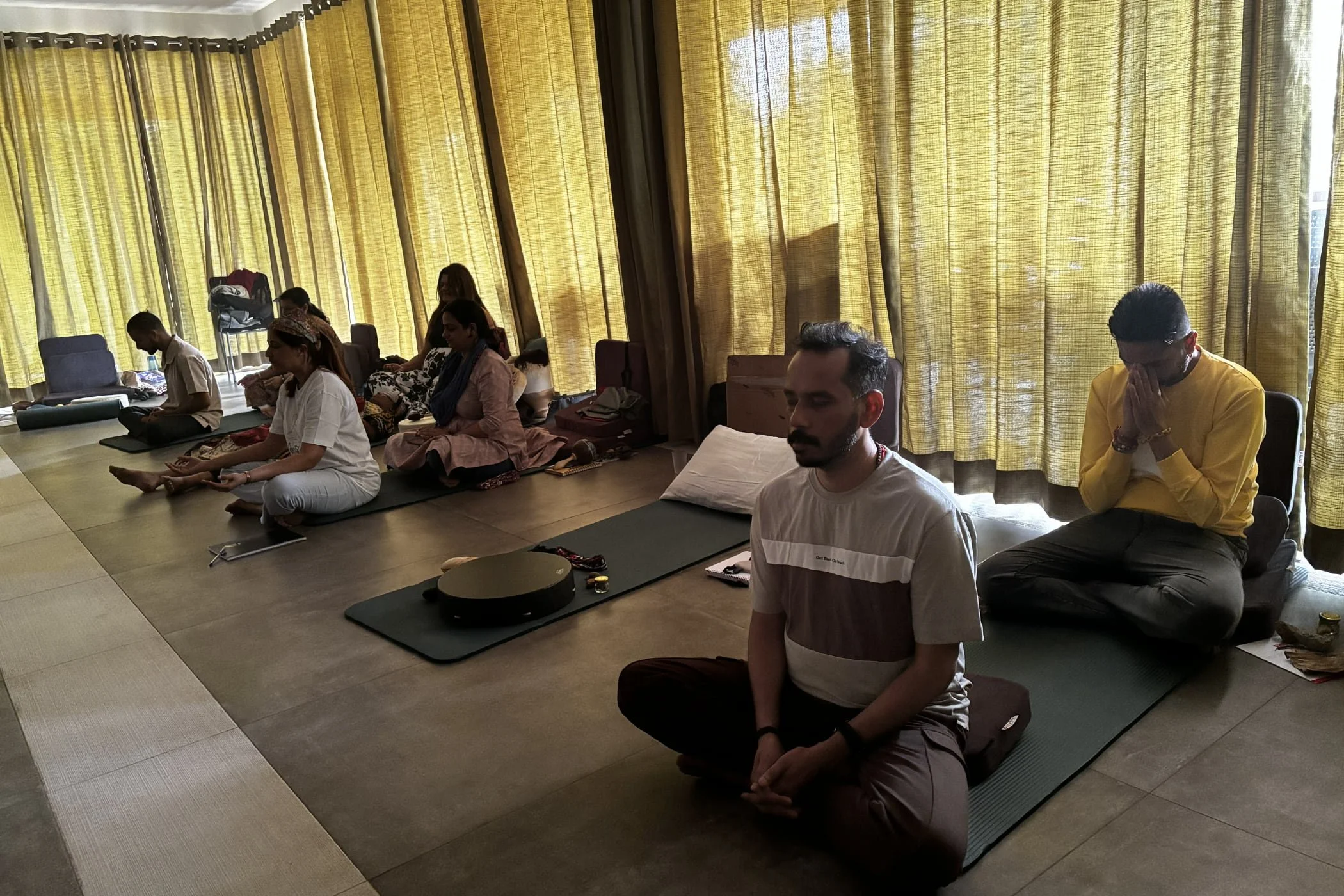
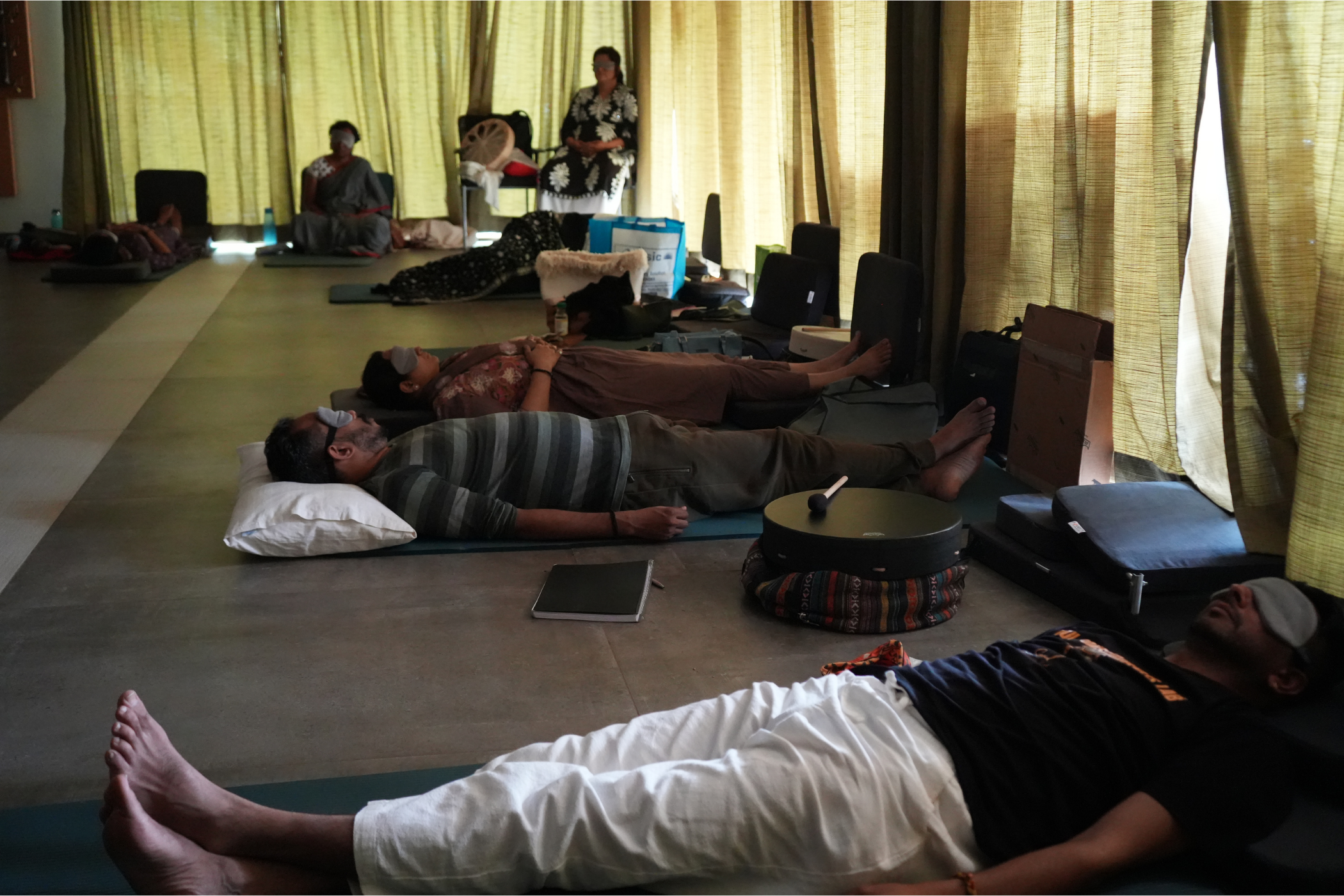
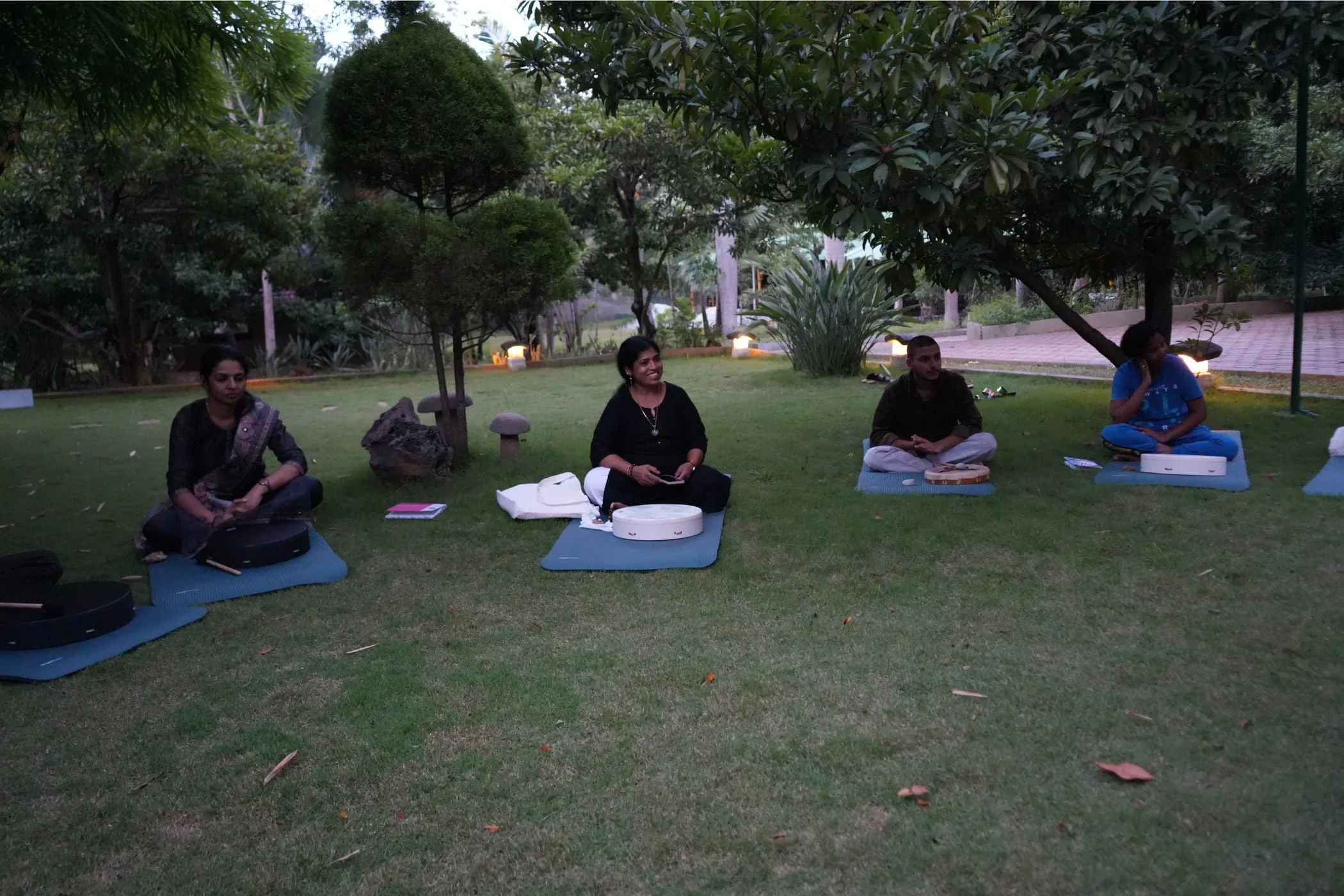
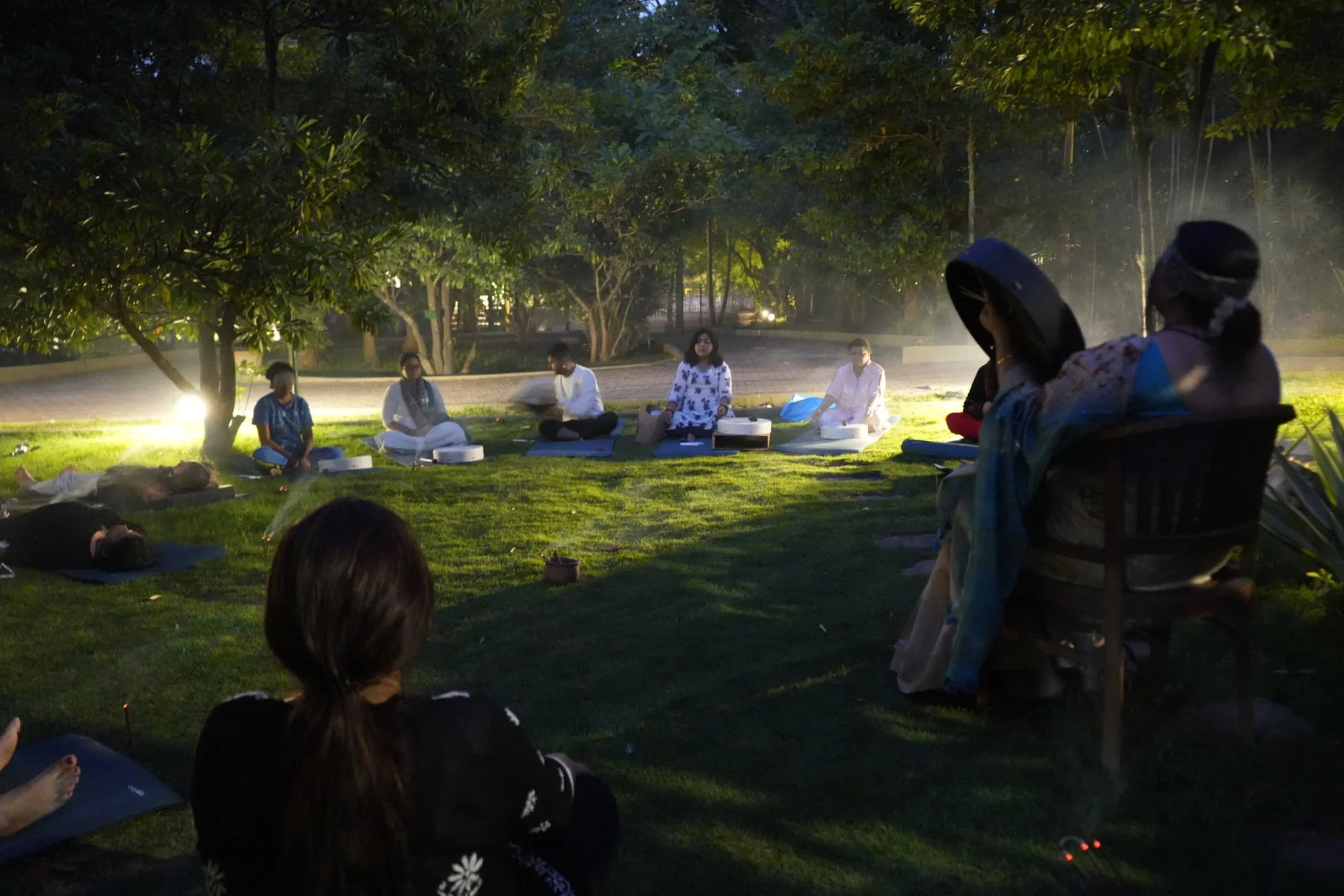
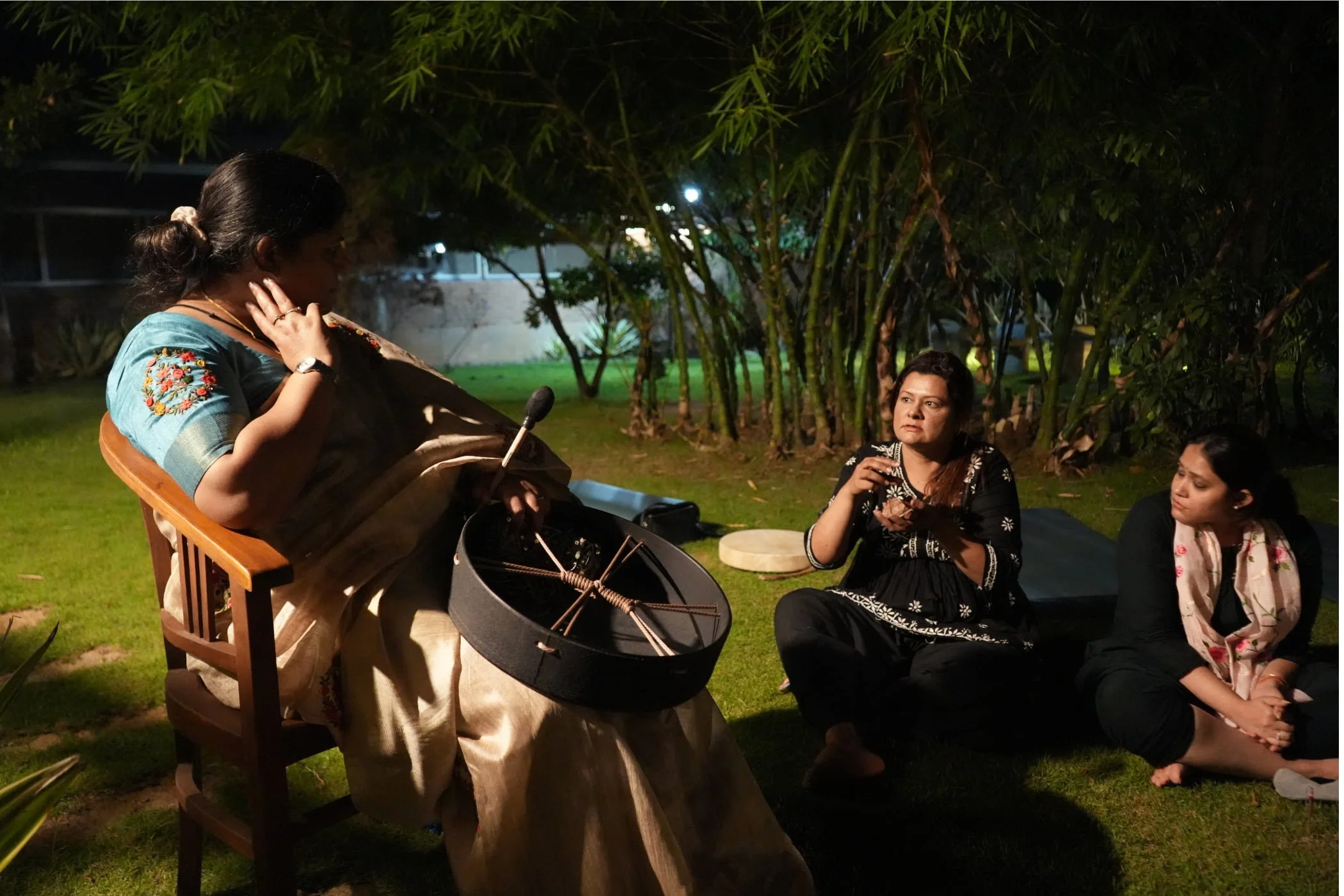
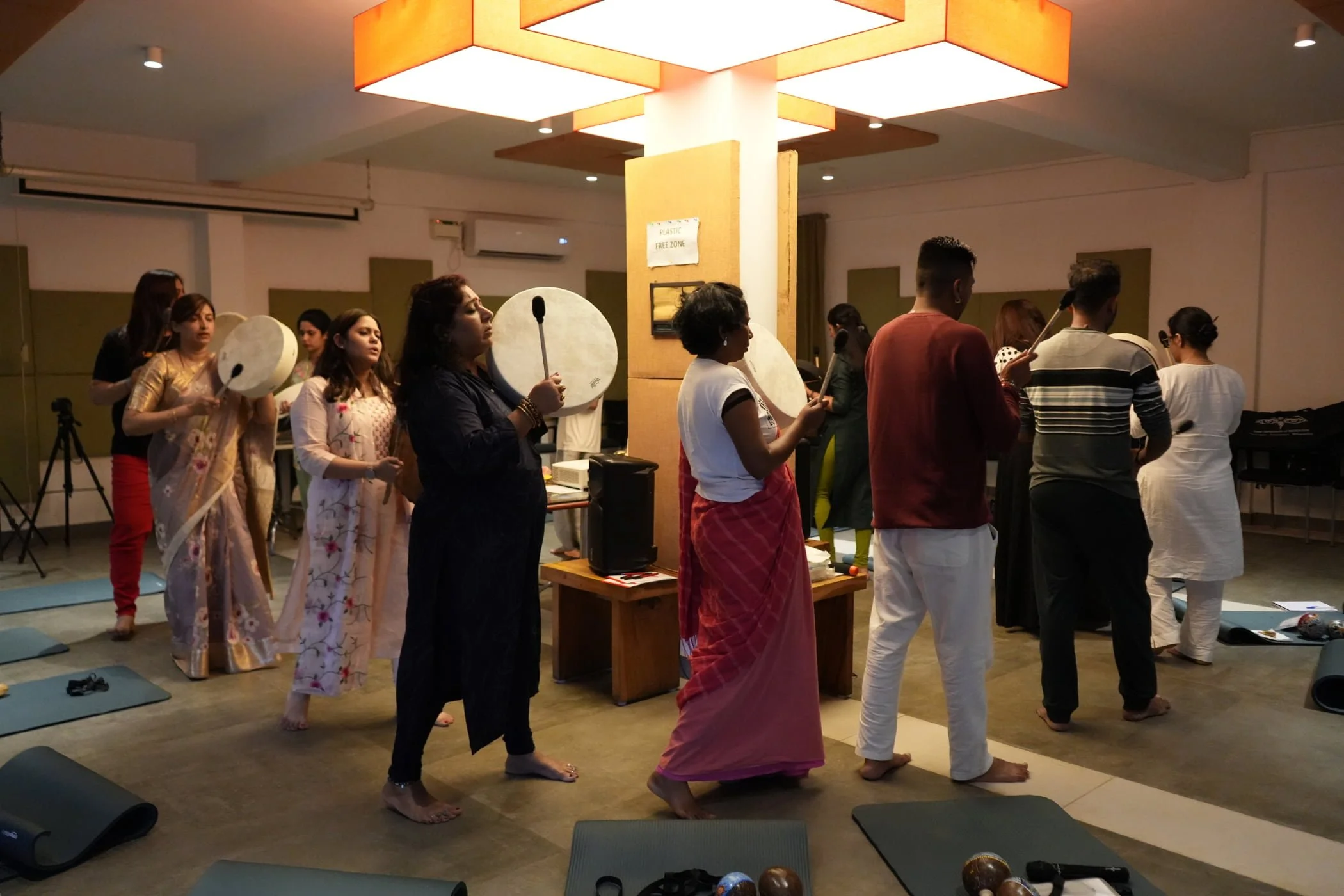
Guided Journeys & Practice
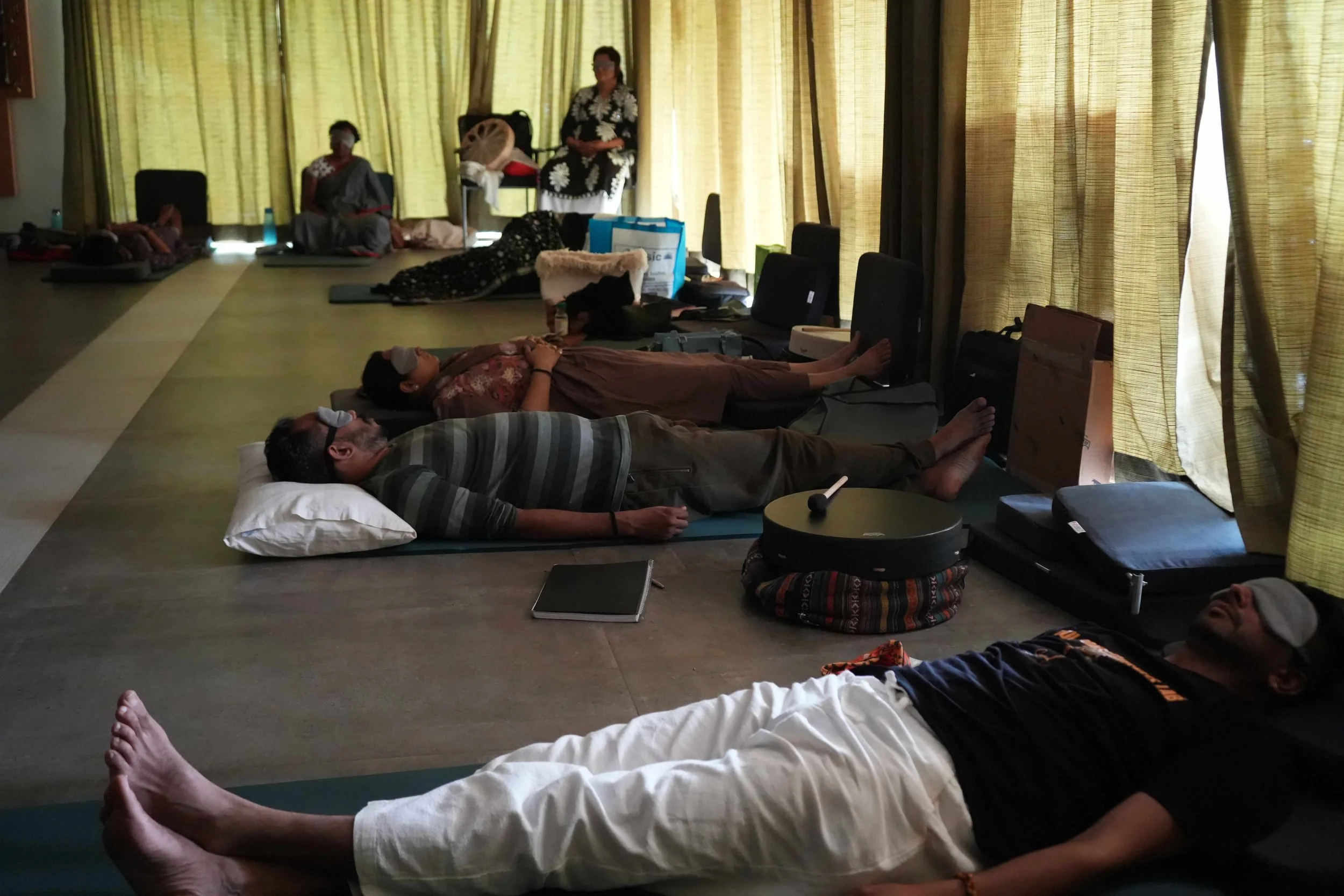
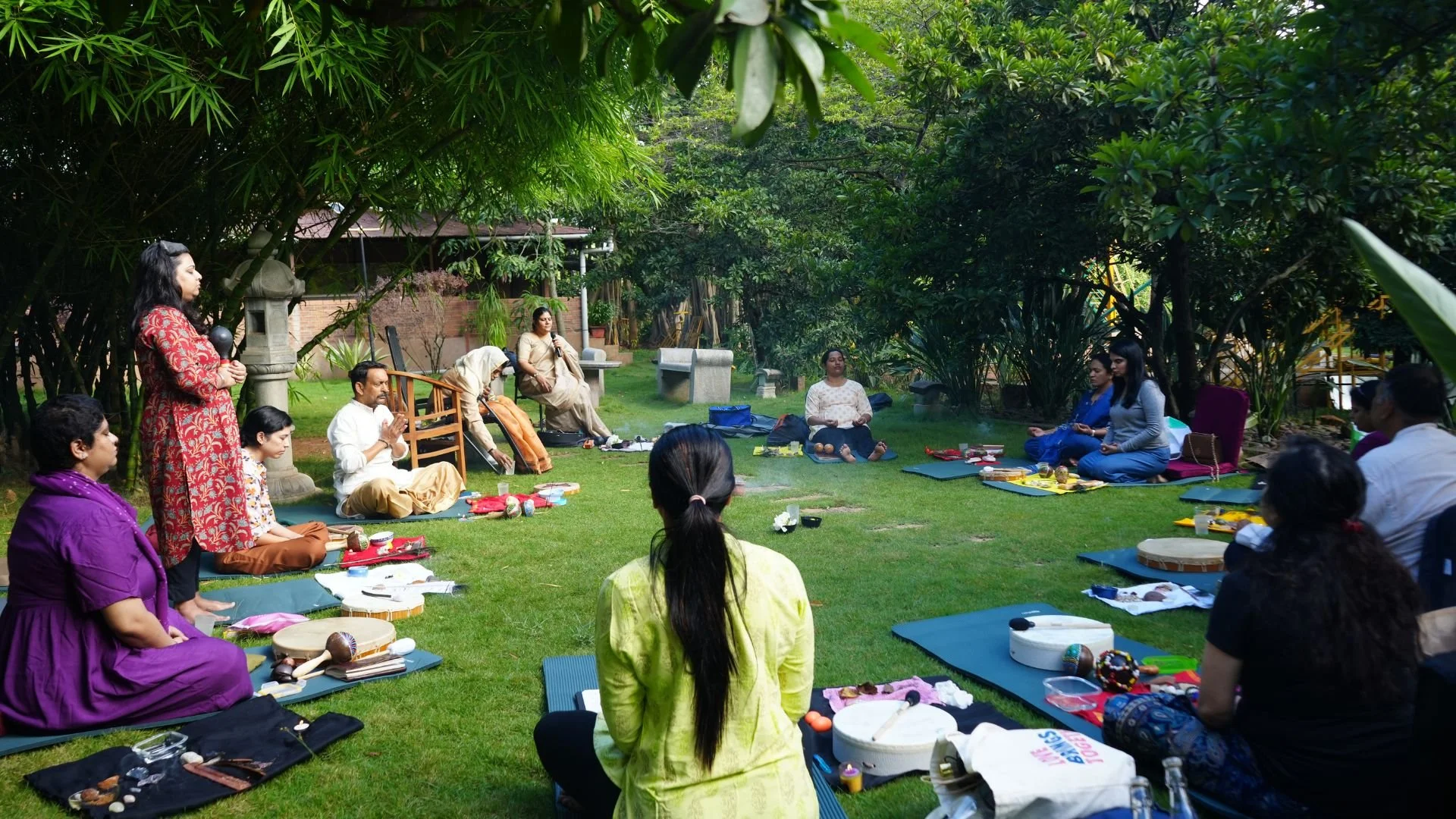
Participants engage in structured, guided journeys into non-ordinary states of consciousness, a core foundation of shamanic practice.
These are not one-time demonstrations.
Each process is practiced multiple times, allowing you to understand not just how to enter these states, but how to navigate, sustain, and return from them safely.
With repetition, clarity begins to replace uncertainty —
and the experience becomes stable rather than accidental.
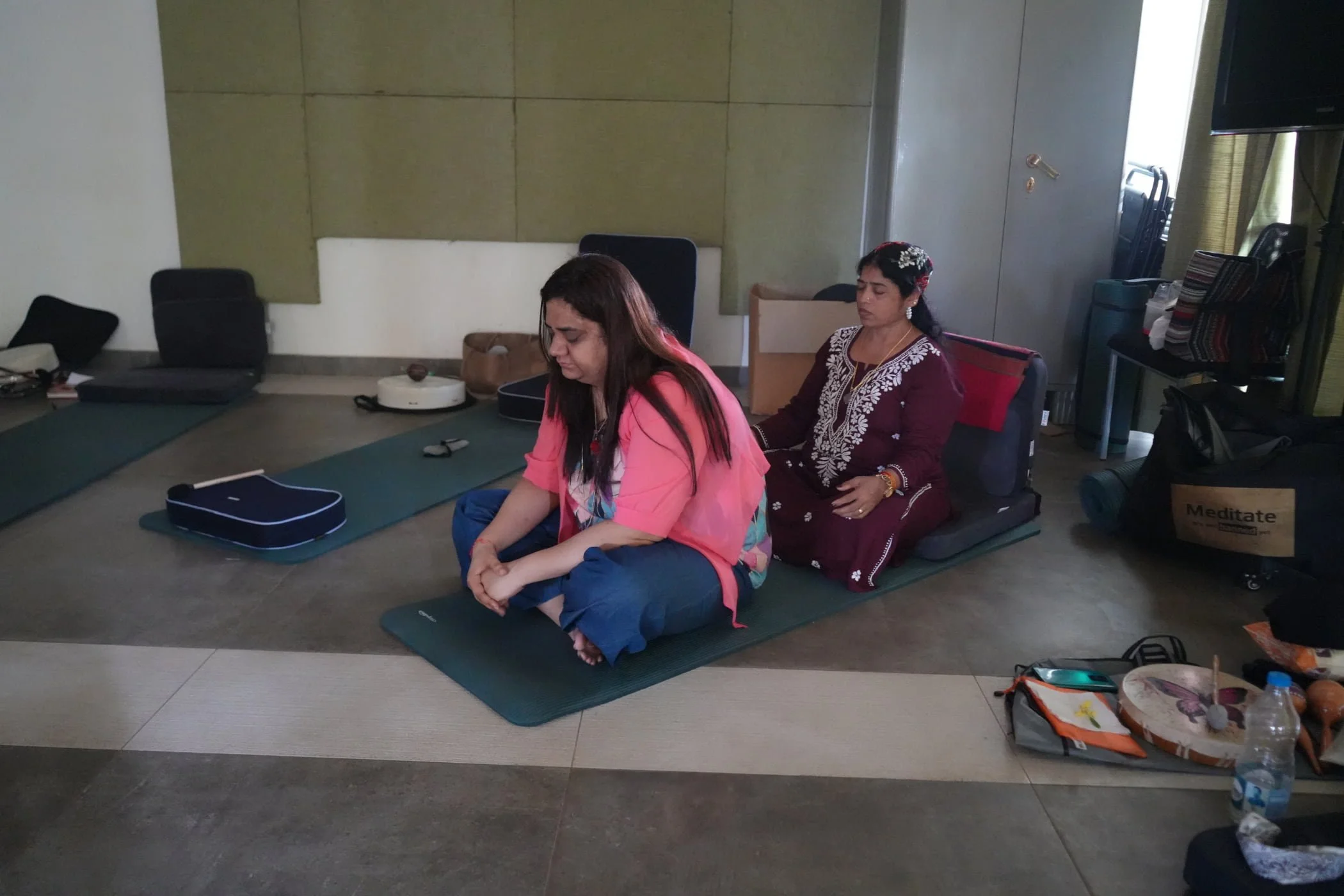
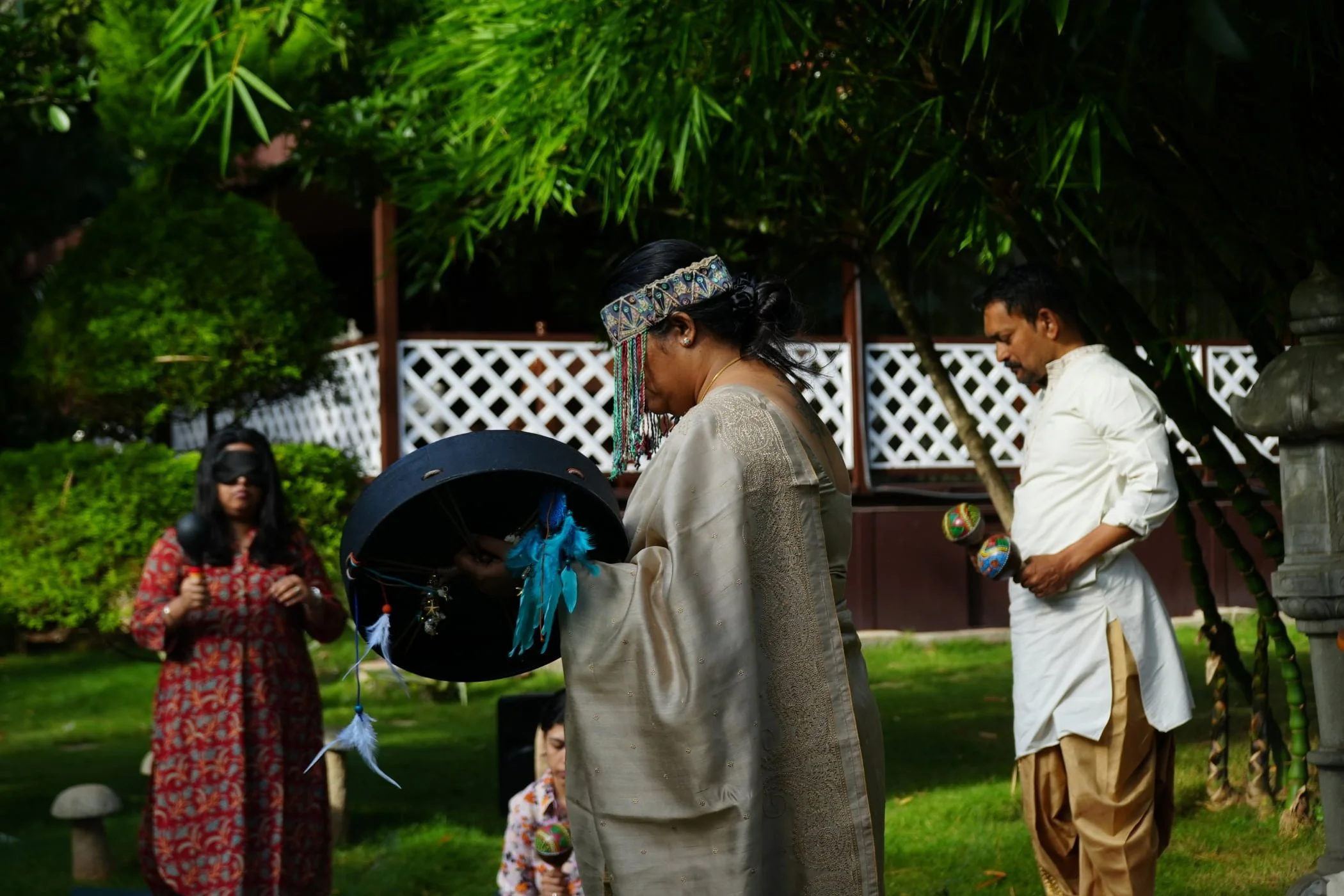
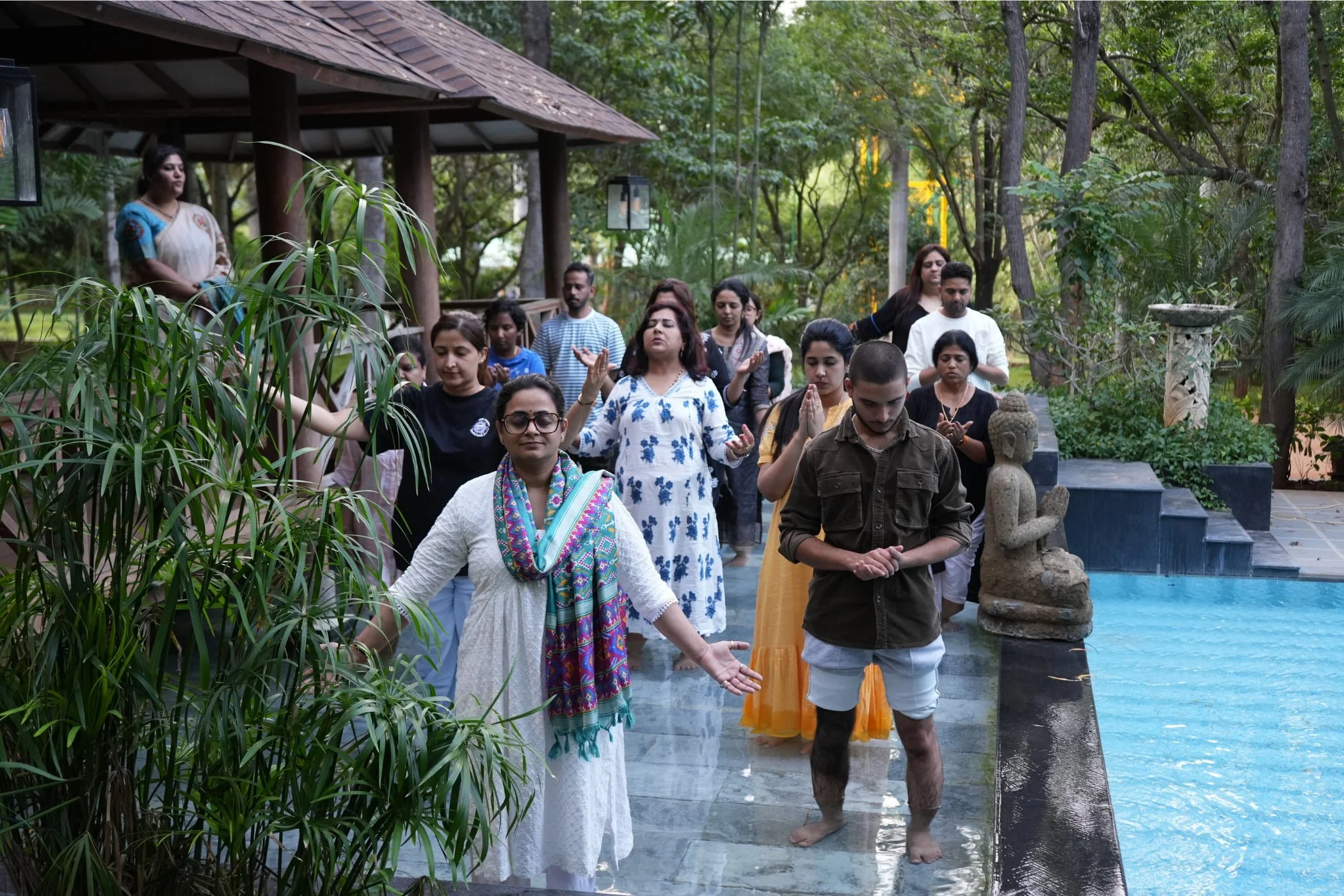
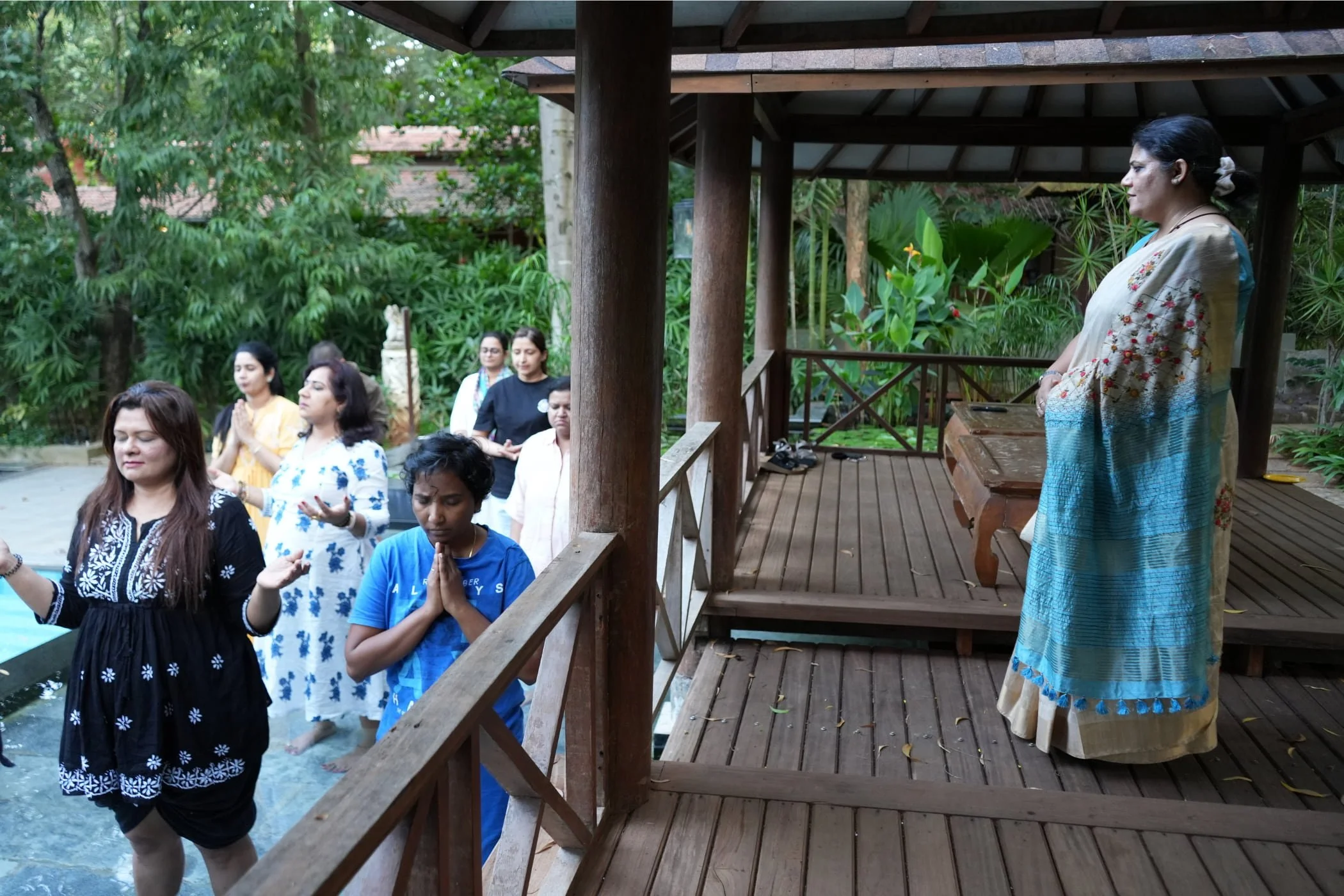
Live shamanic journeying session — learning to enter non-ordinary states safely
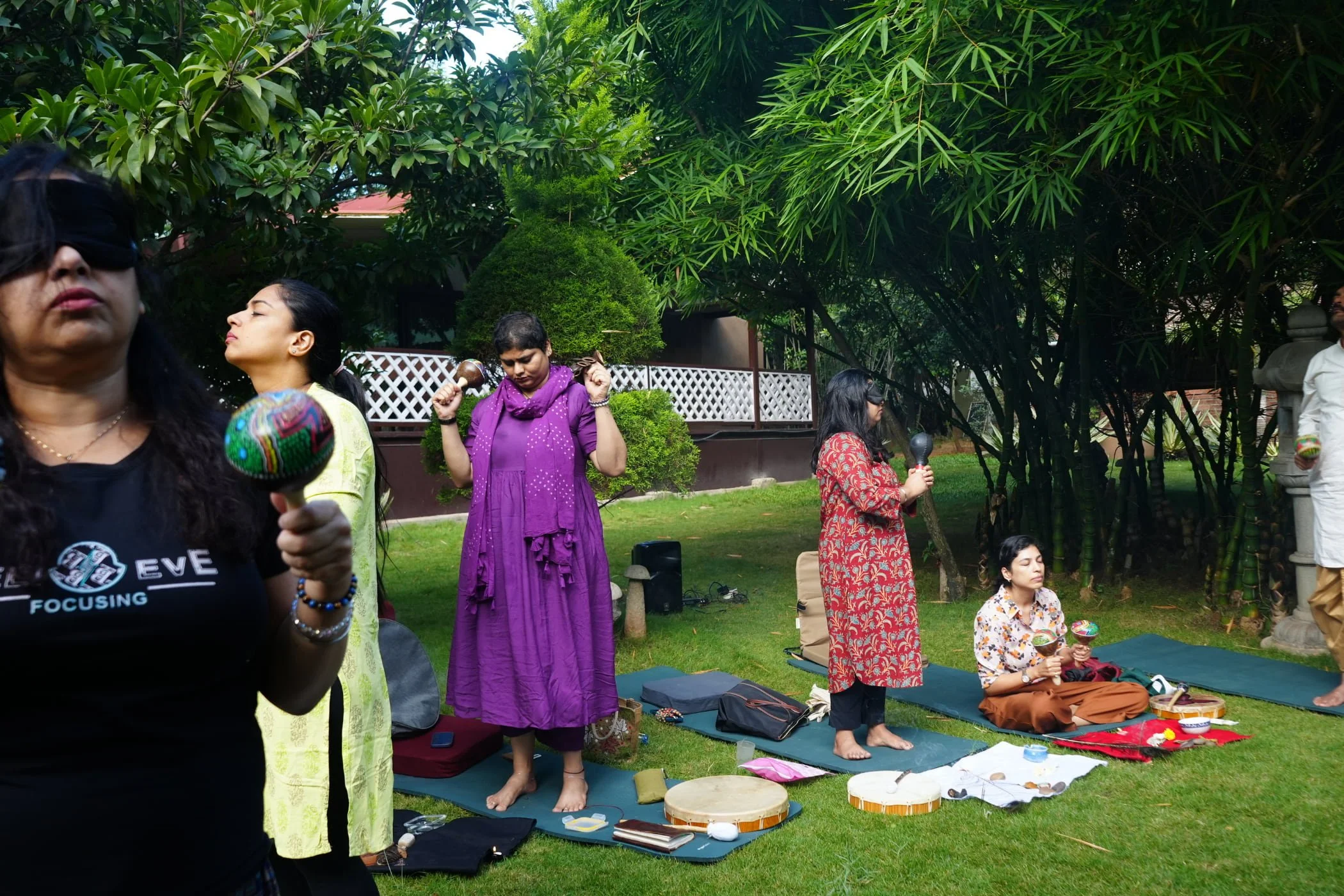
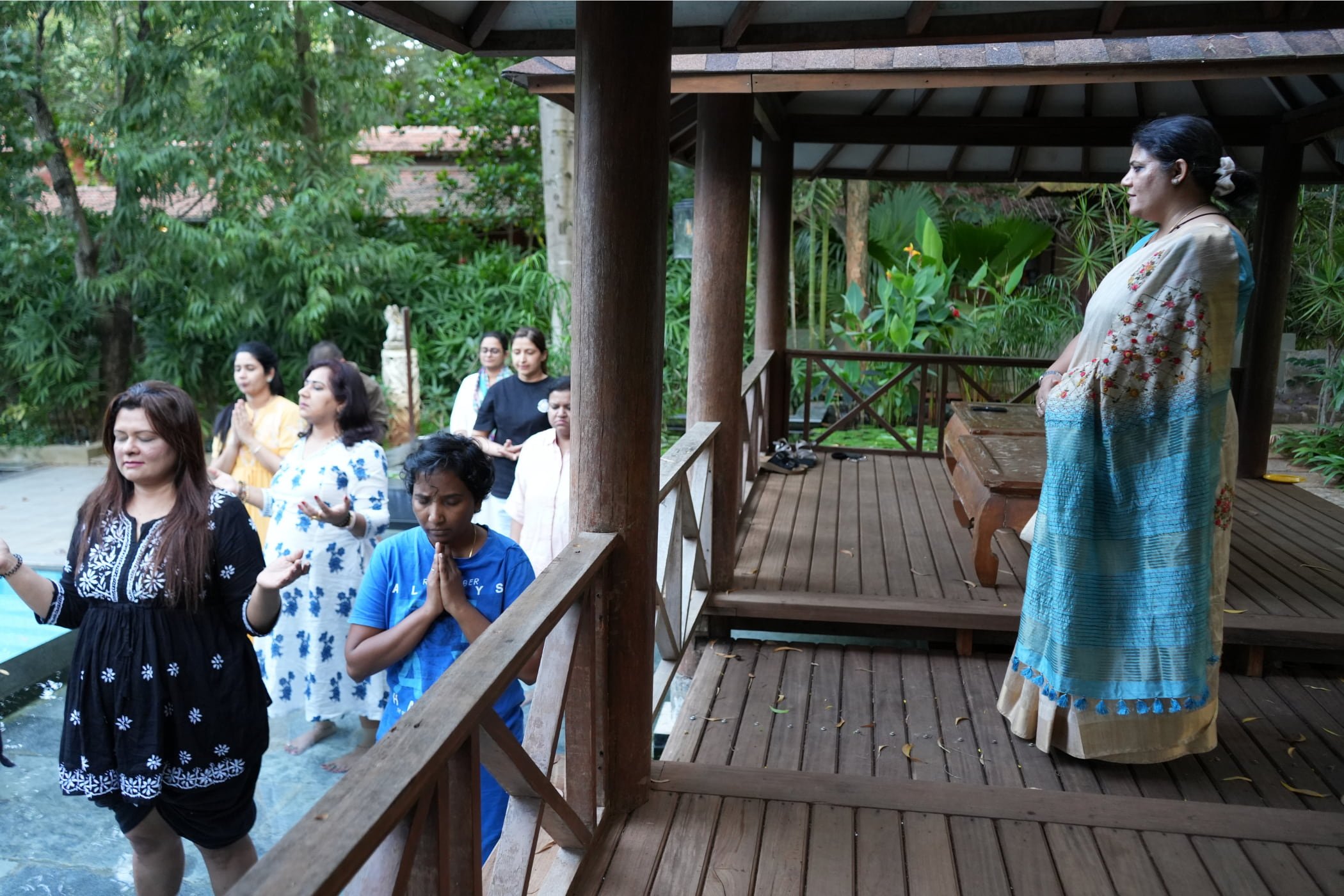
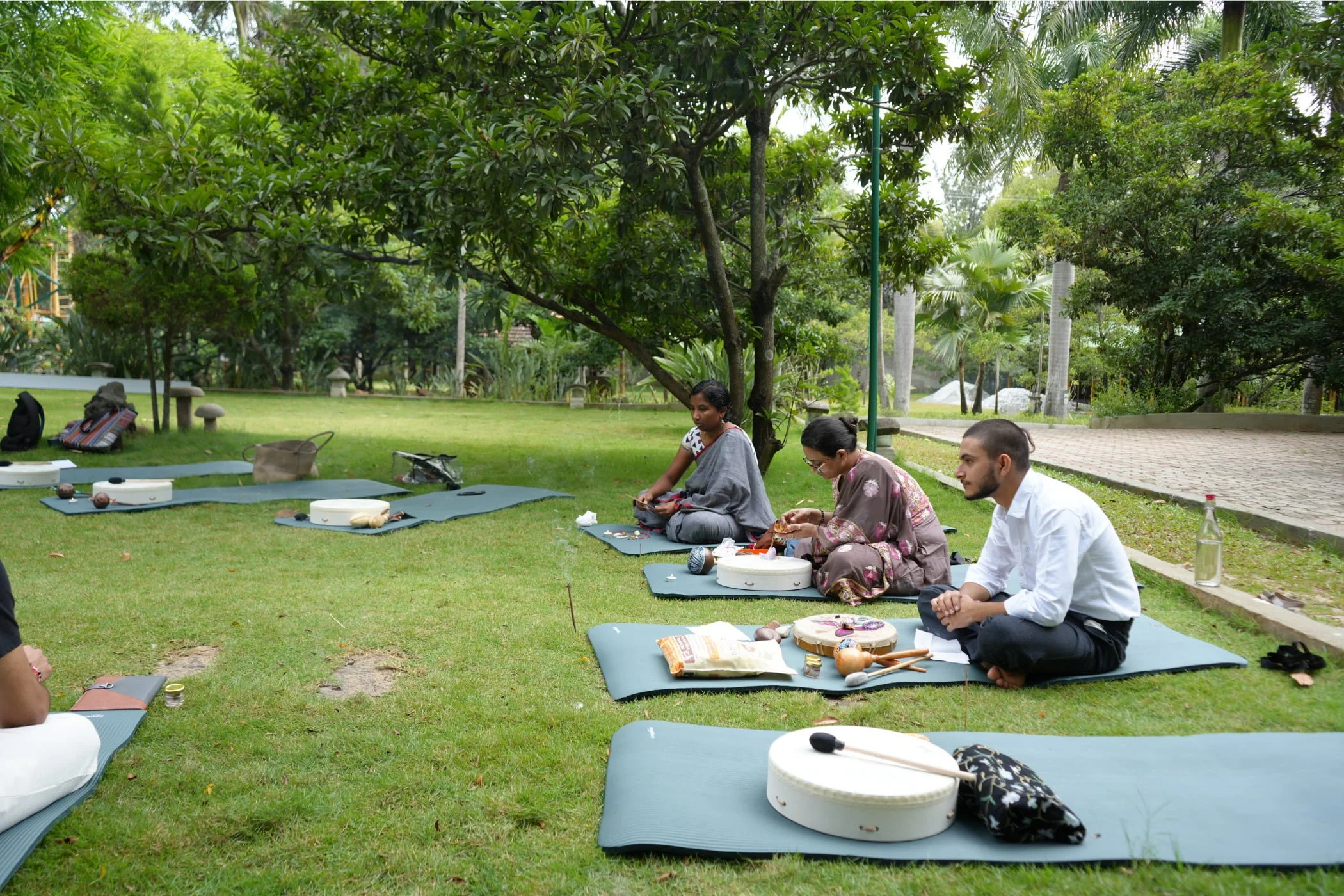
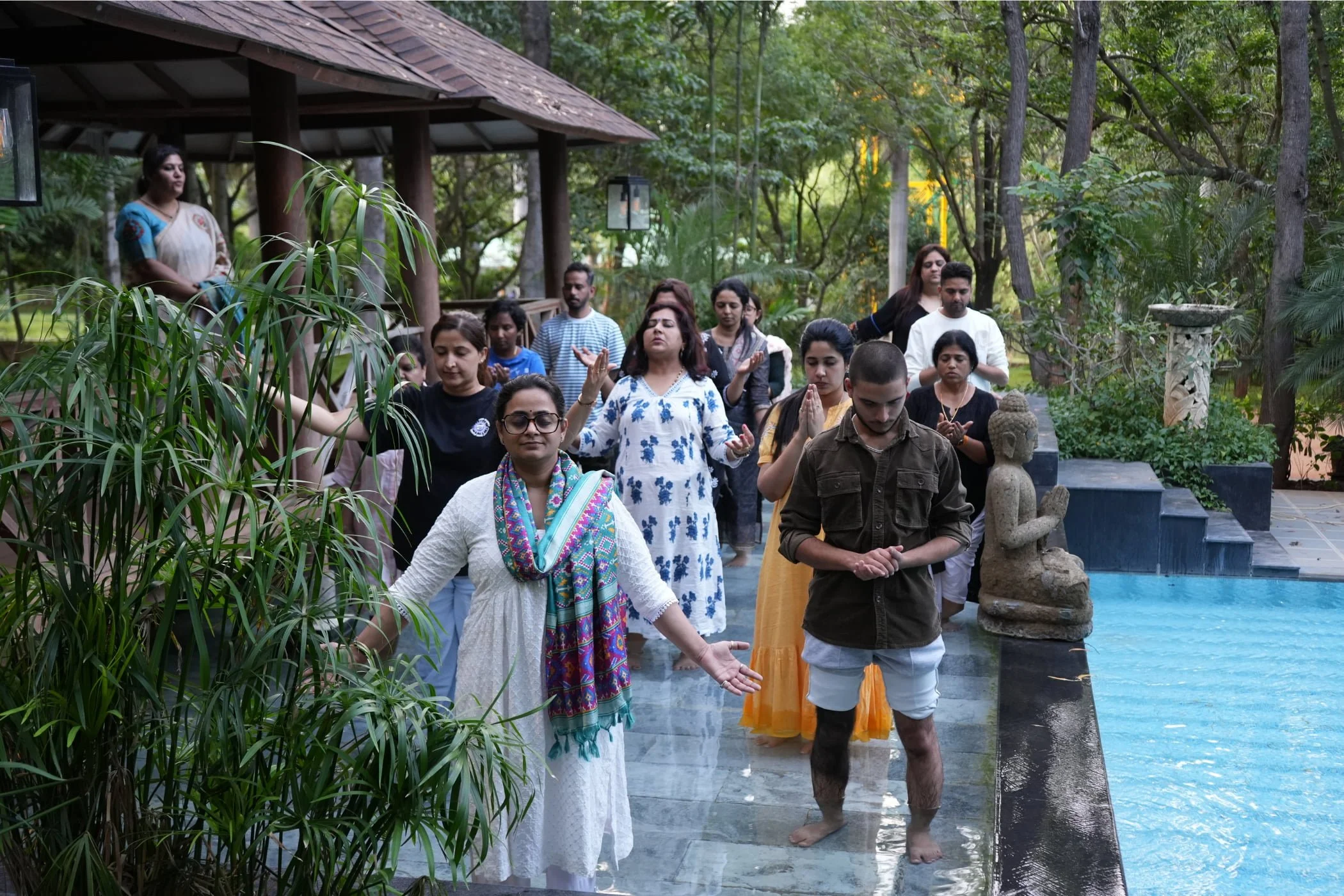
Nature-Based Learning
The training is conducted in natural, outdoor environments, not enclosed classroom spaces.
This allows direct interaction with land, elements, and natural systems, which are central to shamanic practice.
Participants spend time outdoors, learning to connect with the environment not as a concept, but as a living, responsive presence within the work.
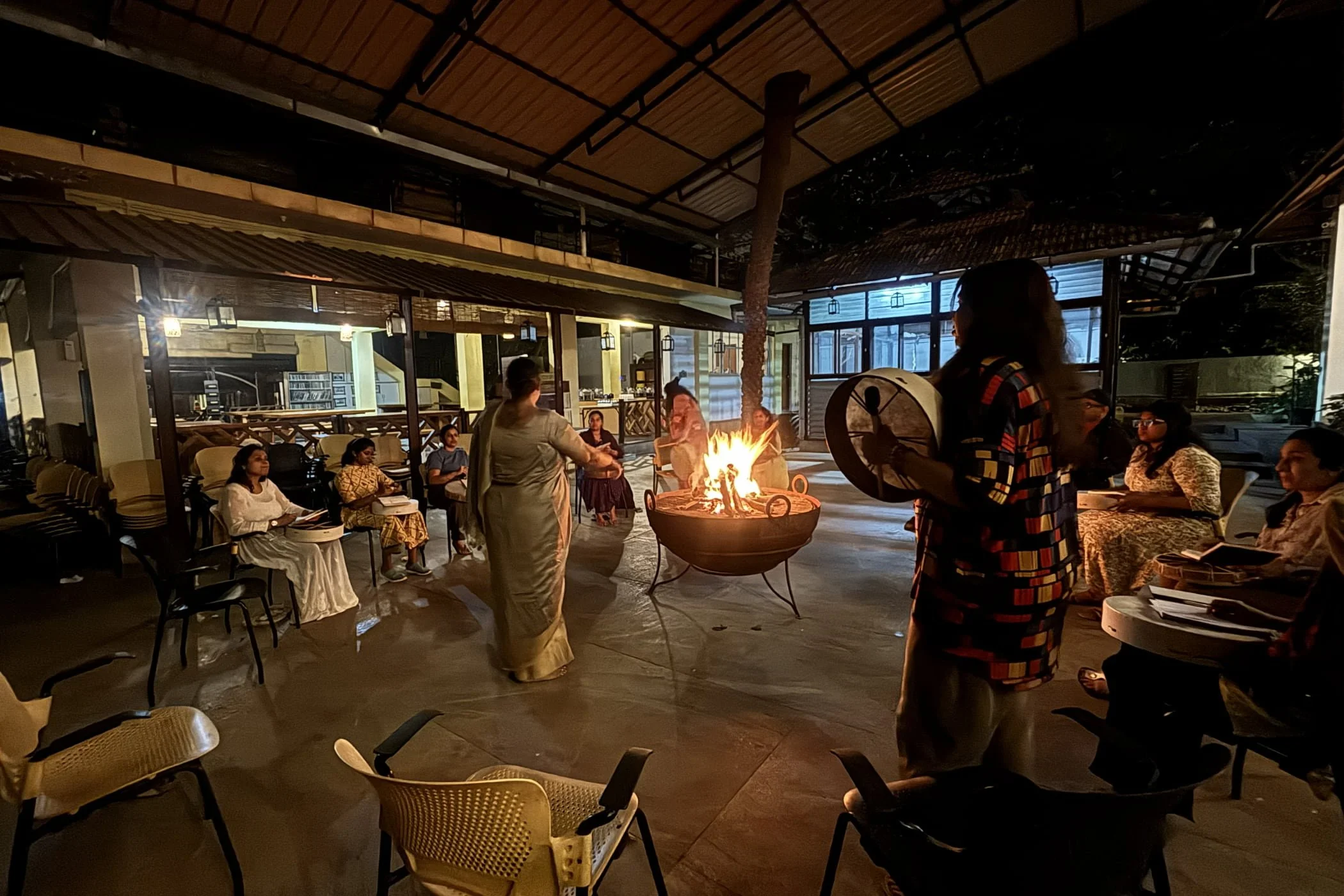
Live shamanic journeying session — learning to enter non-ordinary states safely
Real Practice — Not Demonstration
This training is built on repetition, immersion, and application.
Participants are not watching techniques — they are actively practicing shamanic methods multiple times, across different contexts.
Each process is repeated, observed, and refined with guidance, allowing the experience to deepen naturally over time.
This is where learning shifts from understanding to capability and confidence in real application.
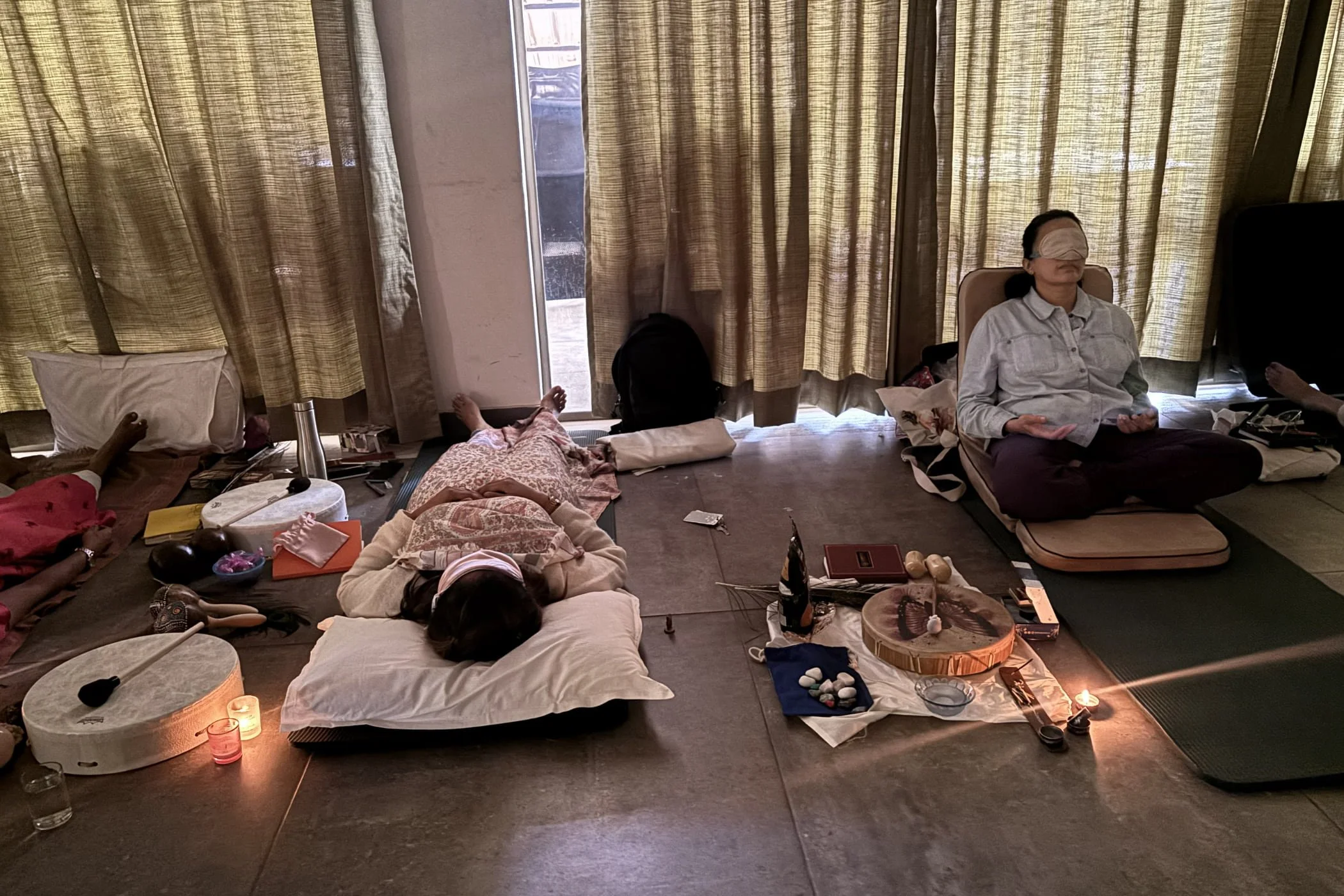
Live shamanic journeying session — learning to enter non-ordinary states safely
Group Work & Shared Processes
A significant part of the learning happens in guided group environments.
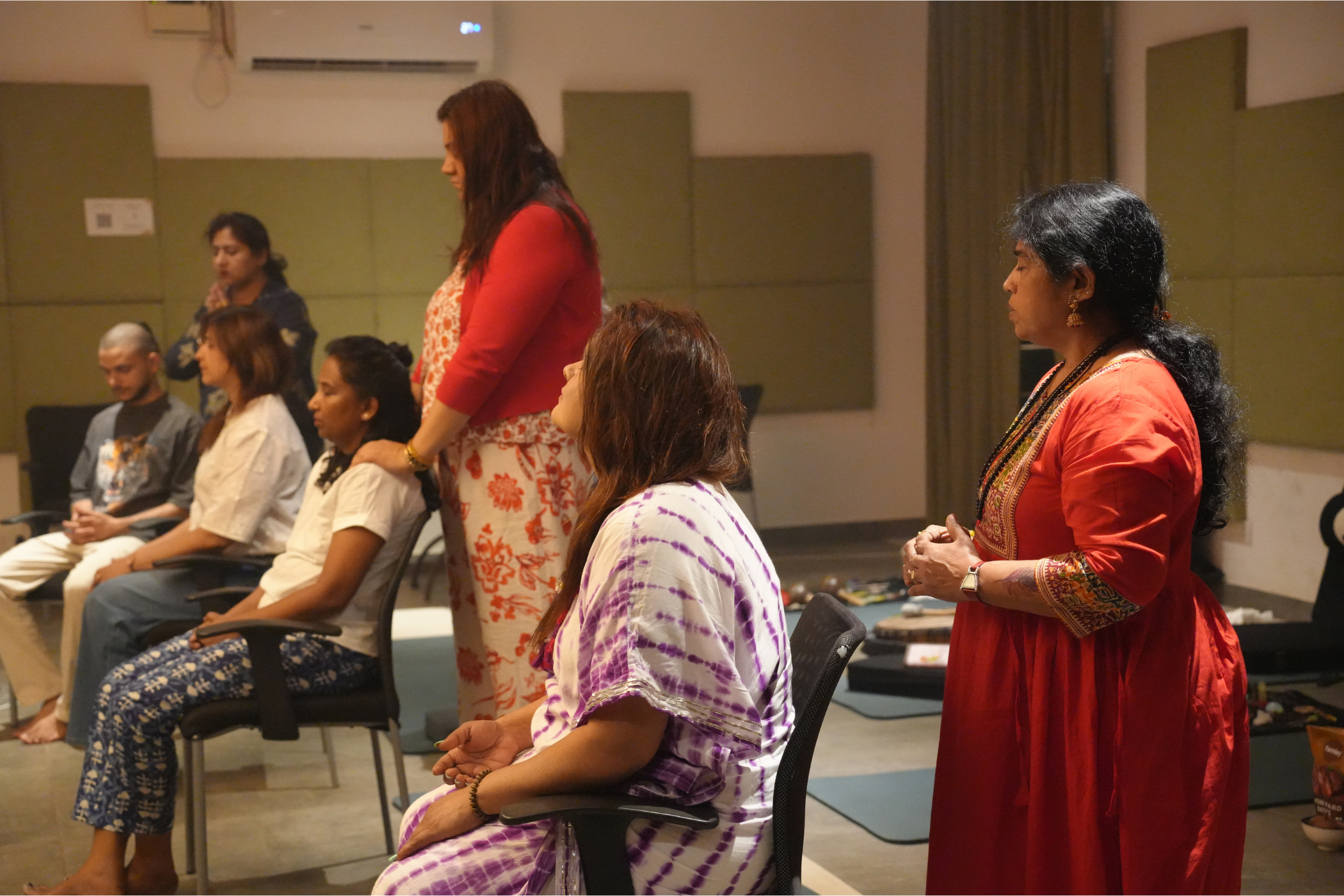
Participants work in pairs, small groups, and structured circles — observing, practicing, and supporting each other through real shamanic processes and healing work.
This creates a learning space where understanding is not only internal, but also reflected through interaction, feedback, and shared experience.
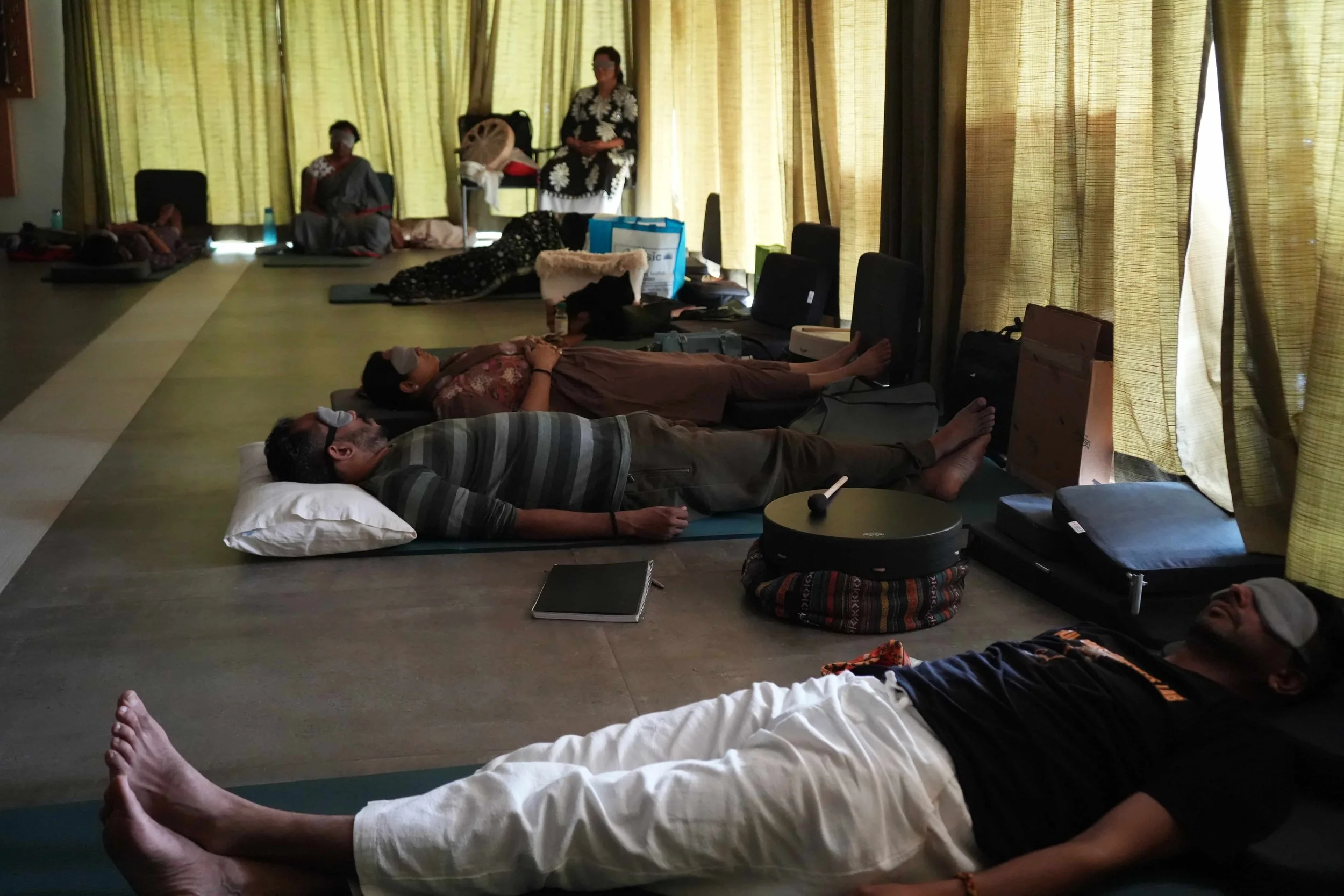
Live shamanic journeying session — learning to enter non-ordinary states safely
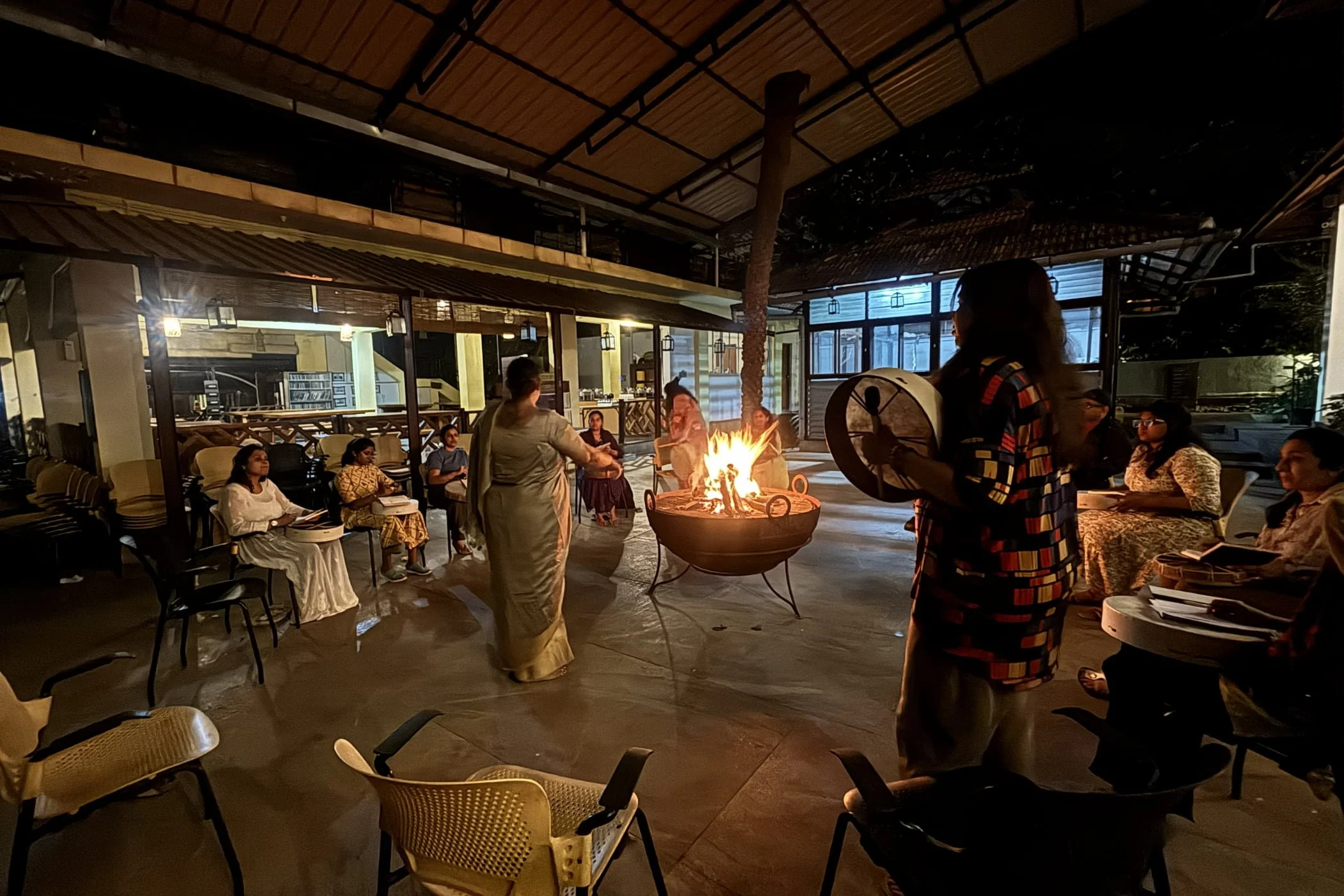
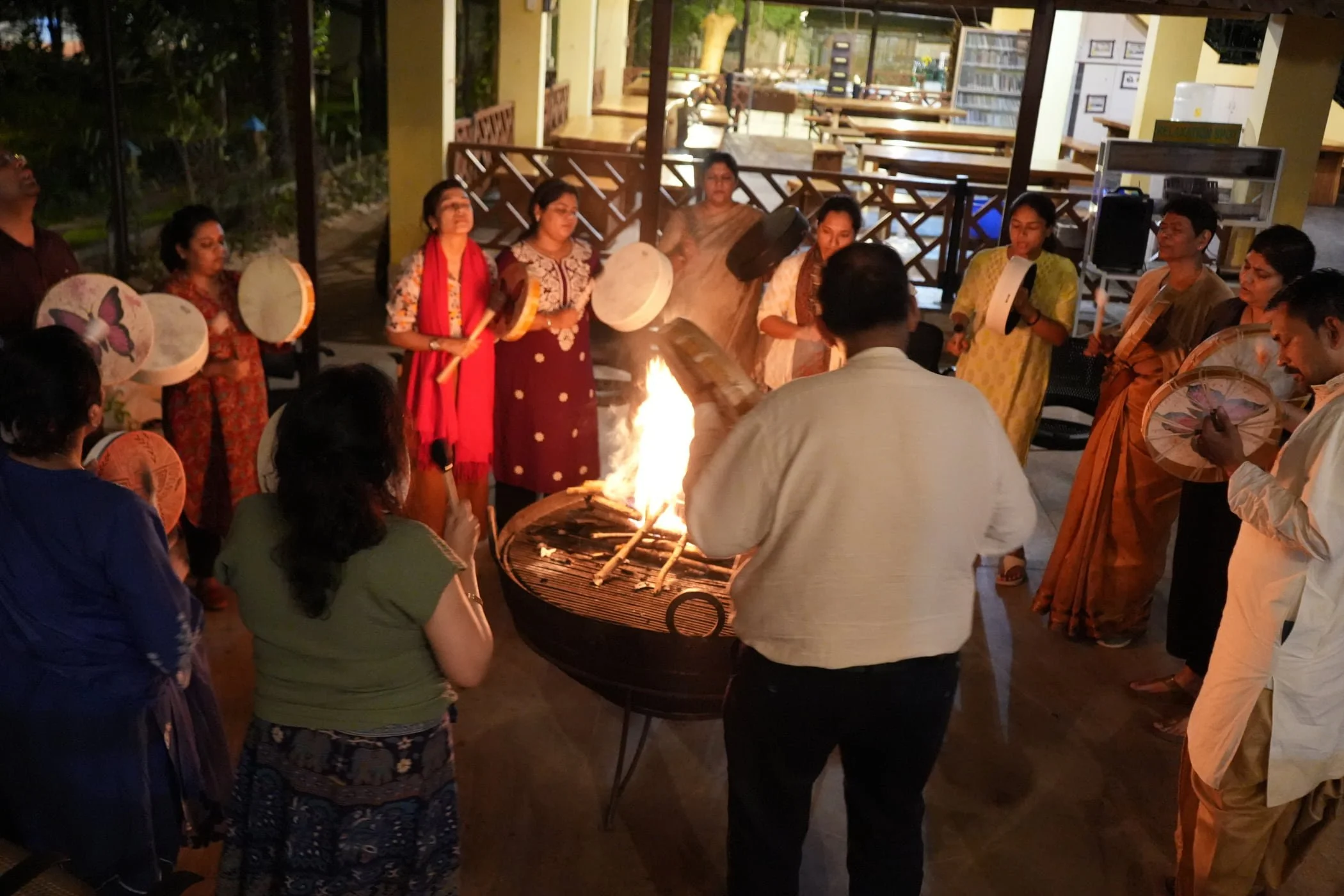
Rituals, Fire & Ceremony
Rituals and ceremonies are an integral part of the training.
These include fire ceremonies, intention work, symbolic processes, and structured ritual practices.
They are conducted in a guided and supervised manner — not as performances, but as processes that support release, transformation, and integration at a deeper level.
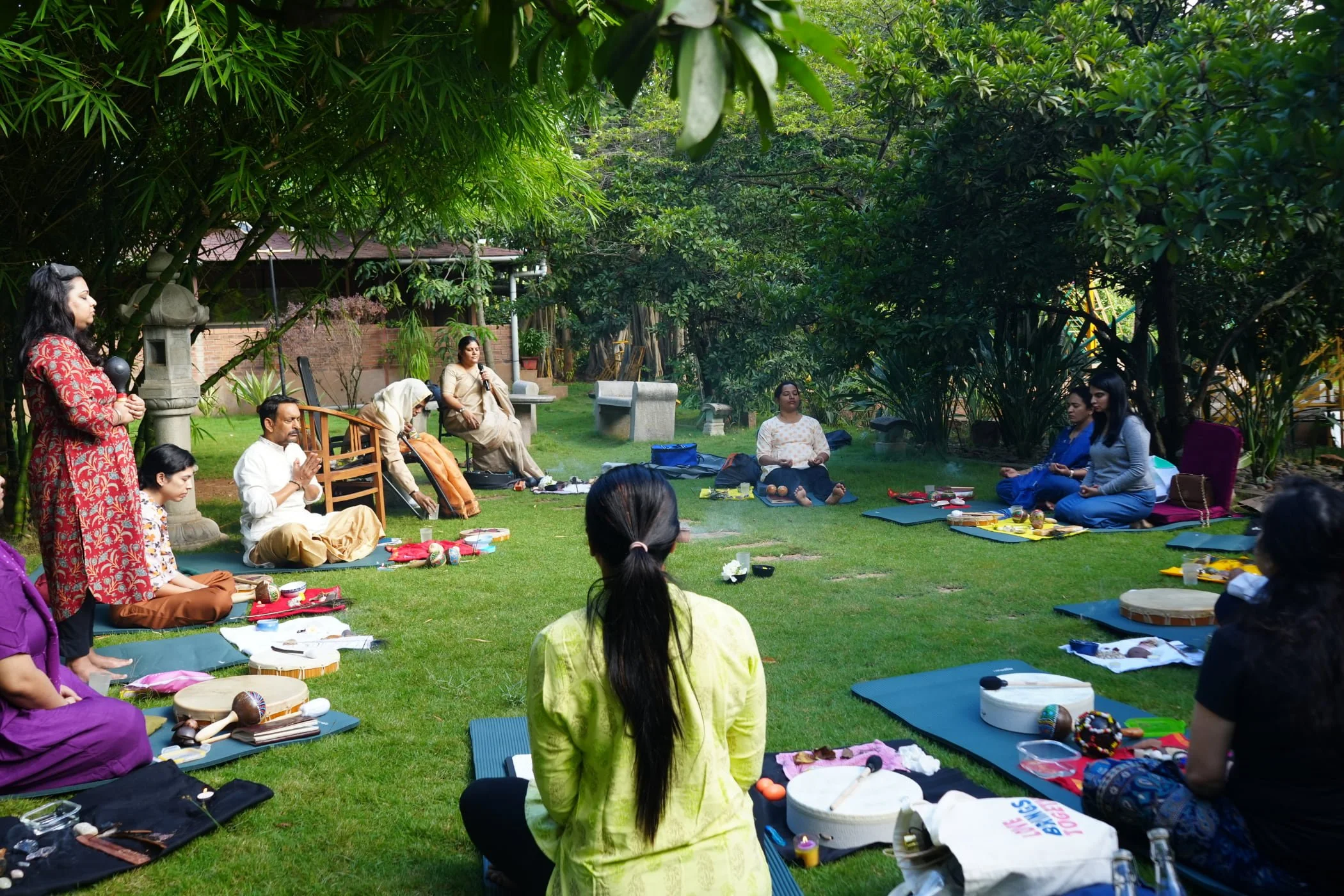
Live shamanic journeying session — learning to enter non-ordinary states safely
Integration Moments
Between structured processes, participants move through moments of silence, reflection, and integration.
This is where experiences begin to settle — and understanding deepens naturally.
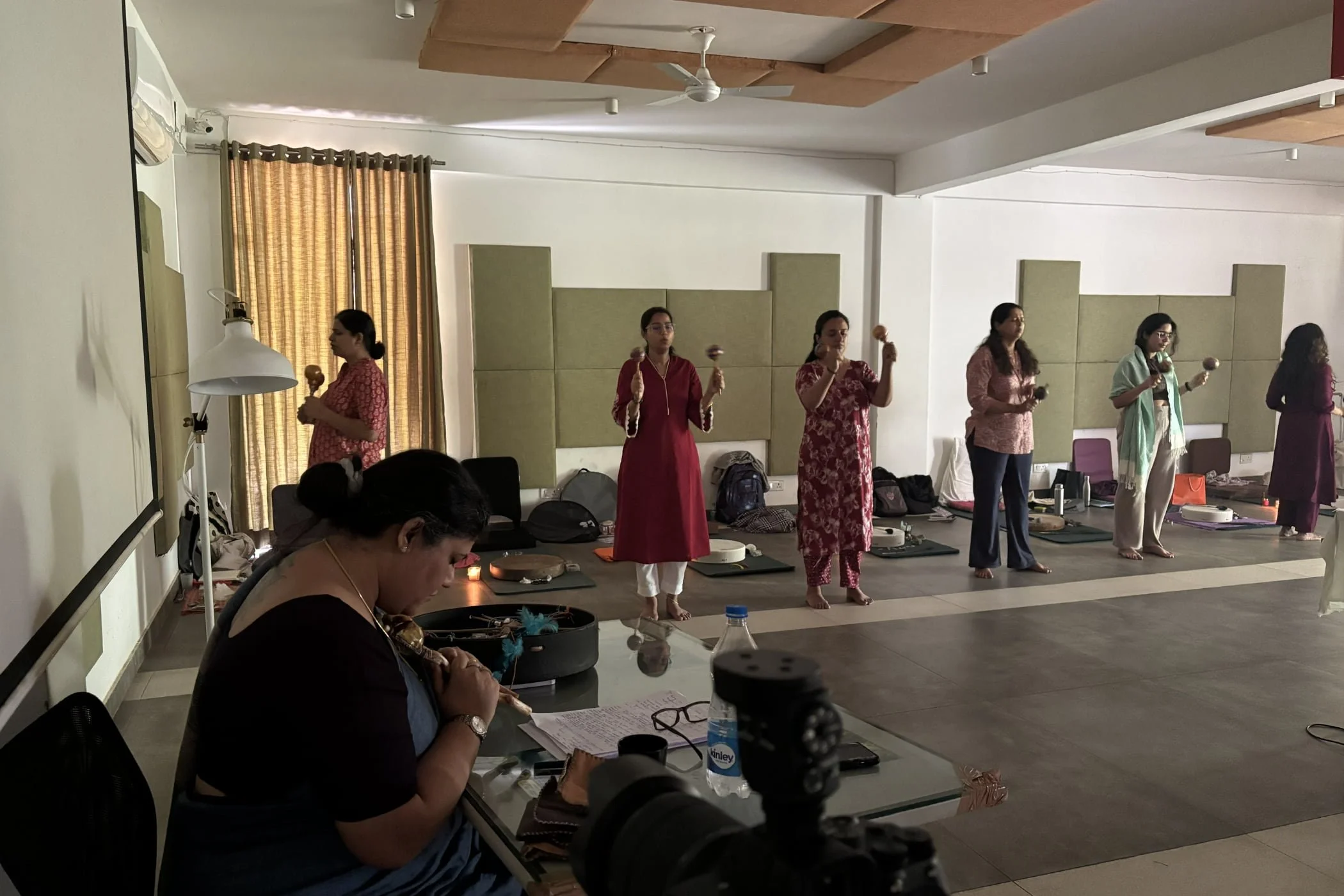
Live shamanic journeying session — learning to enter non-ordinary states safely
This is not a workshop you attend.
It is a process you go through.
What Participants Say About This Shamanism Training
The most accurate way to understand this training
is not through description — but through the experience of those who have gone through it.
Over the past batches, participants from different countries, backgrounds, and professions have gone through this process — many continuing into advanced levels and deeper practice.
These include seekers, therapists, coaches, and individuals exploring shamanism training, consciousness work, and practitioner-level development.
What follows is a small window into those experiences.
98%
of participants recommend this training to others
This is consistent across batches, and across the different programmes conducted by the institute — reflecting not only satisfaction, but the depth of the experience and continued engagement with the work long after the training ends.
Based on post-programme participant feedback collected across all past shamanism batches.
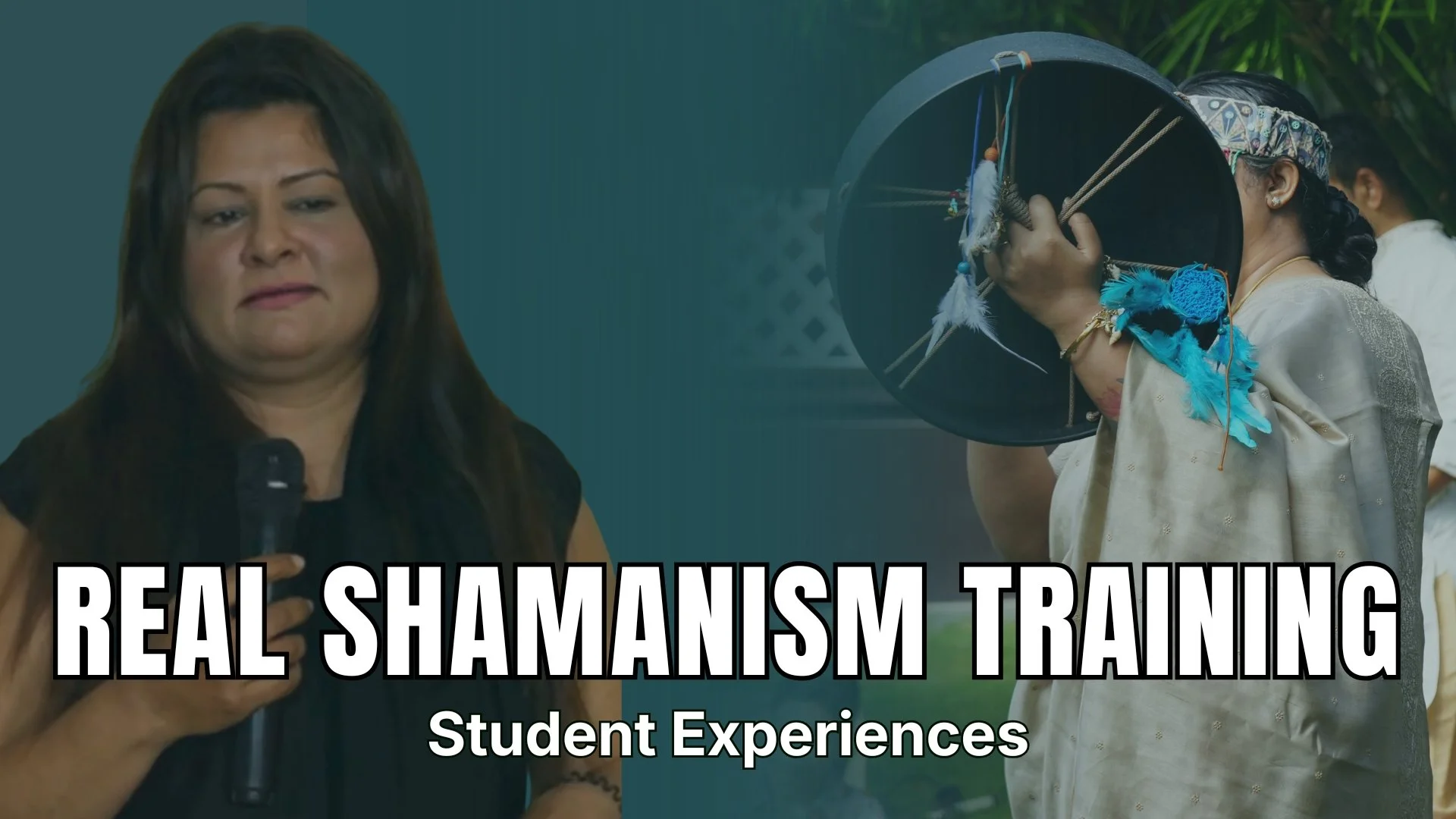
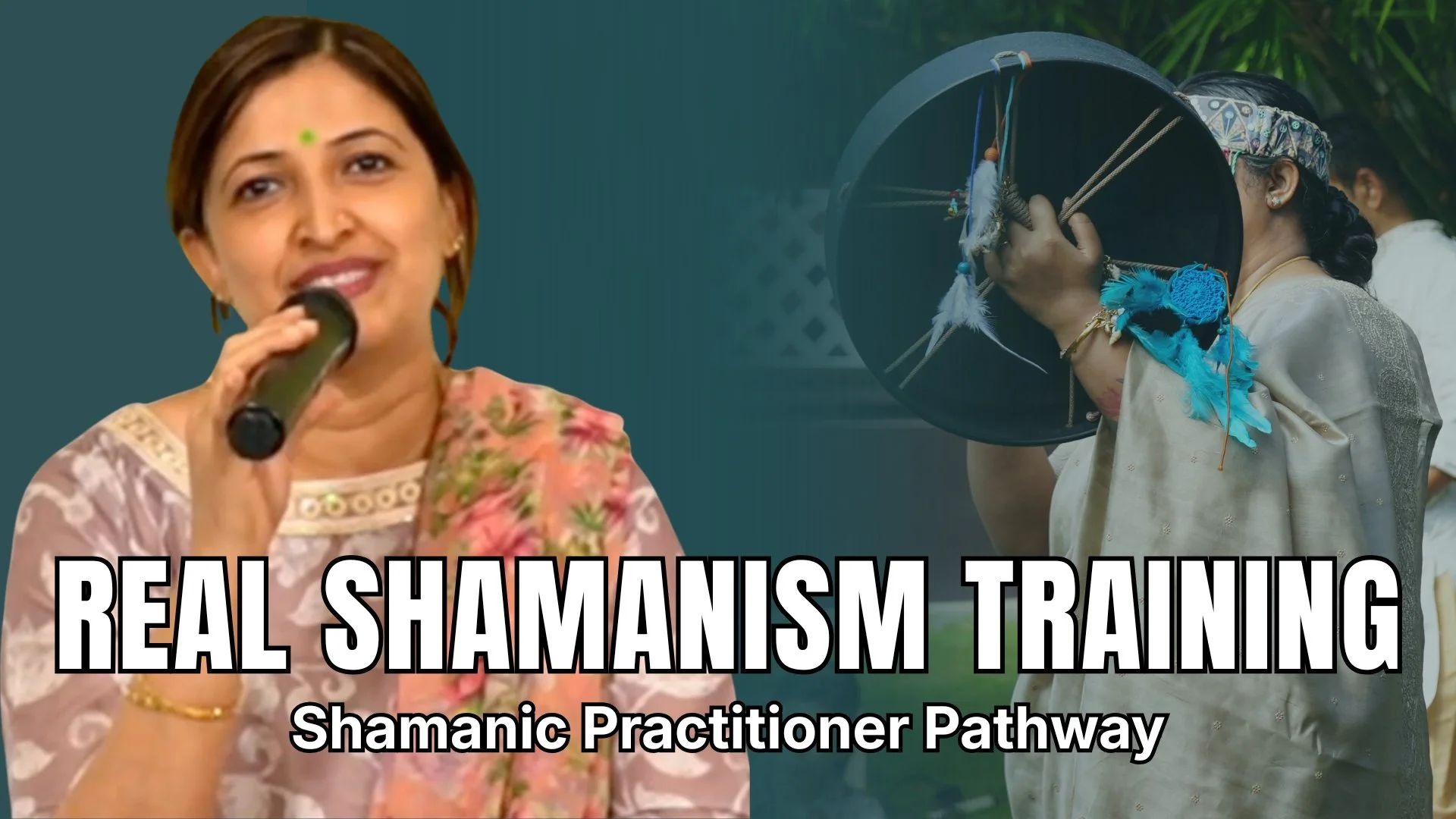
VIDEO TESTIMONIALS
These are not scripted or guided responses.
They are reflections shared by participants after completing the training —
in their own words, based on their direct experience.
Most of these recordings are captured immediately after the program, while the experience is still fresh and unfiltered.
WRITTEN REFLECTIONS
Some experiences are easier to express in writing.
These reflections come from participants after integration —
once they have had time to understand what the training meant for them.
Many of these insights emerge days or weeks after the program, as the work continues to settle and unfold.
“This training shifted my understanding completely. It is not something you learn, it is something you experience.”
Level 2 Participant
“The depth, structure, and support made this unlike anything I have attended before.”
International Participant
“I continued to Level 3 because the work stays with you even after the training ends.”
Advanced Practitioner
Participants commonly share outcomes such as:
Greater clarity in perception and decision-making
Deeper emotional stability and awareness
Stronger connection with intuition and inner guidance
Ability to practice shamanic techniques independently
Continued engagement with healing, ritual, and consciousness work
These are not promised results —
but patterns observed across multiple batches of participants.
Speak to Past Students Before You Decide
Before joining, you are welcome to connect with past participants.
You can speak to them directly, ask questions, and understand the training from their perspective — without filters.
This includes discussing the structure, experience, challenges, and real outcomes of the program.
We believe this level of openness is important for making the right decision.
The Trainer's Own Path
Where This Training Came From
This training is not built on a single system, and it is not assembled from books.
It comes from years of learning on the ground — in different countries, within different traditions, from teachers who practise what they teach. What Dr. Rashhi brings to a room in Bangalore was learned in Peru, in Ireland, in Mexico, in Thailand, and in the places where these traditions are still alive.
That is a different foundation from studying one method and passing it on.
A Global Learning Journey
Dr. Rashhi's shamanic work has been shaped through direct field training across several continents — not conferences or online modules, but time spent within living traditions.
This breadth matters for a practical reason. It shows how differently cultures approach healing, ritual, nature connection and consciousness — and where, remarkably, they converge. Those points of convergence are what a training can safely be built on.
Traditions She Has Trained Within
The training draws on several streams of shamanic practice:
- Core shamanism — certified practitioner, Foundation for Shamanic Studies
- Andean and P'aqo tradition — lineage learning in Peru
- Celtic tradition — lineage practices in Ireland
- Mexican shamanic tradition — direct lineage exposure
- Elemental, land-based and nature-connected practice
- Ritual, ceremonial and journey-based systems
These are not taught as separate traditions to adopt. They are integrated into one structured process, built around experience, safety and clarity in practice.
Fifteen Years of Practice Before Teaching
Dr. Rashhi worked with clients for 15 years and more than 8,500 sessions before she began training others.
That order matters. Every method taught here has been tested and refined across thousands of real sessions — not rehearsed from a manual, and not learned in order to teach it.
It is also why the training is built around practice rather than theory. Someone who has sat with that many people knows what a student will actually face, and what they will need when they do.
Where Her Work Meets This Training
Dr. Rashhi works across shamanism, consciousness exploration, regression and therapeutic practice. That combination is unusual, and it shapes how shamanism is taught here.
It means the work is held with an understanding of psychological ground as well as spiritual tradition — where the two meet, where they differ, and when a person in front of you needs something other than what you are trained to offer.
Her full credentials, and the institutions that issued them, are set out below.
This is not a training built on borrowed knowledge. It is built on lived experience — structured so that it can be shared, practised, and carried responsibly.
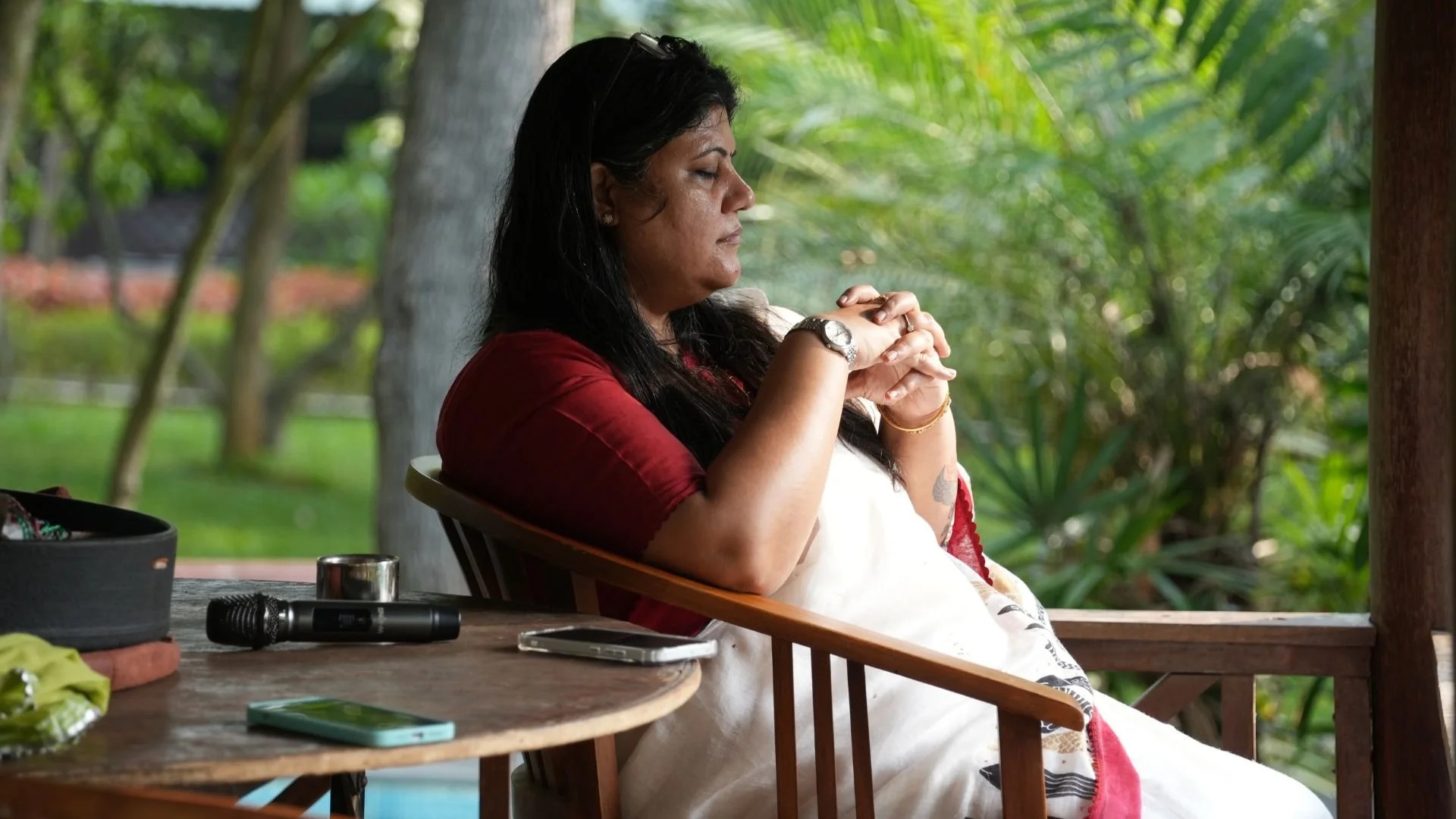
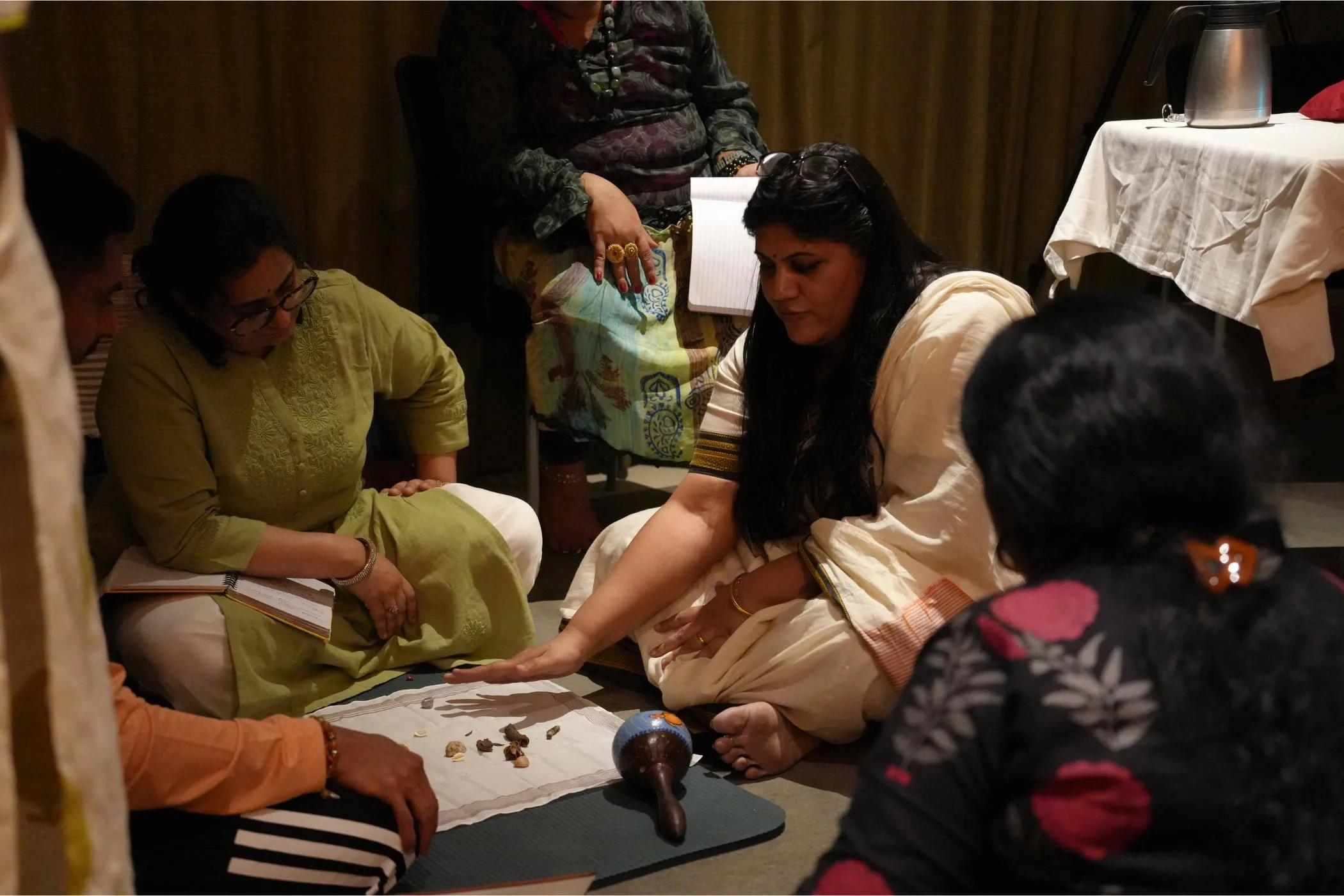

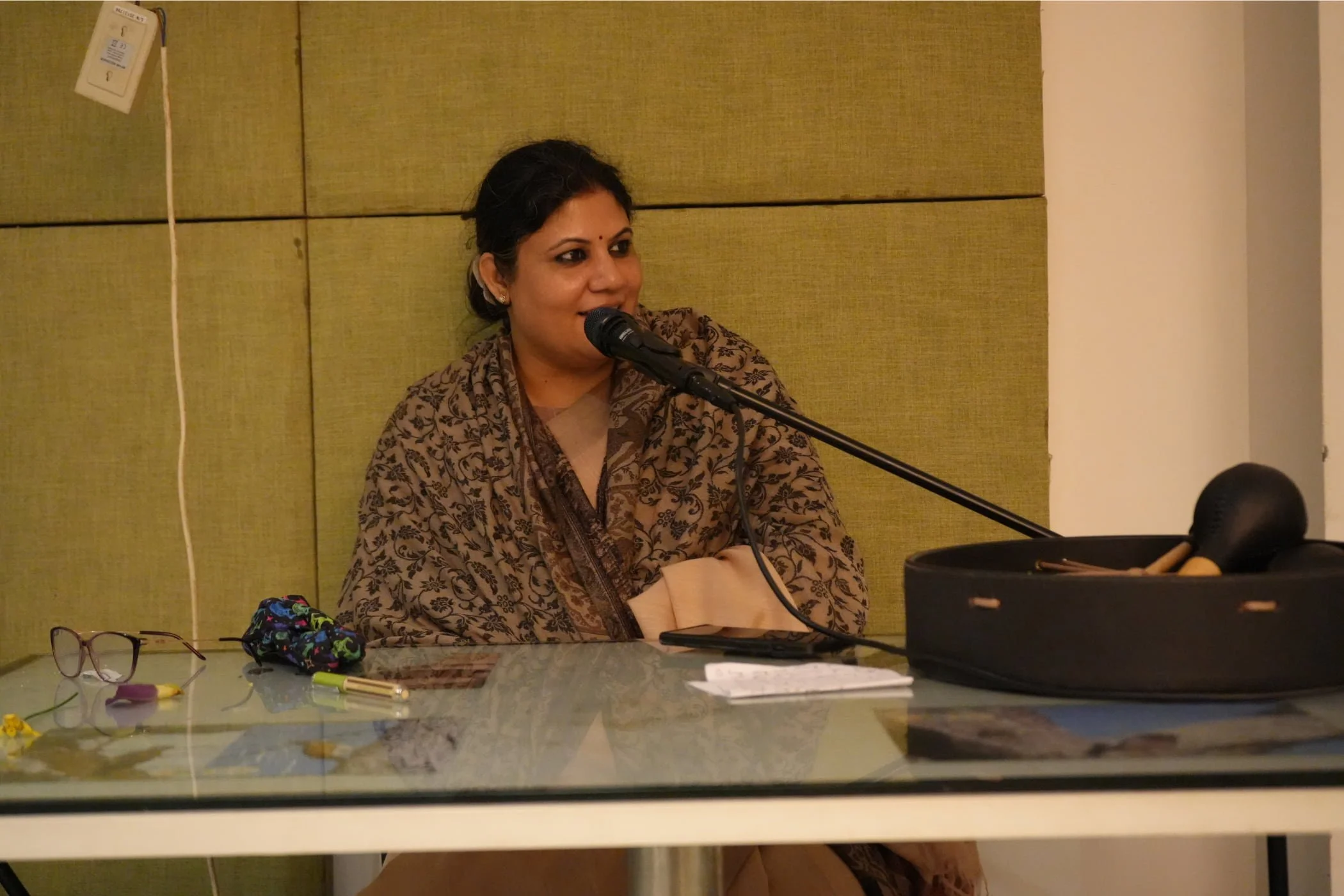
Dr. Rashhi Sharma, PhD
Trained by the field's leading figures. Tested across thousands of client sessions.
A practitioner who trains — not a trainer who practises
Dr. Rashhi Sharma delivered 8,500+ professional sessions across 15+ years before she began teaching others to do the same. Every technique she teaches has been tested and refined across thousands of real client sessions — which is why the training is built around practice rather than theory.
She has trained directly under leading figures in regression, Life Between Lives, mediumship, remote viewing, shamanism and consciousness exploration — one of very few practitioners anywhere certified across all six fields. Her principal credentials are publicly verifiable through the institutional listings below.
She has since trained 350+ certified practitioners from 28 countries — professionals who now carry these methods forward in their own practices globally.
NGH Instructor Certification
Don Mottin — Las Vegas, USA
Certified Hypnotherapy Instructor
NGH — National Guild of Hypnotists, USA
Master Hypnotist
Cal Banyan — USA
Certified Hypnotherapist (CHt.)
NGH — National Guild of Hypnotists, USA
Life Between Lives (LBL) Certified Practitioner
MNI — Michael Newton Institute, USA
Advanced Past Life Regression
Paul Aurand — USA
Past Life Regression
Dr. Brian Weiss — USA
PLR & Future Life Progression
Anne Jirsch — UK
Transpersonal Hypnotherapy, Womb Regression & Inner Child Healing
Paul Aurand — USA
Certified Outreach Trainer
The Monroe Institute — USA
Consciousness Exploration & OBE Programs Graduate
The Monroe Institute — USA
Spiritual Mediumship
Suzanne Giesemann — USA
Remote Viewing — Advanced
Joseph McMoneagle & Debra Catz — USA
Psychokinesis & Manifestation
Joe Gallenberger — USA
Energy Medicine
Dr. Brian Dailey — USA
The Kortum Technique
John Kortum — USA
Certified Shamanic Practitioner
Foundation for Shamanic Studies (FSS Asia) — Thailand & Bali
Multicultural Shamanism — Field Training
Mexico · USA · Peru · Norway · Ireland · France · Italy · Greece · Thailand · Bali
Celtic Tradition
Ireland — Lineage practices
P'aqo & Andean Tradition
Peru — Andean lineage
Mexican Shamanic Tradition
Mexico — Direct lineage exposure
Don Mottin
USA — Las Vegas
NGH Instructor Certification
Dr. Brian Weiss
USA
PLR & Advanced Regression
Paul Aurand
USA
LBL · Transpersonal Hypnotherapy
Anne Jirsch
United Kingdom
PLR · Future Life Progression
Calvin D. Banyan
USA
Master Hypnotherapy
Joe McMoneagle
USA
Remote Viewing Advanced
Suzanne Giesemann
USA
Spiritual Mediumship
Joe Gallenberger
USA
Psychokinesis & Manifestation
Allison Axinn
Italy
Life Between Lives · MNI
Official Career Partner & LBL Practitioner
Michael Newton Institute, USA
Only MNI Career Partner in India
MNI Career Partners Directory
Official Certified Instructor
National Guild of Hypnotists, USA
Outreach Trainer — India
The Monroe Institute, USA
Executive Trainer Accreditation
IPHM, United Kingdom
Certified Life Between Lives (LBL®) Therapist — Michael Newton Institute, USA
There are only approximately 230 certified LBL therapists worldwide — all trained and certified exclusively by the Michael Newton Institute (USA). Dr. Rashhi Sharma is among them, and one of the very few based in India. LBL therapy goes beyond past life regression, working with the soul state between lifetimes as documented in Dr. Michael Newton's research across 7,000+ cases. View the verified MNI profile → newtoninstitute.org
Official Career Partner — Michael Newton Institute (MNI), USA
Soul Consciousness Lab® is one of only 12 Career Partners approved by the Michael Newton Institute (USA) worldwide — and the only one in India. Career Partner status recognises institutions whose training pathway meets MNI's standards as the officially recognised prerequisite route to LBL® certification. Our Clinical Hypnotherapy and Past Life Regression programmes carry this distinction. View the verified MNI Career Partner listing → newtoninstitute.org
Fees & Inclusions
Level 1 — Foundation Programme
The Foundation Programme is where every participant begins. It is fully residential — you live, practise, eat and rest on site for the duration, which is what makes the work possible at this depth.
The 60 hours across these five days count guided group practice under direct supervision, individual morning and evening practice, dream work and the discussions that follow it, and night practice. In this tradition these are not additions to the training — they are where much of the learning happens, which is why the programme is residential rather than taught in sessions.
Fees are shown in full below. There are no additional charges beyond those listed.
Tuition
Training, materials and certification
₹99,000
Residential Stay
Accommodation and all meals, on site
Total Programme Fee
Tuition and residential stay combined · inclusive of GST
What Is Included
- All training sessions and supervised practice
- Accommodation for the full residential period
- All meals throughout the programme
- Training materials and handbook
- Certificate of completion issued by Soul Consciousness Lab®
- Continued access to the practitioner community after the programme
Not Included
- Travel to and from Bangalore
- Airport or station transfers
- Personal expenses
- Any extension of stay beyond the programme dates
What About Levels 2, 3 and 4?
The pathway has four levels, but there is no obligation to continue beyond Level 1. Many participants complete the Foundation Programme and practise with what they have learned; others progress over several years.
Because of this, we do not ask anyone to weigh a four-level commitment while deciding on the first. Fees for all four levels are set out in the training brochure and FAQ document, and are confirmed with you at the eligibility discussion for each stage, on completion of the level before it.
Payment, Confirmation & Cancellation
Places are not confirmed by payment alone. Every participant has an alignment discussion with our team first; a place is confirmed once that discussion is complete and payment is received.
Applications for the September 2026 batch close on 15 September.
Our full payment schedule and cancellation terms are set out in our Training Terms & Conditions.
Or speak with our team first — we are happy to answer questions before you apply.
Post-Training Support
The Five Days Are the Beginning. The Six Months After Are the Training.
Most programmes end when the teaching ends. This one opens into a structured six-month practice period with a weekly circle, a daily practice, a practice log, and continued access to Dr. Rashhi.
“This practice period is not a gap. It is the real training.”
Shamanic skill comes from repetition, not exposure. What you learn in five residential days becomes yours through months of steady practice — and doing that alone, without a circle or guidance, is where most people quietly stop.
of Practice
Weekly Circle
Group journeys, partner divination, and shared practice — every week, sometimes twice.
Monthly With Dr. Rashhi
Live sessions for questions, real cases and direct guidance.
Daily Practice
A structured routine you are given, from fifteen minutes upward.
Reach Out Anytime
When something arises in your practice, you are not waiting for the next call.
Your Daily Practice
You leave with a written practice guide, not a memory of five days. It sets out exactly what to do and for how long.
- A daily minimum of 10–15 minutes — grounding, protection, one short journey, clean closure, and a few lines of journal
- A deeper practice of 20–40 minutes, three or four days a week
- One longer Training Day each week of 60–90 minutes, to build skill rather than maintain it
The guide is specific by design. “Keep practising” is not instruction — knowing precisely what to do on a busy Tuesday is.
The Weekly Shamanic Circle
Every batch becomes a circle, and the circle keeps meeting — weekly on Zoom, sometimes twice a week.
A typical circle runs 60 to 75 minutes:
- Opening directions and protection, together
- A short group journey
- Partner divination practice
- Brief sharing — from experience, not theory
- Power animal song and dance as a group
- Closing and gratitude
Circles also work collectively on a single consented case — everyone journeys on one question, then compares what came. It is the fastest way to learn that guidance arrives differently for different people, and that different does not mean wrong.
Circle rules are firm: everyone joins sober and grounded, confidentiality is absolute, and anyone who feels overwhelmed says “pause” and is brought back to the body.
Monthly Live Sessions With Dr. Rashhi
A live session each month for what a circle cannot resolve on its own.
- Questions arising from your own practice
- Real cases and situations you are holding
- The nuances of this work that are not visible at a beginner level
- Direct guidance on practice, safety and application
If something cannot wait for the monthly session, a circle can request a meeting with the trainer between them.
When to Reach Out
You are told explicitly when to contact Dr. Rashhi rather than working it out alone:
- You have felt stuck or blocked for more than two weeks
- You repeatedly feel fear after journeying
- Dreams or visions are affecting your daily life
- A client situation feels too heavy or complex
- You are unsure whether something is appropriate to do at all
That last one matters most. A practitioner who knows when to ask is safer than one who is certain.
The Practice Log — and Level 2
Progression is earned rather than purchased. Entry to Level 2 requires a practice record showing consistency across the six months:
- Daily practice on at least four days a week
- One longer practice session weekly
- Regular circle attendance
The log itself is simple — date, type of journey, the question asked, what came, and what you did about it in real life.
That last column is the point. Guidance becomes real only when it is lived.
What You Can Practise After Level 1
Level 1 gives you real, usable practice — and clear limits. We tell you exactly where they are, because a practitioner who attempts advanced work too early puts a client at risk.
You may work with
- Protection and cleansing for a client
- Power animal retrieval, where you feel stable in it
- Journeys for insight, with permission
- The healing ritual taught at Level 1
- Divination with stones and altar, as guidance
- Teaching a client basic grounding and self-practice
Not until Level 2 and beyond
- Soul retrieval
- Extraction and clearing work
- Anything framed as curse or entity removal
- Trauma-intense or regression-style processes
- Work with severe psychiatric conditions
- Plant medicine ceremonies of any kind
Alongside these, the ethics are non-negotiable from day one: explicit consent before journeying for anyone, absolute confidentiality, and no fear work — never telling a client they are cursed, attached to, or in danger. Where someone needs medical or mental-health care, you refer. Our Ethical Standards set this out in full.
We walk slowly. We walk safely. We walk together.
Application Process
How to Join the Shamanism Training
This training is not open for direct booking.
Because of the depth of the work and the nature of shamanic practice, energy work, and consciousness-based training, each participant is onboarded through a guided process.
This ensures that the program remains aligned, safe, and suitable for those who are genuinely ready for this work.
Read Program Details
Speak to Team
Alignment Discussion
Speak to Past Student
Apply & Confirm
Onboarding
Read the Program Details Carefully
Begin by going through this page and the program brochure in detail.
This will help you understand:
- The structure of the training
- What is included at each level
- The depth and nature of the work
- The expectations from participants
This step is important to ensure clarity before moving forward.
Speak to the Team
Once you feel aligned, you can connect with the team.
This initial interaction helps:
- Address basic questions
- Understand your interest and intent
- Guide you on the next steps
You may connect via WhatsApp or a scheduled call.
Alignment Discussion
A short discussion is conducted to understand your readiness for the program.
This includes:
- Your background and experience, if any
- Your intention for joining
- Your comfort with group work and experiential processes
- Your openness to learning through practice
This step ensures that the training environment remains stable and suitable for all participants.
Speak to Past Participants
Before making a decision, you are welcome to connect with past students.
You can:
- Ask about their experience
- Understand the structure from a participant’s perspective
- Clarify expectations and outcomes
- Gain a realistic view of the training
This level of transparency allows you to make an informed and confident decision.
Application & Confirmation
Once you decide to proceed:
- You complete the application or enrollment process
- Confirm your seat by making the registration/payment
- Receive official confirmation for the program
Seats are limited, and are allocated based on completion of this process.
Onboarding & Preparation
After confirmation, you will receive:
- Joining instructions and program details
- Guidelines for preparation before the training
- Travel and venue information
- Any required pre-training practices or orientation
This ensures that you arrive prepared and ready for the experience.
This process is designed to ensure clarity, alignment, and readiness — so that the training remains focused, safe, and meaningful for everyone involved.
Questions & Clarity
Frequently Asked Questions — Shamanism Training
Structure, readiness, safety, the residential format, certification and post-training support — answered before you apply.
A structured, experiential process in which you learn to work with non-ordinary states of consciousness, energy, nature and healing practices through direct experience.
Unlike theoretical courses, this training is built on guided journeying, energy work, ritual, ceremony, group practice and nature-based learning. The theory is close to zero. Every method is entered, experienced, discussed and entered again.
No. The Level 1 Foundation Programme is designed for beginners as well as those with prior exposure.
You need no previous spiritual training, healing background or particular belief system. What is needed is openness, sincerity, emotional readiness and a willingness to practise.
Level 1 — Foundation Programme: 25 to 29 September 2026, in Bangalore, fully residential. Applications close 15 September 2026.
Later levels run as follows:
Level 2 — Expansion: 6 days · 2027 dates announced to Level 1 graduates
Level 3 — Advanced: 8 days · 9–16 May 2027
Level 4 — Practitioner: 10 days · by progression from Level 3
Each level is entered after an eligibility discussion on completion of the one before it.
For the Level 1 Foundation Programme:
Tuition: ₹99,000 — training, materials and certification
Residential stay: ₹26,000 twin sharing · ₹38,000 single occupancy
Total: ₹1,25,000 twin sharing · ₹1,37,000 single occupancy
All figures are inclusive of GST, and there are no additional charges beyond those listed.
The fee covers all training sessions, accommodation for the full residential period, all five meals a day, training materials, certification, and continued access to the practitioner community afterwards.
Not included: travel to and from Bangalore, airport or station transfers, personal expenses, and any extension of stay beyond the programme dates.
Yes. Accommodation for all four nights and five meals a day are included in the residential fee — breakfast, mid-morning tea, a vegetarian and non-vegetarian buffet lunch, high tea, and dinner, all cooked fresh on site.
Every room is the same: three single beds, an attached bathroom and a small balcony. Twin sharing means you and one other participant; single occupancy means the room to yourself.
Dietary requirements are arranged — tell us when you apply.
A certificate of completion issued by Soul Consciousness Lab®, signed by Dr. Rashhi Sharma, recording the level completed, the dates, the venue and the certified practice hours — 60 hours for Level 1.
We are straightforward about what this is. Shamanism has no governing body anywhere in the world, and no register exists to check a practitioner against. Any provider claiming external accreditation specifically for shamanic practice is describing something that does not exist.
What our certificate carries is the training you completed and the hours recorded on it. Levels 1 to 3 certify completion at that depth; practitioner standing is conferred on completion of Level 4.
No level of this training constitutes a licence to practise, or a medical or psychological qualification.
Yes, but not automatically.
If you have trained in shamanism elsewhere you may apply for a higher level. Entry is reviewed individually on your prior training, your ability to work with core practices, your emotional readiness, and your capacity to take part in a group learning environment.
This keeps the learning space stable and safe for everyone in it.
Because the work cannot be done through a screen — and we have set out the reasons in full on this page, rather than simply asserting it.
In short: a trainer needs to see you enter and leave a non-ordinary state; healing methods are demonstrated and then practised physically on each other; the initiations of drums, rattles, smoke and gathered tools are given in the trainer's presence; the altar is built from what you gather on the land; and grounding, when it is needed, happens on the ground itself.
The Foundation for Shamanic Studies — the body that certified Dr. Rashhi — has published the same position independently.
Online can introduce you to journeying, and our own graduates hold their weekly circle on Zoom after training. It is a good place to sustain a practice. It is not where the practice is given.
Long. We say so plainly, because the people this training suits want to know in advance.
Individual practice begins at 6:30 am. Breakfast is from 8:15. The group is in the hall with Dr. Rashhi from 9:00 am until around 6:00 pm. Dinner is at 9:00 pm, and practice continues into the night — on some nights until around eleven — with a routine to follow before sleep.
Day one begins at 11:00 am to allow for travel. Day five closes at 6:00 pm and everyone leaves together.
That is where the 60 certified hours come from: supervised group practice, individual morning and evening practice, night practice, and dream work with the discussion that follows.
Level 1 builds the foundation of shamanic practice through direct experience:
- Entering non-ordinary states through guided shamanic journeying
- The structure of shamanic reality — lower, middle and upper worlds
- Connecting with power animals and spirit allies
- Sensitivity to nature, elements and energetic environments
- Shamanic divination and intuitive perception
- Dreamwork and symbolic communication
- The medicine wheel and its application
- Community-based healing and group processes
At this stage the focus is not mastery — it is stability, safety and connection.
Level 2 — Expansion. Extraction and energy clearing practices, structured work in soul retrieval, psychopomp work supporting transition and death-related processes, practices for energetic boundaries and self-care, rituals for the departed, and expanded consciousness frameworks.
Level 3 — Advanced. Ancestral dimensions and inherited patterns, ritual and ceremonial process, land and space clearing, elemental work, fire rituals and divination methods, integration across traditions, and creating your own medicine tools.
Level 4 — Practitioner. Professional application, ethics, boundaries, holding space for others responsibly, and working with complex patterns.
Level 1 gives you real, usable practice — and clear limits. We tell you exactly where they are, because a practitioner who attempts advanced work too early puts a client at risk.
After Level 1 you may work with: protection and cleansing for a client; power animal retrieval where you feel stable in it; journeys for insight, with permission; the healing ritual taught at Level 1; divination with stones and altar; and teaching a client basic grounding and self-practice.
Not until Level 2 and beyond: soul retrieval; extraction and clearing work; anything framed as curse or entity removal; trauma-intense or regression-style processes; work with severe psychiatric conditions; and plant ceremonies of any kind.
The ethics are non-negotiable from day one: explicit consent, absolute confidentiality, and no fear work — never telling a client they are cursed, attached to, or in danger. Where someone needs medical or mental-health care, you refer. Our Ethical Standards set this out in full.
Safety is built into how the training runs rather than promised in the abstract.
- Twelve participants maximum, with Dr. Rashhi present throughout
- Every method demonstrated before you attempt it
- The group does not move on until every person can do the practice
- Every practice followed by discussion before anything else begins
- Difficulties addressed on the day they happen, not carried home
- Grounding done on the land, whenever it is needed
You are never left to explore deep states without guidance.
No. None, at any point. No psychoactive plant or substance is used, supplied or recommended in this training or in any Soul Consciousness Lab® programme.
We work with the drum and the rattle, as a great many traditional cultures always have. Participants also work with plants in the sense of relationship — connecting with a plant and learning what it offers for healing — but nothing is ingested.
Alcohol and recreational substances are not permitted before or during the residential programme.
No. Shamanism is a practice and a way of relating to reality, not a belief system requiring faith or conversion.
It is found across many cultures, and this training asks you to adopt no belief system or cultural identity. The focus is direct experience, awareness, ethics and practice.
This training suits sincere seekers, therapists, healers, coaches, counsellors, energy workers, hypnotherapists, regression therapists, and anyone drawn to nature-based consciousness work who wants structured learning rather than fragmented exposure.
It is not suitable if you are looking for quick fixes, a casual workshop, passive learning, or abilities without responsibility — or if you are unwilling to take part in group processes and consistent practice.
There are also circumstances where we would ask you to talk with us first: acute emotional or mental-health crisis, current psychiatric or psychological treatment, a history of psychosis, mania or dissociation, a recent bereavement, a seizure history, or recovery from serious illness. None of these rules you out — but we would rather discuss it honestly and, where appropriate, suggest a later batch.
Participants must be 18 or over.
The five days open into a structured six-month practice period, and this is where the skill is actually built:
- A weekly shamanic circle with your batch — group journeys, partner divination and shared practice, sometimes twice a week
- A written daily practice guide, from ten to fifteen minutes upward, with one longer training day each week
- Monthly live sessions with Dr. Rashhi for questions, real cases and direct guidance
- Contact between sessions when something arises in your practice
- A practice log, which is what earns your place at Level 2
After that, support continues for as long as you practise, at no further cost.
Yes, and we encourage it. Ask us and we will put you in touch.
You will hear about the training from someone with no reason to sell it to you — the structure, the experience, the difficult parts, and what it was actually like.
Send the application form on this page — it takes about two minutes. We reply within two working days to arrange a conversation.
That conversation covers your questions and ours, and whether this is the right training for you at this point. If it is, your place is confirmed and we send everything you need.
This is an application, not a booking. Places are confirmed only after that discussion, never by payment alone — and applying commits you to nothing.
Tell us as early as you can. Your place can transfer to the next batch of the same programme, and 28 days is the point at which the terms change.
Twenty-eight days or more before the start, the place transfers in full. Inside 28 days it still transfers, but the accommodation portion is deducted because the venue's booking is committed by then. The registration fee is not refundable in either case, and transferred fees are not held at the old batch's rate.
Full terms are published in our Training Terms & Conditions — before you pay, not after.
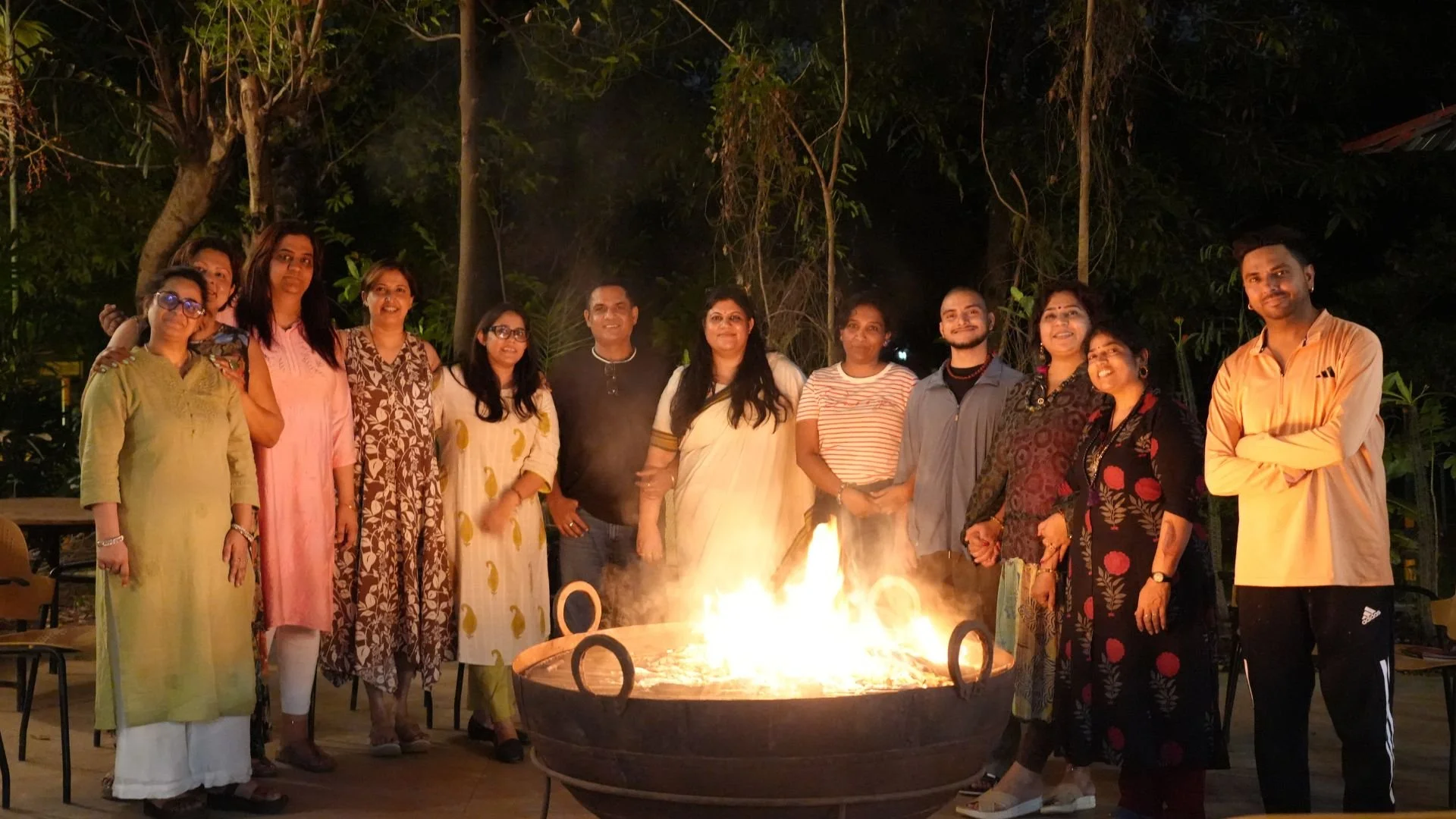
Before You Apply
Our Standards, Published Openly
We publish our terms, our fees and the principles we work by before you pay, not after. Everything below is available to read now, and nothing you are asked to sign on the first day of training will be new to you.
Training Terms & Conditions
Fees, payment, cancellation, transfers, attendance, certification criteria and conduct — for every programme we run.
Read the terms →Ethical Standards
How we teach, how we assess, what we will and will not claim, and the code every certified graduate undertakes to follow.
Read our standards →Privacy Policy
What information we hold, why we hold it, how long we keep it, and who has access to it.
Read the policy →Soul Consciousness Lab® is a professional training institute. Our programmes are educational and vocational. They do not constitute healthcare services or clinical interventions, and completion of a programme is not a medical or psychological qualification. Certification records completed training; it is not a licence to practise. No psychoactive substances are used, supplied or recommended in any programme we offer.
Application & Enrolment
Which Level Are You Applying For?
Places are limited not for marketing reasons, but because the work requires direct supervision, individual attention and a stable group. The process begins with a conversation, not a payment.
There are two routes in, depending on where you are starting from.
Level 1 — Foundation
25 – 29 September 2026 · Bangalore · Applications close 15 September
Start here if shamanism is new to you, or if you have read and explored but never trained formally.
- No prior experience required
- 5 days residential · 60 certified hours
- Maximum 12 participants
- Opens into six months of structured practice
Levels 2, 3 & 4
Entry reviewed individually · dates confirmed at eligibility discussion
Apply here if you have already trained in shamanism — with us or elsewhere — and want to continue at a deeper level.
- Reviewed on your prior training and practice
- Emotional readiness and group capacity considered
- Entry is never automatic
- Our own graduates progress via the practice log
How Places Are Allocated
- Every batch is intentionally small — twelve participants, because that is the supervision ratio this work requires
- Residential participation is mandatory; there is no partial attendance
- Selection happens through an alignment discussion, not on a first-come basis
- Enrolment is confirmed only after that discussion, never by payment alone
This is not a casual workshop or a weekend exploration. It is a structured journey into consciousness, healing, perception and ritual — approached with seriousness, safety and depth.
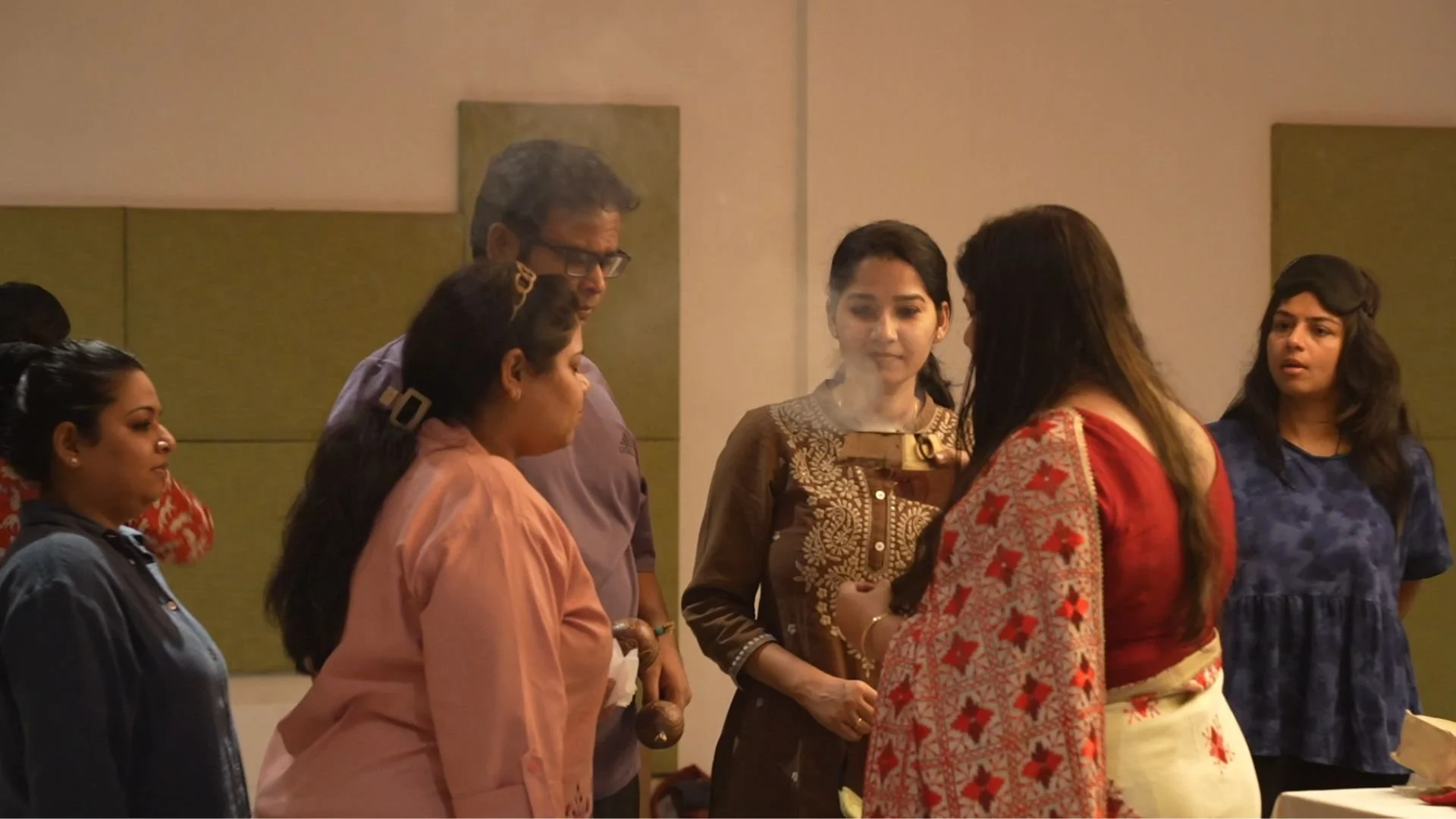
Level 1 — Foundation Programme
Apply for the September Batch
This is an application, not a booking. We read every one, and we speak with everyone before confirming a place — because a group of twelve only works when the twelve are right for it.
It takes two minutes. Tell us a little about yourself and what is drawing you to this work.
You send this application.
We reply within 2 working days to arrange a conversation.
We talk properly — your questions, our questions, and whether this is right for you now.
If it is, your place is confirmed and we send everything you need.
Applying commits you to nothing. If the timing or the fit is not right, we will say so — and you are welcome to come to a later batch. Our Training Terms & Conditions are published in full.
ARE YOU ALREADY PRACTICING SHAMANISM AND WNAT TO UPGRADE OR LEARN MORE?
Apply for the Level-2, Level-3, or Level-4
This application helps us understand your background, readiness, and alignment with the level you are applying for.
Continue Exploring
Explore Our Other Training Programs, Retreats & Healing Sessions
If you are exploring deeper consciousness work, therapeutic training, practitioner development, retreats, or personal healing, you may also find these pathways relevant.
Past Life Regression Training
Professional training in PLR, regression therapy, inner child work, and transpersonal healing.
Explore Program TrainingNGH USA Clinical Hypnotherapy Training
Structured clinical hypnotherapy certification pathway with supervised learning and practice.
Explore Program RetreatOut-of-Body Experience Retreat
Residential OBE and consciousness exploration retreat with guided practice and integration.
Explore Retreat ProgramMonroe Institute Programs
Explore consciousness-based programs connected with Monroe Institute frameworks.
Explore Programs TrainingQuantum Soul Re-Alignment
Learn QSR — a structured hypnosis-based methodology for consciousness-based facilitation and personal exploration.
Healing Retreat TrainingBecome a Psychic
Develop intuitive perception, subtle awareness, and structured psychic abilities through guided training.
Explore Training TrainingRemote Viewing
Explore structured remote viewing and consciousness perception training for disciplined intuitive development.
Explore Remote Viewing Group Healing RetreatSoul Reset | Healing Retreat
A 5-day structured immersion designed to help individuals identify, release, and transform deep emotional patterns, reconnect with their inner self, and realign their life direction.
Explore RetreatLooking for a Personal Healing Session?
If you are not looking for training and want to explore personal healing, regression therapy, Life Between Lives, shamanic healing, Quantum Soul Re-Alignment, or other private sessions, visit our therapy page.