
Shamanic Healing and Severe Mental Health: An Honest Guide
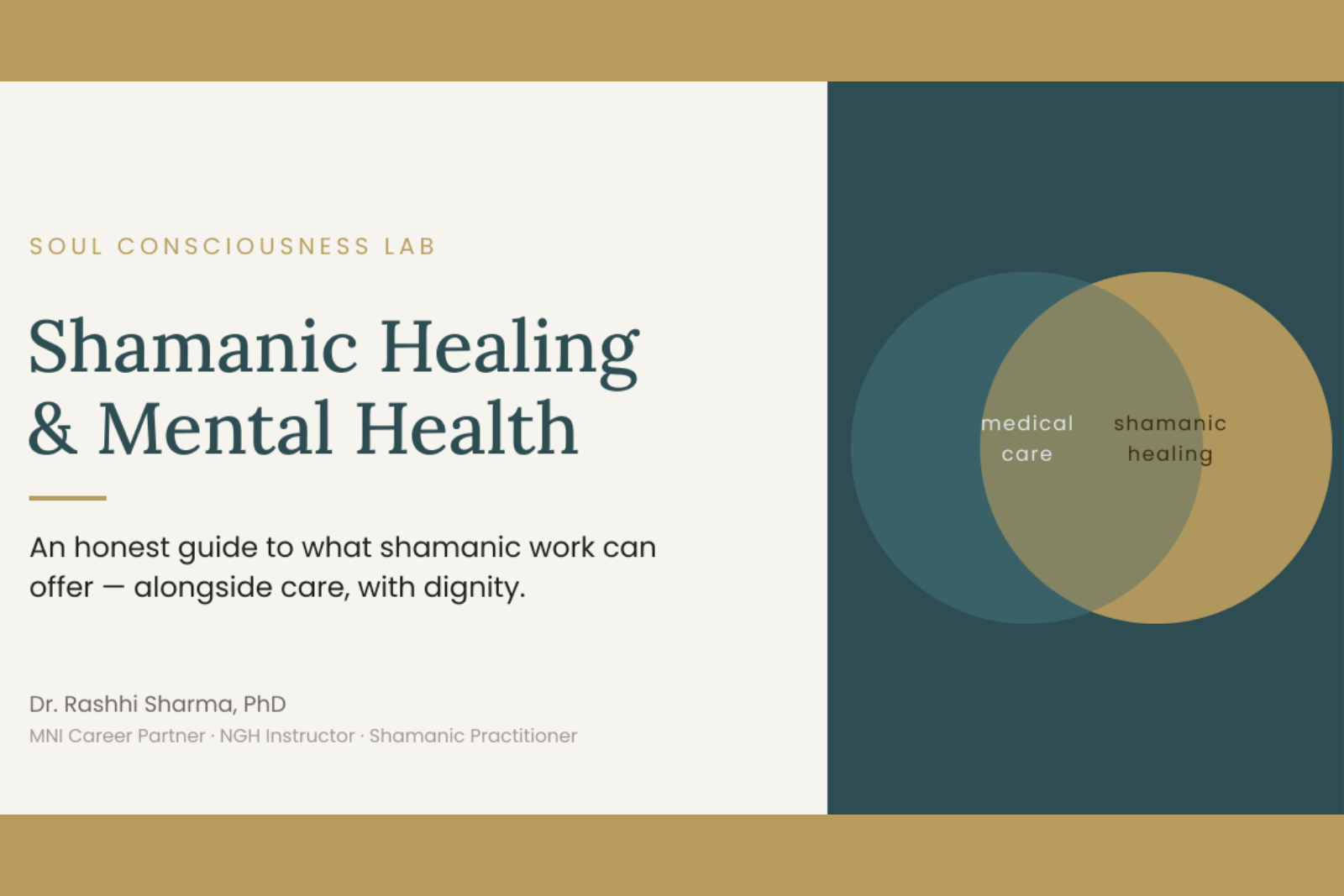
Shamanic healing offers something modern medicine often can't: meaning, belonging, ritual, and a way to feel whole again. Many people wonder whether it can help with conditions like bipolar disorder, schizophrenia, or dissociation — the kind of states where hypnosis isn't suitable. The answer is yes, shamanic work has a real and valuable place here — when it works alongside medical care, in the right way, at the right time. Here's how.
In Short
For someone living with a serious mental-health condition, shamanic healing can be a profound source of meaning, dignity, belonging, and emotional release. It helps a person make sense of what they've been through, grieve what was hard, reconnect with themselves, and feel part of something larger again.
It works best as a companion to medical care, not a replacement for it — and the most caring practitioners are clear about that. Medicine helps steady the storm; shamanic work helps a person understand it, heal around it, and come home to who they are.
A note of care
This work meets people with deep respect — and part of that respect is honesty about safety. If you or someone you love is in immediate crisis (thoughts of self-harm, losing touch with reality, days without sleep), please reach a doctor or local emergency services first. Shamanic healing is here for the journey alongside that care, and the rest of this guide explains exactly how.
If you're reading this for yourself, or for someone you love, take a breath. What you're facing is real and hard — and you are not broken, and you are not alone. Many people who live with these conditions go on to find not just stability, but depth, meaning, and a sense of purpose they never expected. Shamanic healing can be part of how that happens.
Why Hypnosis Isn't Used for These Conditions
In our clinical hypnotherapy work, we're careful about who hypnosis suits. For severe conditions like active psychosis, mania, or unstable dissociation, hypnosis is generally not appropriate — it can stir up more than a person can safely hold, and it isn't a substitute for psychiatric treatment.
So people often ask a hopeful question: if hypnosis isn't right for these states, can shamanic work offer something instead? The answer is genuinely encouraging — yes, it can — and the rest of this guide walks you through how it helps, and how it's kept safe and gentle every step of the way.
Two Ways of Seeing the Same Person
Think of modern medicine and shamanic tradition as two different maps of the same person. One maps the brain, the body, and symptoms. The other maps meaning, soul, relationship, and belonging. A map of roads and a map of rivers can both be true of the same valley.
The mistake — in either direction — is treating one map as the whole truth. Calling every powerful inner experience an "illness" is one error. Calling a real medical emergency "just a spiritual awakening" is the more dangerous one. The grown-up position, and the one we hold, is simple: use both maps, and keep the boundaries clear.
← swipe to see the full diagram →
Two maps of the same person. Good care uses both, without confusing one for the other.
How Shamanic Traditions Understood These States
Long before modern psychiatry, almost every culture had its own way of making sense of states we'd now call psychosis, mania, or dissociation. These weren't diagnoses — they were ways of giving a frightening experience meaning so it could be worked with. Three ideas come up again and again.
1. The "shaman's calling" (initiatory crisis)
Many traditions believed a future healer is sometimes "called" through a hard period — strange visions, illness, withdrawal. They saw it not as a person breaking, but as an old self making way for a healer. Importantly, traditions did not treat everyone this way. They could usually tell the difference between this and ordinary illness.
2. Soul loss
A very widespread idea: that shock or deep trauma can make a part of you "leave" to protect itself. What's left can feel numb, absent, or "not really here." The traditional response is soul retrieval — a gentle ritual to call the lost part home. In modern words, this maps closely onto how dissociation and trauma actually feel.
3. Spirit intrusion
Some traditions saw intrusive voices or a sense of being "occupied" by something not-you as an intrusion to be cleared. This is the lens that's most dangerous if taken literally for psychosis — and we'll come straight to why.
The line that must not be crossed
A psychotic episode is not "a spirit to clear away." Treating active psychosis, mania, or a dissociative crisis as purely spiritual — and dropping medical care — can cost a person their life. These old ideas help us understand meaning. They never replace a doctor.
This Isn't Only a Spiritual Idea
Here's something that surprises people. Psychiatry's own manual — the one doctors use to diagnose — added a category in 1994 called "Religious or Spiritual Problem," and it's still there today. It recognises that some intense, distressing experiences are part of a spiritual process, not a mental illness — and that mislabelling them does harm.
Psychologists call this kind of overwhelming-but-meaningful process a "spiritual emergency." Researchers have even found ways to tell it apart from psychosis. So the old shamanic instinct — that not every breakdown is an illness, and not every illness is a breakdown — has a serious, modern echo. But that same research is firm on the first step, and it's a medical one.
How Shamanic Support Actually Works — Step by Step
When shamanic work is done responsibly for someone with a severe condition, it follows a clear order. Safety always comes first. Here's how a careful practitioner moves through it.
-
Rule out the emergency first
Before anything spiritual is even discussed, the question is: is this person safe right now? Medical and psychiatric causes are checked first. If there's any acute risk, medical care leads — full stop. This is exactly the order the clinical guidance uses too.
-
Make sure real treatment is in place
Shamanic support only begins once a person is under proper care and reasonably stable. That means a diagnosis, treatment, and ideally the practitioner working with the person's doctors or therapists — never around them.
-
Offer a story that brings dignity, not shame
Many people feel reduced to a label — "I am bipolar," "I am schizophrenic." Shamanic work gently offers a different story: "this happened to you, it has meaning, and it has a place in your life." That shift, from shame to meaning, can be quietly powerful.
-
Use ritual to hold grief and change
Severe mental illness takes a lot from a person — time, relationships, a sense of who they were. Ritual gives loss a container. Ceremony, fire work, and symbolic acts help someone grieve what's been hard and mark a turning point, in a way words alone often can't.
-
Rebuild belonging and connection
These conditions are deeply isolating. A big part of shamanic tradition is community and being witnessed. Circles, shared practice, and connection to nature help a person feel part of something again — which supports recovery rather than replacing it.
-
Help integrate the experience
Once the storm has passed, there's still the work of making sense of it. Gentle, grounded practices — done within the person's limits — help turn a painful chapter into something understood, and even a source of strength.
← swipe to see the full diagram →
The order never changes: safety and treatment first, shamanic support alongside — with medical care continuing throughout.
What Each One Does Best
The simplest way to hold this: medicine and shamanic work do different jobs. They're partners, not rivals.
| What a person needs | Medical care gives | Shamanic work can add |
|---|---|---|
| Safety | Diagnosis, medicine, crisis help | Steps back — defers fully to doctors |
| Meaning | Often limited | A story that makes sense of it |
| Identity | Risk of "I am my diagnosis" | "This happened to me — it isn't all of me" |
| Belonging | Can feel isolating | Community, ceremony, being witnessed |
| Grief | Therapy where available | Ritual to hold loss and change |
Notice the first row: on safety, shamanic work steps back completely. That's exactly what makes the rest trustworthy. A practitioner who won't hold that line shouldn't be trusted with the rest either.
Condition by Condition, Honestly
Bipolar disorder
The "highs" can feel visionary or even spiritual — which is exactly why they're dangerous to romanticise. Untreated mania can wreck a life. Shamanic support belongs to the stable periods: making sense of the ups and downs, grieving their cost, building grounding and routine. It has no place during an acute episode, where medical care comes first.
Schizophrenia and psychosis
This needs the most caution. Active psychosis needs psychiatric treatment, and spiritual reframing during an episode can delay care and increase danger. Where supportive work fits, it's only during stable phases, working with the treating team, focused on dignity, connection, and a kinder relationship to the experience — never on "removing symptoms" or replacing medication.
Dissociative disorders
Dissociation comes from trauma — which is why the "soul loss" idea speaks so strongly to people who live with it. But these conditions are delicate and can destabilise fast. Ritual language can bring comfort and words for the experience, but the work must be trauma-informed, slow, and led by trauma specialists, with shamanic support in a clearly secondary role.
Signs to stop and get medical help now
Thoughts of harming yourself or others · losing touch with reality · days without sleep · being unable to care for yourself · voices urging harm · things getting rapidly worse. These are medical emergencies, not spiritual openings. Reach a doctor or emergency services straight away.
Who This Work Tends to Help
You might recognise yourself, or someone close to you, in this:
- You're stable on treatment, but still feel like you've lost a part of yourself along the way.
- You've been told what you have, but never helped to make sense of it, or to grieve what it's cost you.
- You feel alone in it — like no one around you really understands.
- You sense there's meaning in what you've been through, and you want to find it without anyone dismissing your experience or your medical care.
If any of that lands, this work may be for you. It doesn't ask you to stop your treatment, believe anything in particular, or prove anything. It simply meets you where you are.
Beginning Gently — From Anywhere in the World
You don't have to commit to anything to begin. The first step is simply a conversation — to understand where you are, answer your questions honestly, and see whether this work is a fit for you right now. If it isn't the right time, we'll say so. That honesty is part of the care.
Because this work centres on meaning, ritual, and connection rather than medical treatment, much of it can begin gently and online, wherever you are in the world — at a pace that respects your stability and your wellbeing.
How We Hold This at Soul Consciousness Lab
In our shamanism training, shamanic work is taught as a serious consciousness practice — never as a medical treatment. The same integrity runs through everything we do:
- Medical care always comes first. We don't position shamanic work as a treatment for psychiatric conditions, and we refer or defer whenever clinical care is needed.
- Discernment is the first thing we teach. Practitioners learn to tell the difference between a meaning-level process and a medical emergency — and to act on it.
- Consent and scope are clear. Supportive work happens only with informed consent, and where possible in step with a person's care providers.
- Dignity over drama. We meet people's experiences with respect — neither labelling them as broken nor sensationalising them.
Frequently Asked Questions
Honest answers to the questions people ask most about shamanic healing and mental health.
-
It's important to be honest here: shamanic work doesn't cure these conditions, and they do need psychiatric care. But it offers something real and valuable alongside that care — during stable periods, it can be a profound support for meaning, dignity, belonging, and emotional healing. Many people find it gives them back something medicine alone couldn't.
-
Because stabilising a condition and making sense of it are two different needs. Medicine can do the first. People often still long for the second — meaning, belonging, and a dignified story. That's where supportive shamanic work can help, alongside care.
-
Not always — and that's the point. Some intense experiences reflect a spiritual process rather than a disorder, which is why psychiatry's own manual includes a "Religious or Spiritual Problem" category. But telling the two apart needs qualified assessment, and medical causes must be ruled out first.
-
For severe conditions like active psychosis, mania, or unstable dissociation, hypnosis can bring up more than a person can safely manage, and it isn't a substitute for psychiatric care. This is why we screen carefully in our clinical hypnotherapy work.
-
Medical-first. No spiritual interpretation comes before ruling out a medical or psychiatric emergency, and no supportive work ever replaces ongoing treatment.
-
It's best understood as a meaning-centred, supportive ritual — not a clinical treatment. For dissociative disorders specifically, any such work should be trauma-informed, slow, and led by trauma specialists, with shamanic support in a secondary, complementary role.
Written by Dr. Rashhi Sharma, PhD — MNI Career Partner, Only in India · NGH Official Certified Instructor · Monroe Institute Outreach Trainer · Certified Shamanic Practitioner (FSS), with field training across Peru, Mexico, USA and beyond. This article is educational and is not medical advice, diagnosis, or treatment. If you are struggling, please consult a qualified medical or mental-health professional.
Have questions about this work?
You may explore our trainings, sessions, or contact us for guidance.
