
Can Shamanism Be Learned Online?

Knowledge Library · Foundations
Can Shamanism Be Learned Online?
In Short
Partly. An online course can introduce you to shamanism, give you a first guided journey, and help you decide whether this path is for you. That is genuinely useful, and it is not nothing.
But the practice itself is not learned that way. Shamanic work is embodied — done with fire, drum, land, body, group and ceremony, and entered through initiations given in person. The deeper methods, and the safety they require, do not transfer through a screen.
This article explains what does transfer, what does not, and gives you nine questions to ask any teacher before you enrol — online or otherwise.
Why This Question Matters Now
Interest in shamanism has grown quickly, and online offerings have grown with it. In India in particular, you can now find courses promising advanced shamanic training in a few weeks, at a fraction of the cost of a residential programme.
For someone new to this, the choice looks obvious. The syllabi read similarly. The language is similar. One costs a great deal more and requires travel and time away from work.
So the question deserves a straight answer rather than a defensive one, and the answer is not simply no.
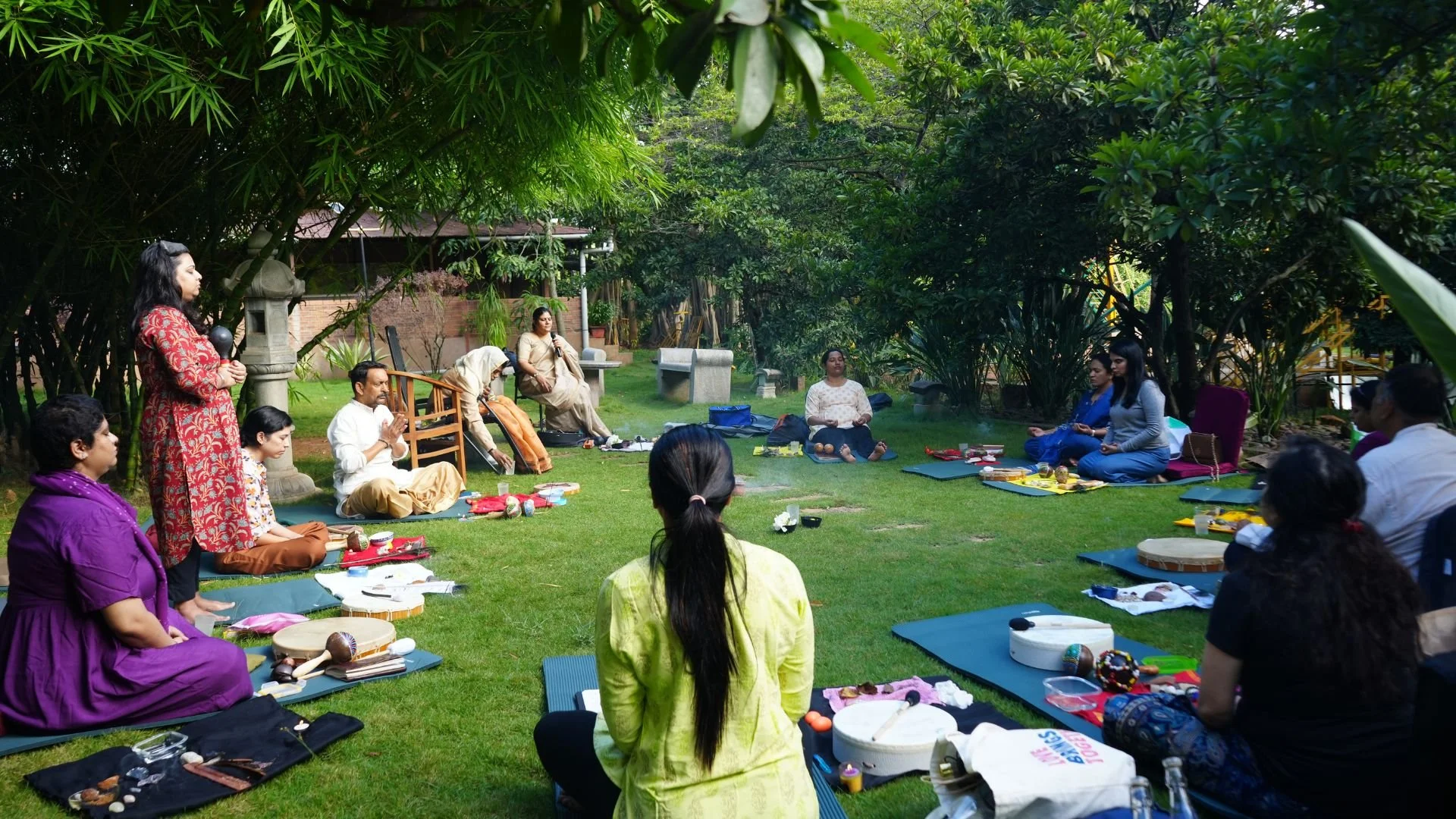
Level 1, Discovery Village. Sessions run indoors and out, from before breakfast into the night.
What Online Genuinely Can Do
It would be dishonest to claim a screen is useless. It is not.
- Introduce the ideas. What shamanism is, where it comes from, what a shaman actually does, how it differs from other traditions — all of this transfers perfectly well in writing or on video.
- Give you a first journey. A guided drum journey can be experienced through headphones. Many people have their first taste of a non-ordinary state this way, and it is real.
- Help you decide. Perhaps most valuably, an online introduction can tell you whether this path calls you at all — before you commit serious money or time.
- Sustain an existing practice. Practitioners who have already trained in person use online circles to keep practising together. Our own graduates meet weekly on Zoom.
If what you want is to understand shamanism, or to find out whether it interests you, an online course can serve you well. There is no need to spend a great deal to answer that question.
What Does Not Transfer
The difficulty begins where the actual practice begins. Below are the specific reasons, drawn from teaching this work in the same room for over a decade.
1. Someone has to see you come back
Shamanic practice means deliberately entering a non-ordinary state, and deliberately leaving it. The leaving matters as much as the entering, and it does not always go cleanly.
Participants do come back ungrounded. It is neither rare nor dramatic, but it needs a trainer who can see it — in breathing, in posture, in the eyes — and bring the person back properly, at the time.
On a video call those signs are largely invisible. And by the time someone types I feel strange, the moment to help has passed.
2. The middle world is not the lower world
The three worlds are not equally demanding. Journeys to the lower and upper worlds are relatively forgiving for a beginner. Middle world work — the spiritual dimension of ordinary physical reality — is the most demanding of the three, and the least suitable for anyone working without direct supervision.
It requires a held container: a trainer who creates and guards the space for the duration of the work. That is a specific skill, and it is not exercised remotely.
3. Grounding happens on the ground
When someone does come back unsettled, grounding is done on the land — feet on earth, among trees, in the place the work was done. It is a physical process, not a reassuring sentence.
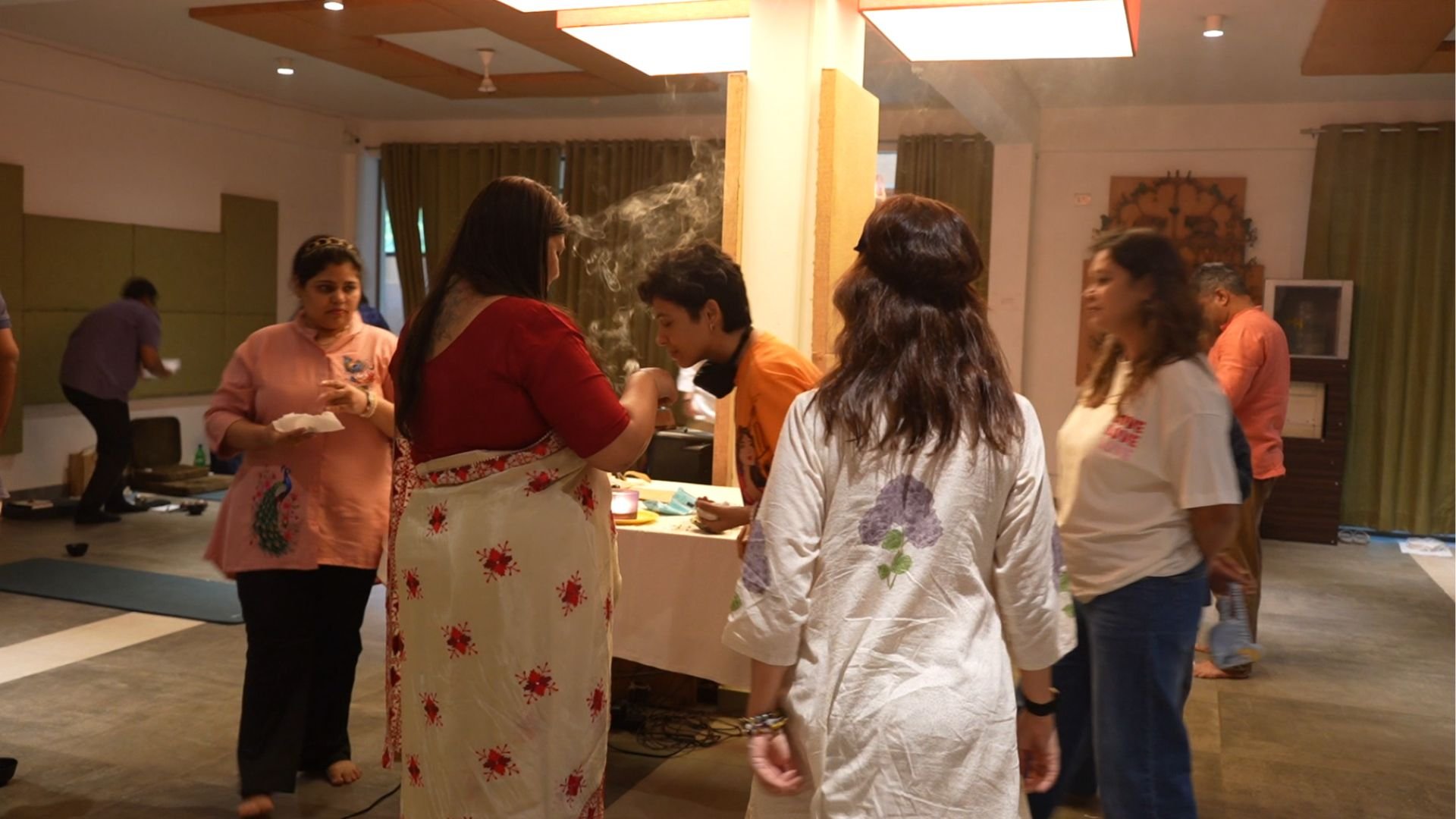
Trainer initiating the students - a smoke initiation by Dr Rashhi Sharma in progress, after the drum circle
4. Initiation is given in person
This is the part least visible from outside the tradition, and arguably the most important.
Shamanic practice carries a great many initiations. Drums are initiated. Rattles are initiated. There is smoke initiation. The stones, crystals and tools a practitioner gathers are each initiated. Ceremony itself is a form of initiation — it is part of how the practice is entered rather than decoration around it.
These are conferred in the presence of a teacher. We do not know of a way to do that through a screen, and we would be sceptical of anyone claiming to have found one.
5. The altar comes from the land you are standing on
Practitioners build their altar from what they gather — going out into nature, connecting with it, and bringing back what is offered. The gathering is itself part of the training.
Divination is done with trees, with flowers, with stones, with earth, with fire. Practitioners also work directly with plants, learning what a plant offers for healing. Nothing is ingested — this is relationship with the plant, not consumption of it.
Relationship with the natural world is not a topic in shamanism. It is the substance of it.
6. You learn it on each other
Healing methods are taught by demonstration first — the teacher works with a real subject while the group watches closely — and then practised in pairs.
That work is physical. One person lies down. The other works close to the body, scanning with their hands and with divination tools. Others stand near enough to observe exactly what is happening with the person receiving.
You cannot practise that on someone in a different house, and you cannot learn it from a thumbnail on a screen.
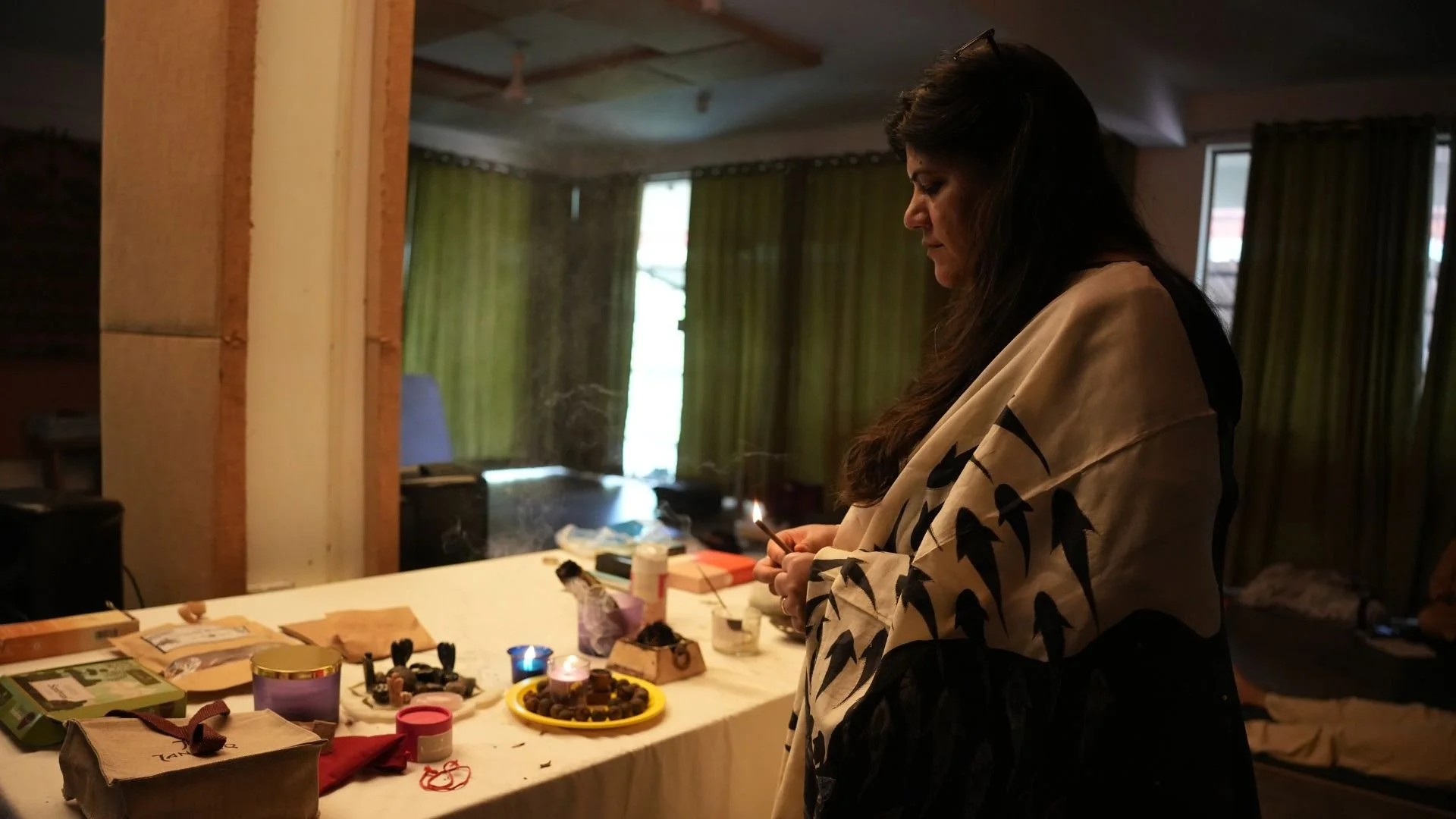
Altars are built from what participants gather. Divination is done with trees, stones, earth and fire.
7. A home is not a container
Set the tradition aside for a moment and consider the practical reality of studying this from home.
Drumming aloud. Rattling. The power animal dance. Lying down undisturbed for an hour. Working past ten at night, and again before dawn.
Most people simply cannot do that with children in the next room, a doorbell, and a household carrying on around them. They hold back — and holding back is the one thing this practice cannot survive. It is not a failing on their part. It is what a house is.
8. The circle is part of the method
Participants journey together, practise on each other, and share what came — every person, every time. What you learn from hearing eleven other people describe the same journey differently is not a supplement to the training. It is a substantial part of it.
The nights carry their own practice, and the dream discussion the following morning belongs to the group. None of that survives being distributed across eleven separate houses.
What the Foundation for Shamanic Studies Says
This is not only our view
The Foundation for Shamanic Studies — founded by Michael Harner, the anthropologist who introduced core shamanism to the modern world — has published its own answer to this question.
FSS describes shamanism as an embodied practice, taught and passed on within a living community. Across many years of teaching core shamanism, they write, the depth of live interaction between participants, held by the power of the gathered circle, is not reproduced in an online format.
They are equally clear about what online can offer: useful introductory information, and a glimpse of another reality — enough to help someone decide whether it is worth pursuing properly, in a circle, with experienced teachers.
It is worth noticing where the most respected shamanic programmes in the world are held: in forest, mountain, jungle and open land. Not on a platform. That is not tradition for its own sake — it is a consequence of what the work requires.
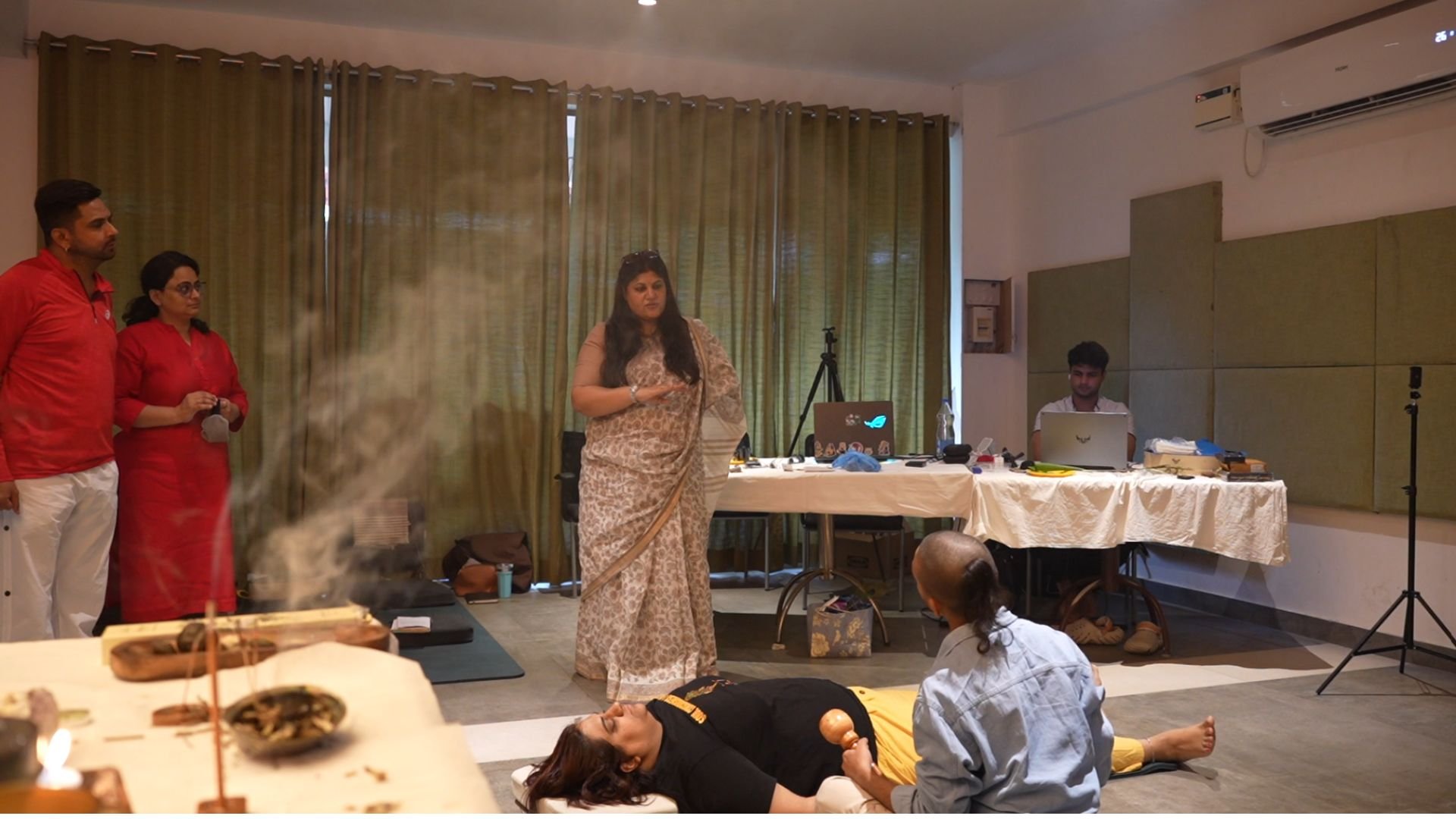
Students practice in pairs, under the close and direct supervision of the trainer, Dr Rashhi Sharma. Other students observe closely.
But Some Serious Trainings Are Online — Aren't They?
Yes, and this is where a blanket answer would mislead you.
Plenty of legitimate therapeutic modalities are taught online, and taught well. Hypnotherapy and past life regression are conducted through voice. A practitioner guides a client's mind with spoken language, and that transmits over a call intact — which is also how many graduates will practise with their own clients afterwards. Learning it online means learning it in the medium you will use.
Shamanic work is not conducted through voice alone. It is done with fire, drum, land, body and group, and entered through initiations given in person.
So the honest distinction is not online versus in person. It is what is being taught. Ask whether the medium of learning matches the medium of the practice. For voice-based therapy, it often does. For shamanism, it does not.
Nine Questions to Ask Any Teacher
Shamanism has no governing body anywhere in the world. Anyone may use the title, and there is no register to check a person against. That places the responsibility on you.
These are the questions worth asking of any programme, online or residential. A serious one will answer all of them without hesitation, and in writing.
- Who trained the teacher — and can I verify it without asking them? Not a lineage they feel connected to, or an ancestral link. A named institution or teacher, with a listing you can open yourself.
- Who issued the awards and accreditations — and who founded that body? An award means something when an independent organisation gives it. It means little when the recipient established the organisation, or when the issuing body exists mainly to issue awards.
- Is what is taught traceable to a tradition, or was it invented by the teacher? Both can have value. But you should be told plainly which you are buying.
- How many contact hours, and how are they counted? A number that cannot be broken down into a daily schedule is not a number.
- How many people are in a group, and who supervises them? If a programme takes forty people, nobody is being watched.
- What happens if I become unsettled during a practice? There should be a specific, immediate answer.
- What am I permitted to do with clients afterwards — and what am I not? A training that sets no limits has not thought about your future clients.
- What support exists after the programme ends? Skill comes from months of practice. What happens during those months?
- Are the terms, fees and cancellation policy published before I pay? Or only afterwards.
Ask us these too. We publish our answers across this site, and Dr. Rashhi's certifications are listed publicly by the institutions that issued them — the Michael Newton Institute, the National Guild of Hypnotists, the Monroe Institute and the Foundation for Shamanic Studies. You can open those listings without asking us for anything.
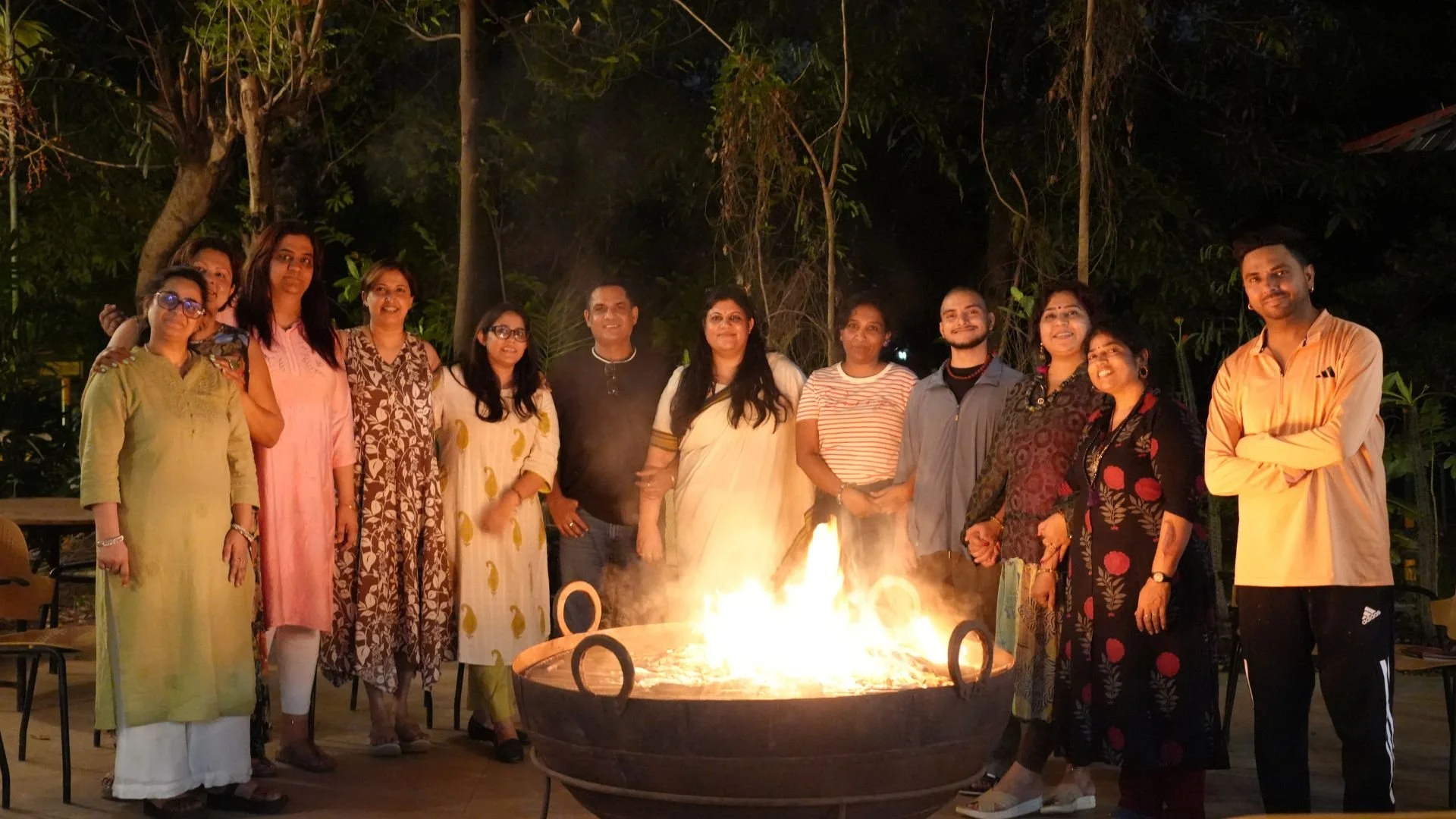
Ceremony and initiations with nature elements, including wind, fire, water, space and earth - are the essential elelemts of Shamanism.
If You Cannot Travel Right Now
This is a real constraint for many people, and it deserves an honest answer rather than a sales pitch.
If a residential programme is not possible for you at the moment, our view is that you are better served by an honest introduction than by an online course promising practitioner-level training. Learn the ideas. Try a guided journey. Read widely. Find out whether this path genuinely calls you.
Then, when circumstances allow, do the deep work properly — in a circle, on land, with a teacher who can see you.
The tradition has waited several thousand years. It will wait for you.
Frequently Asked Questions
Yes, at a basic level. A guided drum journey can be experienced through headphones, and many people have a genuine first experience this way. What online cannot give you is the supervision to work safely at depth, the initiations, or the physical and group elements the practice is built on.
No — and it would be unfair to say so. Many are sincere introductions, and an introduction has real value. The concern is with courses presenting introductory learning as advanced practitioner training. The nine questions above will usually tell you which you are looking at.
Because the costs are different in kind. A residential programme carries accommodation, meals, land, small group sizes and a trainer present throughout. An online course can be delivered to two hundred people at once. The price difference reflects a difference in what is being provided.
You can receive a certificate. Whether you can safely hold a client in soul retrieval, extraction or psychopomp work is a different question — those methods are taught by demonstration and practised on other people under supervision, and neither is possible remotely.
Excellent, and we run them ourselves. Once a practitioner has been trained and initiated in person, online circles are a fine way to keep practising together across distance. Online is a good place to sustain a practice. It is not where the practice is given.
Related Reading
- What Is Shamanism? A Complete Guide
- The History of Shamanism
- Our Ethical Standards and Practitioner Code
- Shamanism Training in India — the residential programme
References
- Foundation for Shamanic Studies, FSS Polestar: Can You Learn Shamanism and Shamanic Healing Online? — shamanism.org
- Harner, M. The Way of the Shaman. Harper & Row.
- Harner, M. Cave and Cosmos. North Atlantic Books.
Have questions about this work?
You may explore our trainings, sessions, or contact us for guidance.
