
How to Become a Past Life Regression Therapist in India
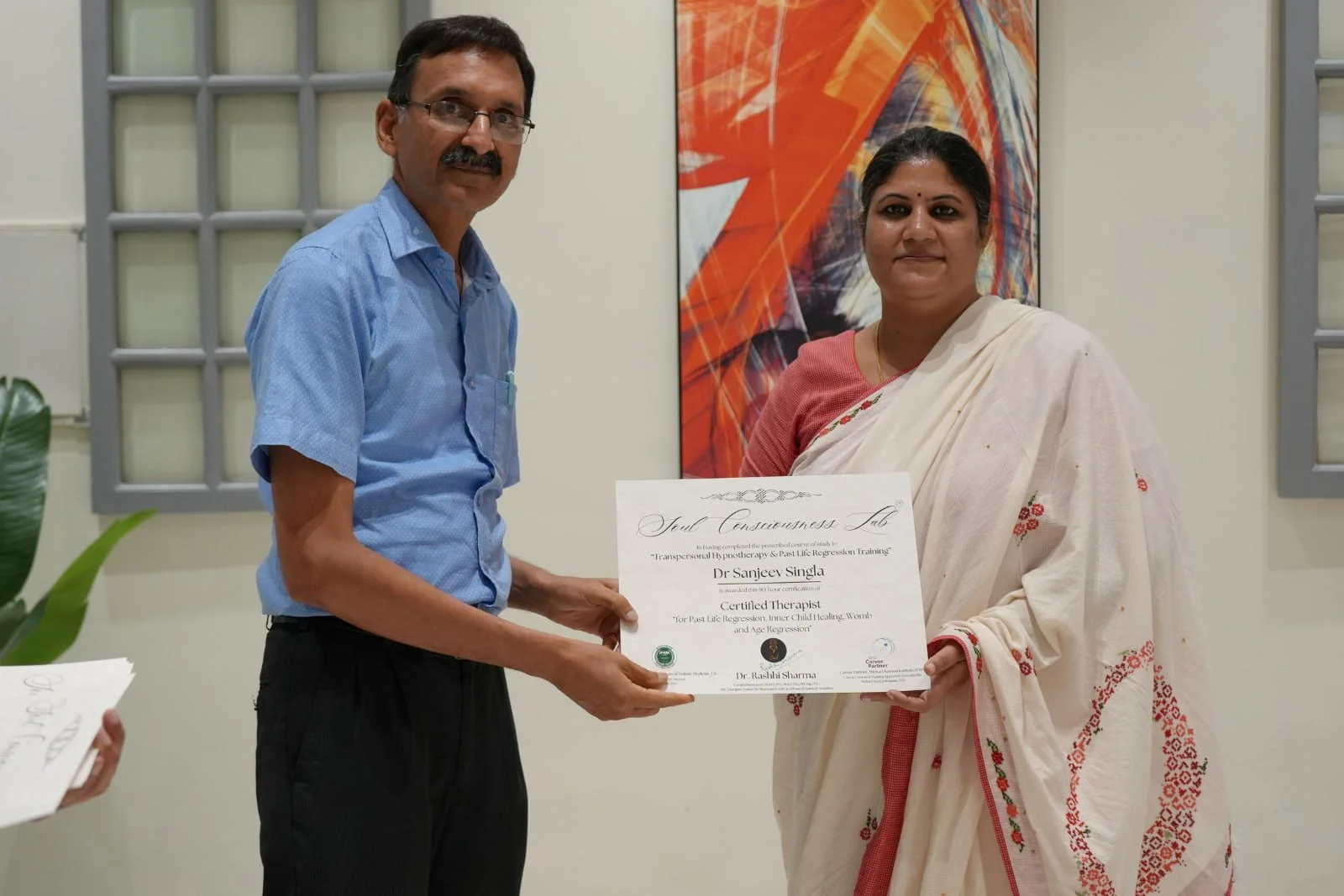
There is no single regulated pathway to becoming a past life regression therapist in India — which makes choosing the right training critical. This guide covers what qualifications matter, which certification bodies carry international recognition, how long it realistically takes, and what building a working practice actually looks like.
India has seen a significant rise in interest in past life regression as both a therapy and a professional practice. Yet the space remains largely unregulated — anyone can claim to teach PLR, and dozens of programmes offer certification with little rigour behind the credential. This makes the choice of training programme the single most important decision in your journey.
Step 1 — Understand What the Work Actually Involves
Before choosing a training, it helps to be clear about what a past life regression therapist actually does — not just in theory, but in a real client session.
A PLR therapist guides clients into a relaxed, focused hypnotic state and then navigates them through memories, patterns, and experiences that arise — from this lifetime and potentially others. The work requires:
- Deep knowledge of hypnotic induction, deepening, and navigation techniques
- The ability to handle emotionally charged material without interference or projection
- A clear ethical framework for working with vulnerable clients
- Session structure that ensures every session ends in a complete, grounded state
- The confidence to facilitate sessions independently — not just observe them
This last point is where most training programmes fail. Watching demonstrations does not produce capable practitioners. Only repeated supervised practice under real conditions does.
Step 2 — Choose the Right Certification Body
In India, PLR certifications range from internationally accredited credentials to self-issued certificates with no external validation. Here is what actually matters:
| Certification body | Type | International recognition |
|---|---|---|
| Michael Newton Institute (MNI), USA | Specialised — regression & LBL | Highest in this field globally |
| National Guild of Hypnotists (NGH), USA | Hypnotherapy — broad | World's largest hypnotherapy body |
| IPHM, UK | Holistic medicine — broad | Internationally recognised, UK-based |
| Self-certified programmes | Unverified | No independent validation |
| Generic wellness institutes | Variable | Rarely recognised internationally |
The key test: Can you independently verify the trainer's credentials on the certifying body's own website? If the answer is no — the certification is self-issued, regardless of how it is presented.
Soul Consciousness Lab's credentials are verifiable at newtoninstitute.org, ngh.net, monroeinstitute.org, and iphm.co.uk.
Step 3 — Evaluate the Training Programme Itself
The certification body matters — but the training programme is what actually determines whether you can practise. Ask these five questions before committing:
-
1
How many supervised practice sessions will I conduct?
The industry average is 1–3 supervised sessions. Soul Consciousness Lab's programme delivers 30–40 supervised sessions per student. This is the single most important differentiator between programmes that produce capable practitioners and those that don't.
-
2
What is the total training duration in hours?
A 2-day or weekend programme cannot build professional capability. Look for a minimum of 80–100 hours. Soul Consciousness Lab's programme runs 90–95 hours over 7 days.
-
3
Is the certification issued immediately after training?
Many programmes issue a participation certificate and require months of case submissions before full certification. Competency-based training certifies you on the basis of demonstrated skill — at the end of the programme.
-
4
What post-training support is included?
Building a practice takes time after training. Monthly mentorship, supervised practice community, and ongoing access to the trainer are what separate practitioners who build successful practices from those who don't.
-
5
Does the programme include business setup training?
Most programmes teach the technique but nothing about building a practice. Look for a programme that dedicates time to client intake, pricing, positioning, and professional practice setup.
Step 4 — Do You Need a Psychology or Medical Background?
This is one of the most common questions — and the answer is no.
Past life regression therapy is a transpersonal approach, not a clinical medical intervention. It does not require a psychology degree, a medical licence, or any specific prior qualification. What it requires is the right training, a clear ethical framework, and sufficient supervised practice to work confidently with real clients.
Practitioners at Soul Consciousness Lab come from a wide range of backgrounds:
Healthcare Professionals
Doctors, nurses, psychologists, and counsellors who add transpersonal depth to their existing practice.
Wellness Practitioners
Yoga teachers, Reiki practitioners, coaches, and energy healers expanding into regression work.
Career Changers
IT professionals, bankers, engineers, and corporate managers building a new professional path.
Personal Seekers
Individuals who came for personal transformation and chose to extend that work professionally.
What matters most is your readiness to engage seriously with the work — not your prior profession.
Step 5 — Understand the Realistic Career Path
Becoming a PLR therapist in India is a genuine professional path — but it requires honest expectations.
What the first year looks like
Most practitioners spend the first 3–6 months after certification building practice confidence — working with friends, family, and early clients at reduced rates, attending monthly mentorship sessions, and refining their technique through real sessions. By 6–12 months, those who have practised consistently typically have a small but steady client base.
Income and practice models
PLR sessions in India are typically priced between ₹3,000–₹15,000 per session, depending on the practitioner's experience, location, and positioning. Online sessions have expanded the market significantly — practitioners now work with clients across India, UAE, UK, USA, Singapore, and Australia from a single location.
Most practitioners combine PLR with other modalities they already practise — yoga, coaching, counselling, or energy healing — creating an integrated offering rather than a single-service practice.
Who builds successful practices
From observing 350+ graduates across 28 countries, the pattern is consistent: practitioners who build successful practices are those who practise consistently from day one, invest in ongoing supervision and mentorship, position themselves with genuine specificity (not generic "healer" positioning), and are patient with the growth timeline.
PLR Training in India — What Is Currently Available
The Indian market for PLR training has grown significantly since 2015. Programmes now range from serious internationally accredited residential training to brief online certifications. Key differences:
| Feature | Standard market programmes | Soul Consciousness Lab |
|---|---|---|
| Training hours | 20–50 hours | 90–95 hours |
| Supervised practice sessions | 1–3 sessions | 30–40 sessions |
| Batch size | 30–50 students | Maximum 12 students |
| International accreditation | Self-certified or generic | MNI (USA) + IPHM (UK) |
| Certification timing | Participation cert. + months of cases | Full cert. on completion |
| Post-training support | None or limited | Lifetime — included |
| Business setup training | None | 10–12 hours dedicated |
About Soul Consciousness Lab's PLR Training Programme
Frequently Asked Questions
Common questions about becoming a PLR therapist in India.
-
No. Past life regression therapy is a transpersonal approach — not a clinical medical intervention. No degree, medical licence, or psychology qualification is required. What matters is the right training, sufficient supervised practice, and a clear ethical framework. Practitioners come from IT, medicine, teaching, engineering, yoga, business, and many other backgrounds.
-
The training itself takes 7 days at Soul Consciousness Lab — after which you are trained, assessed, and certified. However, building genuine professional confidence and a working practice typically takes 6–12 months of consistent practice after certification. The training is the foundation; what you build on it depends on how consistently you practise.
-
Yes. Past life regression therapy is a complementary and alternative therapy — not a regulated medical practice. It can be practised professionally in India without a medical licence, provided you are transparent about the nature of the work, do not make medical claims, and operate within a clear ethical framework. It is practised as a professional service, not a medical treatment.
-
Yes — and many Soul Consciousness Lab graduates do exactly this. PLR sessions work effectively online via Zoom. Practitioners based in India regularly work with clients in the UK, USA, UAE, Singapore, Australia, and across Europe. Online practice has significantly expanded the addressable client base for Indian-based PLR therapists.
-
Session fees in India typically range from ₹3,000 to ₹15,000 per session depending on experience, positioning, and location. Most practitioners start at the lower end and increase fees as their practice grows. Online practice with international clients can command significantly higher fees. Income depends entirely on how consistently you practise and how you position yourself — it is not automatic income from day one.
-
The most internationally recognised certifications for regression and transpersonal work are from the Michael Newton Institute (USA), the National Guild of Hypnotists (USA), and IPHM (UK). Soul Consciousness Lab is accredited by all three. MNI is the gold standard specifically for past life regression and Life Between Lives work — and Soul Consciousness Lab is the only MNI Career Partner in India.
-
Yes — and this is one of the most common profiles in our training batches. Yoga teachers, Reiki practitioners, coaches, and energy healers who add PLR to their practice find it significantly deepens their offering and expands their client base. The modalities work naturally together — PLR addresses deeper pattern-level work that surface-level wellness approaches cannot reach.
-
Clinical hypnotherapy is typically goal-oriented and symptom-focused — working within the current lifetime on specific issues like habits, phobias, or anxiety. A PLR therapist uses a transpersonal approach, working with a broader experiential framework that may include memories and patterns from previous lifetimes. PLR tends to work at greater depth and with more open-ended exploration. Many serious practitioners train in both — Soul Consciousness Lab offers NGH-approved clinical hypnotherapy training alongside PLR.
Related Reading
- → Past Life Regression Training Programme — Full Details
- → Best Past Life Regression Training in India: What Serious Students Must Know
- → PLR Training: What Serious Students Must Know Before Choosing
- → What Is Past Life Regression? A Complete Guide
- → Is Past Life Regression Safe?
- → Book a PLR Therapy Session with Dr. Rashhi Sharma
Soul Consciousness Lab has been training PLR practitioners since 2010. Dr. Rashhi Sharma's credentials are independently verifiable through the Michael Newton Institute, National Guild of Hypnotists, The Monroe Institute, and IPHM.
Have questions about this work?
You may explore our trainings, sessions, or contact us for guidance.
